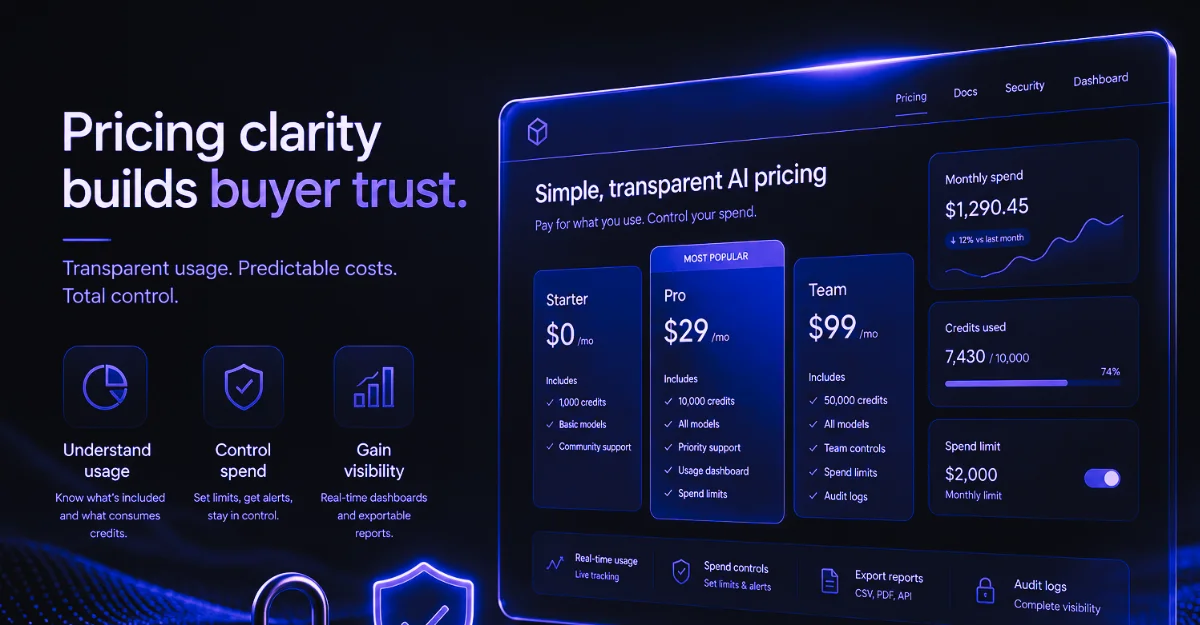
AI pricing pages are becoming the first buyer trust test
Cursor’s June 2025 pricing overhaul on its Pro plan matters because it demonstrates how an AI product’s pricing model can shift from a conversion asset into a pre-purchase risk filter.
The buyer reads for risk
Finance-aware buyers now assess whether credit systems, usage limits, and overage mechanics are legible before any sales conversation.
Ambiguity delays the demo
When usage evidence is missing or vague, hesitation forms before the buyer requests a demo.
Pricing signals maturity
Variable AI consumption makes the pricing page a governance and predictability test, not just a packaging page.
What Changed in Cursor’s AI Pricing in 2025?
Need a sharper read on your market?
I help teams turn competitor movement, buyer behavior, platform shifts, and public business signals into clearer strategic decisions.
Cursor showed how AI pricing becomes a trust test
Cursor’s June 2025 pricing change made one issue visible: buyers do not only react to price. They react to whether usage, overages, credits, and controls are understandable before sales gets involved.
Pricing model shifts
Cursor moved away from the prior fixed-request expectation around its Pro plan and toward model-usage-based pricing.
Communication gap becomes public
Cursor acknowledged the rollout was not handled clearly enough and offered refunds for unexpected usage between June 16 and July 4.
Pricing surface shows governance
Cursor’s pricing page and documentation describe included model usage, on-demand billing, usage pools, plan pricing, and per-model API rates.
From fixed expectations
Buyers had to understand usage-based pricing instead of simple request limits.
Unexpected usage exposure
Complex tasks and frontier-model selection created uncertainty around how quickly usage could be consumed.
Visibility and controls
Usage dashboards, spend visibility, and clearer documentation became part of the recovery signal.
What does buyer trust mean before a software demo?
Pre-demo trust is the confidence or doubt a buyer forms about predictability, control, and vendor maturity solely from public pricing information and documentation.
Trust starts in sales
Demos, case studies, logos, and sales conversations are treated as the primary trust builders.
Trust starts on the pricing page
Buyers first check whether they can forecast spend, explain pricing to finance, and govern usage after deployment.
Why Do AI Pricing Pages Create Buyer Confusion?
What the AI product can deliver
Automation, speed, workflow leverage, and frontier-model capability.
What the buyer can predict and control
Usage exposure, overage behavior, spend limits, and internal explainability.
Credit opacity
Credits are mentioned but not mapped to concrete consumption such as model, tokens, context, or tool use.
“Unlimited” fragility
Unlimited usage is claimed without clear boundaries on models, features, routing, throttling, or usage patterns.
Overage invisibility
Overage mechanics, spend limits, and alerts are absent or require a sales conversation to understand.
Specific, operational, buyer-usable language
- What is included?
- What consumes it?
- What happens next?
- What controls exist?
Abstract, promotional, deferred explanation
- “Contact sales for details”
- “Custom pricing” without usage context
- “Unlimited usage” without qualifiers
- Credits without workload translation
What Should an AI SaaS Pricing Page Explain?
Buyers need more than a plan name and a credit count. They need enough pricing evidence to understand usage, estimate exposure, and defend the purchase internally before sales gets involved.
Usage clarity
Pricing-page proof: included usage, credit rules, model access.
Workload translation
Pricing-page proof: credit-to-workload examples by task and team size.
Exposure control
Pricing-page proof: caps, alerts, opt-in overages.
Admin governance
Pricing-page proof: team controls, pooled usage, audit logs.
Procurement explainability
Pricing-page proof: finance FAQ, TCO examples, documentation.
Why Should Smaller AI SaaS Companies Care About Pricing Clarity?
Smaller teams do not have the same brand buffer or recovery capacity as larger platforms. When pricing ambiguity appears, buyers treat it as an early signal of operational risk.
What buyers are checking before sales
For finance-aware buyers, the pricing page is often the first public document used to assess whether AI usage can be forecast and governed.
What does a credit actually represent in real workloads?
What happens when complex runs or long-context usage spike?
Can an admin set hard limits before spend becomes a surprise?
Most exposed company types
AI devtool and coding assistant startups
AI agent and workflow automation platforms
Vertical AI SaaS adding inference-heavy features
Smaller B2B platforms exposing usage-based AI
Agencies and custom AI solution builders
How AI pricing confusion affects smaller SaaS companies
Credit-pool model + unclear rollout
Raises buyer expectations for workload mapping and controls.
Peer pricing-page wording on credits, “unlimited,” and overages.
Addition of usage dashboards
Governance features move from nice-to-have to table stakes.
New dashboard releases and admin spend-limit features.
Public backlash requiring apology
Trust recovery is expensive; smaller teams have less margin.
Forum sentiment and clarification patterns across the category.
Enterprise controls expansion
Buyers import governance requirements downward.
Job postings and feature releases around billing controls.
How Do AI SaaS Companies Explain Usage, Overages, and Controls?
This benchmark reflects public pricing and documentation signals checked on June 18, 2026. It does not evaluate private enterprise contracts, negotiated terms, or unpublished admin settings.
Cursor
Clear: $20 pool for frontier models at API rates; Auto mode routing.
On-demand billed in arrears; spend limits available.
Usage dashboard; spend-limit toggle.
Approximate requests per model.
GitHub Copilot
Token-based AI Credits tied to plan price; monthly allotment.
Option to allow overages at published rates or hard cap.
Org, cost-center, and user budget controls; consumption notifications.
Token consumption across input, output, and cached usage.
Anthropic Claude
Usage-credit controls documented for Team and seat-based Enterprise plans; paid plans support usage credits after plan limits.
Pay-as-you-go supported after limits; relationship between subscription usage and API rates varies by plan type.
Per-user spend limits, org caps, and usage analytics.
Varies by plan tier.
OpenAI ChatGPT
Credit pools, optional purchased credits, and rate cards documented for certain Business, Enterprise, and Edu features.
Overages or additional purchases configurable at workspace level.
Workspace owner controls for overages and limits.
Limited public token examples; focus on feature access.
Broader Vertical AI SaaS / Agents
Frequently generic “credits included” or “unlimited in tier.”
Often vague or deferred to sales.
Rarely shown on public pricing pages.
Almost never concrete workload examples.
How Can You Score an AI SaaS Pricing Page?
Score your AI SaaS pricing page across 10 trust signals. Each category scores 0–2. The total score shows how clear your pricing page feels before a buyer books a demo.
Missing
Absent from the pricing page or public documentation.
Mentioned
Present, but not operationally clear enough for buyer use.
Buyer-usable
Specific, measurable, and actionable for a non-technical reviewer.
Usage Explanation
Does the page explain what is included and what consumes the allowance?
Credit / Token Mapping
Are credits or units tied to model, context, tool calls, or usage variables?
Workload Examples
Are there concrete examples by task type, team size, model tier, or monthly usage?
Overage / Extra Usage Policy
Is it clear what happens after included usage and whether overages are opt-in?
Admin / Spend Controls
Are dashboards, alerts, hard caps, or budget controls visible?
Predictability for Finance
Can a non-technical reviewer estimate monthly exposure from public materials?
“Unlimited” Clarification
Does the page explain what is truly unlimited versus routed, throttled, or metered?
Trial Usage Visibility
Can buyers see usage and remaining allowance during evaluation or trial?
Documentation Accessibility
Can buyers find detailed explanations without contacting sales?
Enterprise Governance / Auditability
Are audit logs, pooled controls, exports, or compliance-ready features visible?
Finance-aware buyers may struggle to understand usage, exposure, and controls.
What Should Buyers Check on an AI SaaS Pricing Page?
Before booking a demo, finance-aware buyers should be able to understand cost clarity, exposure control, and governance from the public pricing page.
Cost Clarity
What usage is included in the base price?
What specifically consumes credits or units?
What drives meaningfully higher consumption?
Exposure Control
Are overages automatic or opt-in / spend-limit enabled?
Can admins set hard caps or budgets at user, team, or org level?
Are real-time alerts or usage dashboards available before limits are hit?
Governance
Can usage be reviewed and broken down by user, team, model, or workflow?
Can finance or procurement estimate monthly exposure from public materials alone?
Are audit logs, pooled controls, or exportable reports available for compliance reviews?
How Should AI SaaS Companies Monitor Pricing Changes?
Pricing pressure does not first appear in churn or win-rate dashboards. It appears earlier in public signals: pricing-page edits, usage dashboards, documentation updates, forum complaints, and competitor language shifts.
Public pricing signals
Microcopy changes, credit language, “unlimited” qualifiers, and overage explanations.
Buyer expectation shift
Finance and procurement begin asking earlier questions about usage predictability and control.
Pipeline impact
Unclear pricing turns into weaker demo quality, longer cycles, and late-stage finance objections.
What pricing changes signal
Variable inference cost is becoming a buyer-visible governance requirement. Pricing pages that fail to make consumption predictable create pre-demo friction.
What teams miss
Teams often treat pricing controversies as isolated rollout issues instead of early evidence of buyer caution and procurement pressure.
When AI pricing clarity becomes harder to ignore
More AI SaaS companies move frontier-model usage behind gates, premium tiers, or on-demand billing.
Finance and procurement ask earlier questions about spend predictability, overages, and auditability.
Pricing-page clarity becomes a stronger differentiator in crowded AI-native categories.
Governance-visible pricing may become table stakes for enterprise-facing AI SaaS.
What business decisions should AI pricing clarity influence?
Pricing page structure and explanatory content
Product roadmap for usage visibility and spend controls
Sales enablement on cost-predictability conversations
Trial design and qualification criteria
Internal watchlist scope for peer pricing changes
Can buyers estimate AI SaaS costs from your pricing page?
If a buyer read only your pricing page and public documentation, could they estimate monthly spend for a representative team workflow with reasonable accuracy?
“The internal question is not whether our AI capabilities create value. The internal question is whether a buyer can assess cost predictability and control from the pricing page before they ever speak to us.”
What AI pricing signals should SaaS teams monitor?
- Peer wording on included usage, credits, and “unlimited” tiers
- Usage dashboards, spend-limit controls, and real-time previews
- Procurement language around usage transparency and guardrails
- Hiring signals for billing infrastructure and pricing roles
- Forum and review sentiment on cost predictability
What AI SaaS pricing signals should teams ignore?
Do not over-index on overall growth narratives. The material signal sits in the mechanics of credit translation, overage communication, and governance surface area.
What could make AI SaaS pricing clarity less important?
This reading would weaken if multiple major AI SaaS players maintained credit-based models with minimal public friction and no measurable impact on demo quality or sales-cycle length.
What the article identifies
Signal, affected company types, mechanism, watchpoints, and decision implications.
What IVVORA delivers
Competitor pricing-page audits, language gaps, recommended microcopy, buyer questions, and recurring signal history.
Need to evaluate how your AI pricing surface compares with peers?
IVVORA builds private pricing clarity audits and usage-governance watchlists for smaller AI tool and SaaS companies tracking these signals.
Why AI SaaS pricing pages matter before a demo
Ambiguous usage language can quietly filter out qualified buyers before they request a demo. The signal to monitor is how peers are making credit value, consumption mechanics, and admin controls legible in public documentation.
Lead Market Intelligence Analyst, IVVORA