What This Article Explains About AI SaaS Pricing
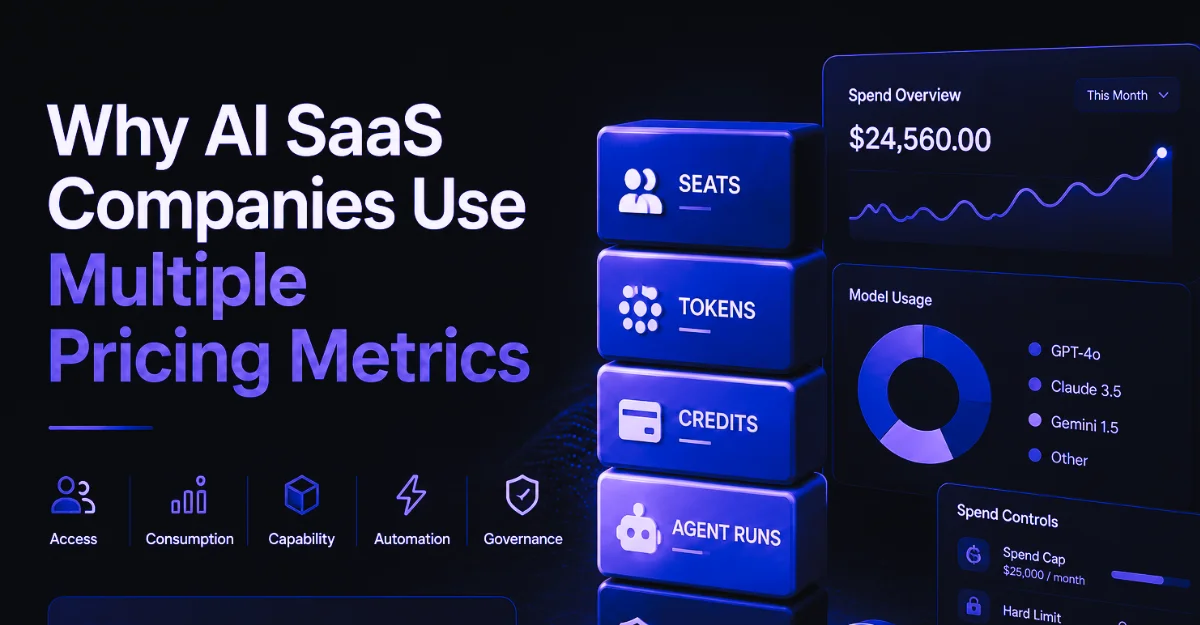
This brief explains why AI SaaS companies use different pricing metrics for access, usage, capability, automation, abstraction, and control.
Six pricing layers
A clear model for understanding how seats, tokens, credits, agent runs, and controls fit into AI SaaS pricing.
18 public pricing sources
A June 2026 provider matrix showing how AI SaaS, coding tools, workflow platforms, and APIs price usage.
Pricing transparency risk
A buyer-side evaluation model for spotting unclear credits, weak controls, hidden overages, and governance gaps.
What are AI SaaS pricing metrics?
The AI SaaS Metering Stack is the layered commercial architecture that assigns distinct pricing metrics to the six economic layers of AI software: access, consumption, capability, automation, abstraction, and control.
Key insight: AI pricing becomes complex precisely when vendors must price both human access and machine work inside the same product.
Why Per-Seat Pricing Does Not Work Alone for AI SaaS
AI usage breaks the traditional SaaS assumption that one licensed user roughly equals one predictable cost unit.
Low-intensity usage
Short prompts on standard models with limited context and few follow-up actions.
same cost profile
High-intensity usage
Large documents, frontier models, tool calls, long-context agents, retries, verification loops, and background workflows.
Pricing implication: AI cost now scales with model class, context length, tool orchestration, retry logic, verification loops, and persistent agent execution — not simply with licensed headcount.
Need competitive intelligence that goes deeper?
I analyze public signals, product systems, positioning gaps, policy language, and competitor behavior to find what the market is really saying.
How AI SaaS Pricing Is Different From AI API Pricing
The same pricing units appear across AI software, but their purpose changes depending on whether the product sells governed access, raw inference, or both.
Seats first, usage layered later
Seats govern humans, teams, permissions, and admin control. Credits or usage meters appear when AI features create variable cost.
SaaS access plus infrastructure cost
Coding assistants and agent platforms sell collaboration and access, but consume model, tool, and workflow resources at scale.
Usage-first pricing
API platforms price compute, model usage, service tiers, and tool calls because developers consume raw inference directly.
Market signal: hybrid pricing emerges most clearly where SaaS products import infrastructure-style usage into enterprise packaging.
What Are the Main AI SaaS Pricing Metrics?
Each pricing metric answers a different commercial question. Problems appear when one unit is forced to price access, usage, capability, automation, abstraction, and control at the same time.
Who can use the product?
Metric: Seats, user licenses
Purpose: Revenue floor + governance surface
How much AI was used?
Metric: Tokens, API calls, compute units
Purpose: Recover variable inference and backend cost
What level of model or feature?
Metric: Premium model tiers, flags
Purpose: Isolate higher-cost capabilities
How much autonomous work occurred?
Metric: Agent runs, session hours, workflows
Purpose: Meter repeated or background execution
How is consumption made budgetable?
Metric: Credits, prepaid pools
Purpose: Convert technical units into manageable units
Can the buyer govern risk?
Metric: Spend caps, logs, admin roles
Purpose: Enable enterprise approval and auditability
How AI Agents Create New Pricing Challenges
Human chat has a visible interaction boundary. Agentic work does not. One instruction can trigger planning, tool use, retries, validation, and background execution.
Human prompt
The user gives one instruction or starts one workflow.
Agent planning
The agent breaks the request into steps, files, tools, and tasks.
Machine execution
Tool calls, code, search, file reads, retries, tests, and validation consume resources.
Background work
Execution can continue after the human has moved on or logged out.
User access
Pricing is tied mainly to the human user, seat, and visible product access.
Machine work performed
Pricing must account for autonomous execution, retries, tools, context, and background workload.
Pricing implication: platforms that ignore agentic execution either absorb rising background cost or create invoice impact buyers cannot see in advance.
AI SaaS Pricing Benchmark: 18 Providers Compared
IVVORA reviewed public pricing architecture across application SaaS, coding assistants, workflow platforms, and AI infrastructure providers to identify how seats, usage, credits, workflow meters, and API pricing are being combined.
providers reviewed across SaaS, coding, workflow, and infrastructure categories
application SaaS, coding assistant, and workflow providers exposed hybrid or metered pricing structures
API and infrastructure providers were usage-first, organized around tokens, service tiers, and model consumption
Market signal: hybrid metering is most visible where vendors sell SaaS access but incur infrastructure-like AI consumption costs.
How hybrid providers were classified
A provider was classified as hybrid if public pricing combined a base subscription, seat, or plan structure with at least one separate usage, credit, workflow, agent, quota, or feature-based meter.
How API providers were classified
API-first providers with no seat or subscription access layer were classified as usage-first infrastructure because pricing centers on raw inference consumption.
What pricing data was not counted
Private enterprise contracts, user-reported pricing, reseller quotes, unsupported community claims, and outdated third-party roundups were excluded.
How sales-gated pricing was handled
Providers with sales-gated pricing and insufficient public unit detail were marked as public detail limited. Classification reflects visible public pricing architecture only.
Which sources were used for the AI SaaS pricing benchmark?
Official pricing pages, documentation, billing help centers, product terms, or official blog/changelog sources.
Official sales pages with partial pricing structure but no full public unit detail.
Public commentary, analyst writeups, or user forums. Excluded unless labeled anecdotal.
AI SaaS pricing provider matrix: June 2026
Classification reflects publicly visible pricing architecture as of June 12, 2026.
| Provider | Category | Seat / Subscription | Tokens / Compute | Credits / Abstraction | Agent / Workflow Meter | Governance Controls | Classification | Primary Public Source |
|---|---|---|---|---|---|---|---|---|
| GitHub Copilot | Coding assistant | Yes | Yes, via AI Credits | AI Credits, token-based | Indirect coding sessions | Usage dashboards, budgets | Hybrid | GitHub official announcement + billing docs |
| Cursor | Coding assistant | Yes | Model usage | Included usage credits | Agent usage | Enterprise controls | Hybrid | Cursor pricing page |
| Claude Team / Enterprise | AI workspace | Yes | Yes | Usage credits | Agent/session-hour and tool-based where listed | Spend limits, analytics | Hybrid | Anthropic Help Center / pricing |
| Notion | Workspace AI | Yes | Token unit not exposed publicly | Notion credits for Custom Agents | Custom Agent runs | Workspace admin | Hybrid | Notion pricing + Help Center |
| Perplexity Enterprise | AI search / workspace | Yes, per seat | Query limits | Not publicly detailed | Research / Labs queries | Admin controls / enterprise privacy controls | Hybrid, query-capped | Perplexity Enterprise pricing |
| v0 by Vercel | App builder | Per user, Team / Business | Implied usage | Monthly credits + purchased credits | Limited | Team billing | Hybrid | v0 pricing documentation |
| Zapier | Workflow automation | Yes | Tasks | Not publicly detailed | Task executions | Usage tiers | Workflow-metered | Zapier pricing |
| Make.com | Workflow automation | Yes | Operations / credits | Credit-based; varies by tokens, model, file size, processing time | Operation executions | Usage visibility | Workflow-metered | Make Help Center |
| OpenAI API | Infrastructure | No | Input, output, cached, tools, service tiers | Service tiers | N/A | Rate limits, tiers | Usage-first infrastructure | OpenAI API pricing page |
| Anthropic API | Infrastructure | No | Yes | Advanced agents, search, code execution | Session hours where listed | Rate limits, caching | Usage-first infrastructure | Anthropic pricing / platform docs |
| Replit | Coding assistant | Yes | Usage-based | Monthly credits | Agent usage and spend management | Team / Enterprise controls | Hybrid | Replit pricing + AI billing docs |
| Windsurf | Coding assistant | Subscription with quota / usage controls | Public pricing structure changed in 2026 | Quota / usage controls | Agent runs | Admin dashboards | Hybrid / quota-based | Windsurf public pricing |
| JetBrains AI | Coding assistant | Yes | Usage | AI Credits, top-ups, monthly quota | Agent mode | Usage tracking | Hybrid | JetBrains AI plans |
| Writer | AI workspace | Yes | Not publicly detailed | Fixed credit limits | Enterprise solution packs | Enterprise controls | Hybrid / seat + credits | Writer public plan page |
| Salesforce Agentforce | Enterprise workflow | Yes | Consumption-based, Flex Credits or Conversations | Usage / credits | Agent runs | Enterprise controls | Hybrid | Salesforce pricing documentation |
| ServiceNow AI Agents | Enterprise workflow | Sales-gated / public pricing detail limited | Public unit detail limited | Public unit detail limited | AI capabilities public; pricing structure not fully public | Enterprise governance positioning | Public detail limited | ServiceNow public AI pages |
| Google Gemini API | Infrastructure | No | Yes | Service tiers | N/A | Rate limits, tiers | Usage-first infrastructure | Google Gemini API pricing |
| Mistral API | Infrastructure | No | Yes | Limited | N/A | Rate limits | Usage-first infrastructure | Mistral pricing documentation |
Among the 14 reviewed application SaaS, coding assistant, and workflow providers, 13 exposed hybrid, workflow-metered, or access-plus-usage pricing structures. The four API/infrastructure providers were usage-first. One enterprise workflow provider had insufficient public pricing-unit detail for full classification.
Each provider was classified independently across seven fields using only publicly visible pricing pages, official documentation, help centers, product terms, or official announcements as of June 12, 2026.
Sources used for the AI SaaS pricing benchmark
GitHub Copilot usage-based billing confirmed by GitHub official announcement and billing docs. Cursor confirmed by Cursor pricing page. Claude confirmed by Anthropic Help Center and pricing documentation. Notion Custom Agent credits confirmed by Notion pricing and Help Center. v0 confirmed by v0 pricing documentation. Make credit mechanics confirmed by Make Help Center. Replit confirmed by Replit pricing and AI billing docs. JetBrains confirmed by JetBrains AI plans. Writer confirmed by Writer public plan page. Salesforce Agentforce confirmed by Salesforce pricing documentation. OpenAI API, Google Gemini API, and Mistral confirmed by respective official API pricing pages. Perplexity, Windsurf, and ServiceNow confirmed by respective public pricing and product pages.
How to Evaluate AI SaaS Pricing Transparency
This rubric identifies where AI SaaS pricing pages create clarity for buyers and where they leave procurement, finance, and product teams exposed to billing ambiguity.
This brief defines the rubric. Provider-level scores are excluded from this version because scoring requires archived screenshots and consistent re-checking across all 18 providers.
Base price clarity
Not public
Public and plan-specific
Included usage clarity
Not disclosed
Included quota or allowance visible
Credit conversion clarity
Not disclosed
Credit burn logic or conversion visible
Model-level cost clarity
No distinction
Model-level pricing or burn difference visible
Overage clarity
No overage terms
Overage rate or process visible
Hard cap availability
No cap
Admin-controlled cap or block available
Usage exportability
Dashboard only or none
Exportable logs or billing reports
Admin control depth
Basic billing only
Role, team, or workspace controls
Enterprise terms clarity
Sales-only or opaque
Public structure described
Pricing change notice
No history
Dated announcement or changelog
What is the difference between seats, tokens, credits, and agent runs?
AI pricing units are not interchangeable. Each one measures a different part of access, consumption, automation, or control.
Access and governance
Does not measure compute intensity.
Model processing
Does not measure business value.
Commercialized usage
Does not show transparent cost unless conversion is visible.
Interaction count
Does not measure context size or model cost.
Autonomous activity
Does not measure quality or completed value.
Process automation volume
Does not measure AI reasoning cost.
Budget control
Does not measure ROI. It defines the boundary buyers need before variable AI spend can scale.
What are the most common problems with AI SaaS pricing?
Most pricing failures appear when buyers cannot connect usage, cost, and control before the invoice arrives.
Hidden credit drain
Buyers receive credits but cannot see which models or features burn them fastest.
Fake unlimited plan
Marketing claims unlimited while high-intensity agentic workflows are quietly throttled.
Agent overrun problem
Background automation consumes usage without pre-run cost estimates or visibility.
Admin dashboard trap
Usage is visible after the fact, but hard spend prevention or pre-approval workflows are missing.
Token-value mismatch
The buyer pays for long outputs even when the business value delivered is low.
Enterprise surprise
Legal approves the subscription, then finance discovers separate usage exposure on agents or premium models.
What AI SaaS Pricing Means for Buyers and Vendors
AI SaaS pricing is no longer only a plan comparison. Each role needs to evaluate a different risk layer: margin, contract clarity, product value, usage growth, technical cost, and adoption friction.
Forecastability and margin exposure
Watch gross margin exposure, overage predictability, and whether usage can be forecast before renewal.
Contract clarity and controls
Check usage versus access terms, hard caps, audit logs, data terms, and overage boundaries.
Metric-to-value alignment
Evaluate whether pricing meters reflect the actual work drivers and customer value created.
Expansion revenue signals
Watch usage analytics, credit drawdown, and consumption patterns that indicate upsell potential.
Technical cost drivers
Track model cost curves, caching economics, context size, tool calls, and agent execution load.
Adoption versus bill shock
Monitor onboarding friction, unclear usage units, and buyer anxiety around opaque credits or overages.
Buyer implication: the strongest AI SaaS pricing pages make access, usage, caps, attribution, and overage rules visible before procurement approval.
How AI SaaS Pricing May Change in 2026 and 2027
AI SaaS pricing is moving from simple seat expansion toward layered usage, credit, agent, governance, and contract structures.
Seats remain, but not alone
Seat pricing stays important for access and governance, but it is no longer the full monetization model.
Credits become more central
Credits are likely to become the main buyer-facing unit across multi-feature AI SaaS products.
Agent runs get priced separately
Agent run and session-hour pricing becomes more common as autonomous workflows scale.
Usage visibility moves into the product
Dashboards and attribution shift from billing admin into the core user and admin experience.
Hard caps become expected
Procurement teams will require hard caps and pre-approval workflows before broad AI rollout.
Model-level cost becomes more visible
Pricing pages will disclose more feature-level and model-level cost differences.
Vague “unlimited AI” claims
Unlimited claims weaken when they are not paired with clear fair-use terms, caps, and visible controls.
Workload and outcome monetization
AI copilots and agents shift from seat-expansion plays toward workload, usage, and outcome-linked monetization.
who can use it
what gets consumed
what is included
how spend is controlled
What are the limits of this AI SaaS pricing benchmark?
This benchmark uses publicly visible pricing information only. Sales-gated enterprise contracts, negotiated discounts, reseller pricing, private customer terms, and non-public usage commitments were excluded.
Public pricing pages can change quickly, especially for AI coding assistants, agent platforms, and usage-credit models. The classification should be read as a point-in-time view of public pricing architecture, not a complete view of realized customer pricing.
Common Questions About AI SaaS Pricing Metrics
These definitions clarify how seats, tokens, credits, agent runs, and governance controls work together in AI SaaS pricing.
Why do AI SaaS companies use multiple pricing metrics?
Because AI software separates access, consumption, capability, automation, and governance. Seats govern users and teams. Tokens recover compute cost. Credits simplify procurement. Agent and workflow meters capture autonomous execution.
What is the difference between tokens and credits in AI pricing?
Tokens are the infrastructure unit processed by models. Credits are the buyer-facing commercial abstraction that may convert to tokens, model usage, agent runs, or feature bundles.
Why do AI SaaS companies still use seat-based pricing?
Seats provide access control, permissions, auditability, SSO, admin management, collaboration features, and a predictable revenue floor.
Why does seat-based pricing break for AI products?
Because two users on the same seat plan can create very different inference costs depending on model choice, prompt length, context, tool calls, and agent activity.
What is hybrid AI SaaS pricing?
Hybrid pricing combines a base subscription or seat model with usage-based, credit-based, token-based, or workflow-based metering for AI consumption and automation.
What should buyers check before signing an AI SaaS contract?
Published credit conversion logic, hard spend caps, exportable usage logs, agent-run visibility and attribution, model-level cost transparency, and clear separation of access versus consumption terms.
AI SaaS pricing glossary: seats, tokens, credits, agents, and overage
Licensed human user with access rights and administrative controls.
Technical unit of text processed, including input, output, and cached tokens.
Commercial abstraction or prepaid pool that converts consumption into a buyer-managed unit.
Meter for autonomous or multi-step background processes.
Separate access or pricing for higher-cost frontier models.
Hard or soft limit set by admins to control total consumption.
Usage beyond the included allowance.
Policy-based restriction often paired with “unlimited” claims.
What AI SaaS pricing metrics mean for buyers and vendors
AI SaaS pricing is no longer a single number attached to a user. It is a control system for allocating access, recovering compute cost, governing autonomous machine work, and making variable AI spend acceptable to finance.
The companies that win will not be the ones with the most meters. They will be the ones whose meters make variable AI economics clear enough for buyers to trust, govern, and scale.
IVVORA AI SaaS Pricing Metrics Benchmark
June 12, 2026
IVVORA retained dated screenshots and source notes for all included providers. Pricing pages and documentation change frequently. This article reflects public information as of the date checked.