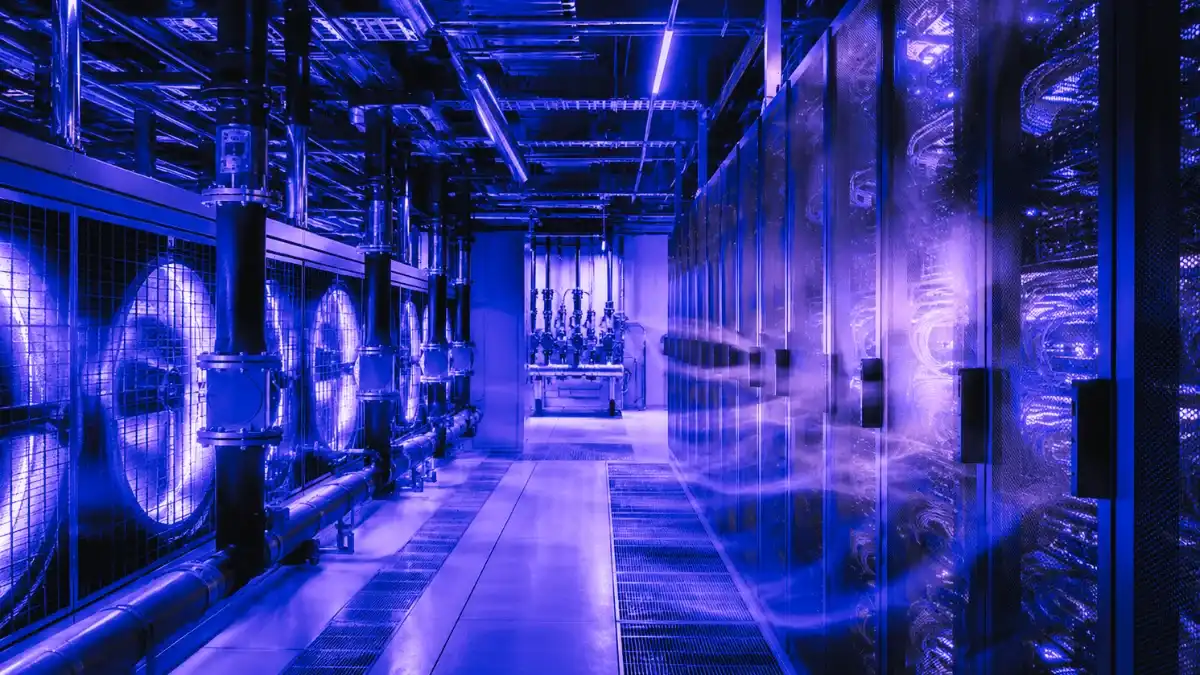
Modine’s $4B cooling deal matters because it shows that AI data center growth is generating enough heat and deployment pressure to prompt customers to reserve cooling capacity years in advance. The company’s 60-80% FY2027 data center growth target turns that thermal demand into a measurable financial signal.
Why Modine’s $4B Cooling Deal Matters for AI Data Centers
Modine Manufacturing Company’s May 2026 data center cooling deal illustrates how demand for AI infrastructure is reshaping the economics of thermal management.
The company signed a long-term agreement to reserve and supply more than $4 billion of Airedale by Modine cooling products to one strategic data center customer from 2027 to 2029.
The customer also paid $165 million upfront. That detail makes the deal look less like a normal equipment order and more like an early move to secure cooling capacity before AI demand tightens supply.
The deeper story is that AI data center growth is pulling cooling into the core of infrastructure planning.
As rack power density rises, thermal capacity becomes a deployment constraint.
Modine’s May 27 fiscal 2026 results make that shift harder to dismiss, especially after the company raised its fiscal 2027 data center revenue growth target to 60% to 80%.
Key Facts
The financial signals behind Modine’s AI cooling demand
Modine’s update combines growth guidance, a multi-year cooling agreement, customer-funded expansion, and visible data center product momentum.
Raised guidance shows data center cooling demand is large enough to reshape Modine’s forward outlook.
More than $4 billion of cooling products are tied to one strategic data center customer across 2027-2029.
Upfront payment to support capacity investments.
Company sales rose 23 percent year over year.
The segment carrying the data center cooling momentum.
Shows AI cooling demand already appearing in reported results.
Down 510 basis points from planned capacity expansion costs.
Guidance implies continued operating scale alongside expansion.
Modine aims to approach or exceed $2 billion in data center revenue by fiscal 2028.
Why Is AI Data Center Cooling Demand Growing
The acceleration is visible in five signals.
Modine raised its fiscal 2027 data center revenue growth target to 60-80 percent.
Data center product sales grew 158 percent in Q4 fiscal 2026.
One customer signed a capacity agreement exceeding $4 billion.
The same customer paid $165 million upfront to support capacity expansion.
Modine’s implied FY2027 data center revenue could approach its fiscal 2028 target one year early.
What Evidence Shows Data Center Cooling Demand Is Rising?
Evidence Base
External signals behind the AI cooling thesis
Modine’s disclosure is the company-specific signal. The broader evidence shows why AI cooling demand is part of a larger data center infrastructure constraint.
Shows cooling demand is visible in company guidance and customer commitments.
More electricity consumption increases heat-removal requirements.
Shows thermal standards are adapting to denser compute environments.
Confirms cooling is part of a broader infrastructure constraint.
Higher rack density creates more concentrated thermal loads.
What Modine Announced
Modine executed two coordinated moves.
First, the LTA reserves and supplies more than $4 billion of Airedale cooling systems.
Second, fiscal 2027 guidance explicitly accelerates the data centers business.
These actions suggest thermal capacity has become strategically scarce for at least one major data center buyer.
What This Analysis Adds
Analysis Framework
Four signals behind Modine’s AI cooling story
The article is not only tracking Modine’s guidance. It connects the company’s numbers to the larger infrastructure shift created by AI data center growth.
AI systems concentrate more power inside data center racks, creating measurable thermal demand.
Cooling supply is moving from normal equipment procurement into reserved industrial capacity.
The $165M advance shows procurement pressure strong enough to support supplier capacity buildout.
Infrastructure value is migrating from chips and cloud spending into cooling, power, and facility systems.
IVVORA AI Infrastructure Heat Chain
AI Infrastructure Heat Chain
How AI demand becomes thermal infrastructure demand
The Modine signal matters because digital AI demand moves through the physical data center stack before it becomes deployable capacity.
More training and inference workloads increase compute requirements.
More accelerators concentrate power inside racks and rows.
Electricity becomes concentrated thermal load inside the facility.
Suppliers become part of deployment planning, not late-stage procurement.
From market signal to strategic direction.
I help teams translate scattered market evidence into positioning, growth, competitor, and decision-making clarity.
Why Airedale by Modine Is Becoming Central to AI Cooling Demand
Airedale by Modine designs and manufactures precision cooling systems for mission-critical environments.
The portfolio includes chillers, precision air handlers, fan walls, in-row coolers, liquid-to-air and liquid-to-liquid solutions, and integrated controls.
Cooling Function Map
What Airedale cooling systems do inside AI data centers
The value is not only cooling equipment. These systems support the operating conditions that make high-density AI compute usable.
Moves thermal load away from dense racks, rows, and facility cooling loops.
Supports stable operating conditions for mission-critical AI infrastructure.
Helps reduce wasted energy as compute density and cooling demand rise.
Connects cooling design with the electrical systems required for AI deployment.
How Is AI Data Center Cooling Different From Normal HVAC?
Mission-Critical Cooling
Why AI data center cooling is not ordinary HVAC
AI cooling is not only about lowering temperature. It protects uptime, hardware reliability, energy performance, and deployment capacity.
Cooling systems need backup capacity because failure can affect compute availability.
High-density racks require precise thermal management to avoid hardware stress.
Stable environmental conditions help protect sensitive server and accelerator equipment.
Dense AI racks create localized heat that must be managed before it affects performance.
Cooling choices affect power usage, operating cost, and facility-level efficiency.
Cooling and electrical systems must be planned together for high-density AI deployment.
Cooling failure can affect compute availability and hardware lifespan at a massive scale.
Mission-critical thermal infrastructure, therefore, receives strategic procurement treatment.
Why Do AI Data Centers Need More Cooling?
AI servers consume large amounts of electricity. Nearly all of that energy eventually becomes heat inside the data center.
Cooling systems account for a significant and growing share of that consumption.
How Does AI Rack Density Change Data Center Cooling Needs
Rack density is the electrical power consumed by equipment inside a single server rack, typically measured in kilowatts.
Electricity Demand Signal
More data center electricity means more heat to remove
The IEA projection matters because nearly all electricity consumed by servers eventually becomes heat inside the facility.
AI-focused servers are projected to drive nearly half of the net increase.
AI-focused server electricity demand is described as growing around 30 percent annually.
What Types of Cooling Do AI Data Centers Use?
Cooling Architecture Map
AI density does not eliminate existing cooling systems. It forces operators to combine air, liquid, chiller, and rack-level technologies more carefully.
Controls airflow and temperature in mission-critical spaces.
Remove heat from facility cooling systems at data center scale.
Capture heat closer to high-density racks and rows.
Sends coolant near processors and accelerators.
Submerges equipment in dielectric fluid for specialized designs.
Manage coolant flow between facility loops, racks, and servers.
What Does Modine’s 60-80% Data Center Growth Target Mean
Fiscal 2026 already delivered strong data center growth on an expanded base.
Applying the new 60-80 % guidance produces the following original revenue range (assuming a conservative fiscal 2026 data center base of $1.1–1.2 billion derived from segment momentum and acquisitions).
Revenue Implication
What Modine’s 60-80% data center target could imply
If the fiscal 2026 data center base is around $1.1-$1.2 billion, the FY2027 target range could move Modine close to its fiscal 2028 ambition sooner than expected.
Modine’s long-term target is to approach or exceed $2B in data center revenue by fiscal 2028.
This trajectory positions Modine to approach or reach its fiscal 2028 target of more than $2 billion in data center revenue one year early, assuming execution.
Why Are Data Center Customers Reserving Cooling Capacity Years Ahead
The LTA is a capacity reservation, not an immediate order book.
Modine reserves and supplies more than $4 billion of Airedale products across 2027-2029.
The $165 million upfront payment helps fund manufacturing expansion and aligns supplier capex with customer build schedules.
Revenue will be recognized as products are delivered and performance obligations satisfied under accounting rules.
The structure shifts procurement from spot purchases to strategic infrastructure planning.
Procurement Shift
From equipment buying to capacity reservation
The $4B agreement is not only a sales signal. It shows how AI buildouts change the way critical infrastructure is secured.
Buy equipment near project need
- Supplier capacity is assumed available
- Orders follow normal procurement windows
- Cooling is treated as facility support
- Lead time is managed late in the build cycle
Reserve capacity years ahead
- Supplier throughput becomes strategic
- Customers help fund expansion
- Cooling becomes a deployment constraint
- Lead time becomes part of project risk control
Capacity Agreement vs Backlog vs Revenue
A capacity agreement reserves the supplier’s production capacity over a defined period. Backlog usually refers to contracted orders that have not yet been fulfilled.
Revenue is recognized when products are delivered or performance obligations are satisfied.
Modine’s $4 billion LTA should therefore be read as a long-term capacity commitment, not immediately recognized revenue.
What Is the Difference Between Modine’s Fiscal Year and the LTA Timeline
Modine’s fiscal year ends March 31. Fiscal 2027 refers to the company reporting year ending March 31, 2027.
The $4 billion LTA covers calendar years 2027-2029.
That means the guidance period and the agreement period overlap but are not identical.
What Does LTA Mean in Modine’s Data Center Cooling Deal?
LTA means long-term agreement.
In Modine’s case, the LTA is a multi-year agreement to reserve and supply more than $4 billion in Airedale cooling products to a single strategic data center customer over 2027-2029.
What Makes Modine’s $4B Cooling Deal Unusual?
The unusual part is not that a data center customer is buying cooling equipment.
The unusual part is the size, duration, and upfront financing structure.
A three-year, more-than-$4 billion capacity agreement with a $165 million customer advance suggests that cooling supply is important enough to secure before normal procurement windows.
Modine vs Vertiv: Which Company Benefits From AI Data Center Cooling
Modine is a more concentrated AI cooling exposure through Airedale, while Vertiv is a broader data center infrastructure company with both power and thermal systems.
Modine’s $4B LTA is notable because it provides a specific, quantified example of cooling capacity reserved years in advance.
Is Modine an AI Data Center Infrastructure Company?
Modine is not an AI software or chip company. It is an industrial thermal management company whose AI exposure comes from cooling systems used in high-density data centers.
In that sense, Modine is a beneficiary of AI infrastructure rather than a pure AI company.
Confirmed Facts vs Interpretation
The disclosed facts show what Modine reported. The interpretation explains what those facts may reveal about AI cooling demand, procurement pressure, and capacity constraints.
Fiscal 2027 data center growth target.
Suggests demand has outpaced prior planning assumptions.
Long-term agreement signed May 26, 2026.
Indicates at least one large customer is reserving thermal capacity years ahead.
Upfront customer payment.
Shows cooling capacity expansion is important enough for customer pre-funding.
Gross margin compression in Climate Solutions.
Reflects near-term cost pressure from capacity expansion.
Q4 data center product growth.
Shows demand has translated into reported revenue acceleration.
What Risks Could Affect Modine’s AI Data Center Cooling Growth
Execution risk from rapid manufacturing scale-up remains real. Sustained gross margin pressure until new capacity reaches high utilization is possible.
Customer concentration on one large, unnamed strategic data center customer creates both validation and dependency.
Hyperscaler capex slowdown, supply chain issues, or technology shifts to alternative cooling architectures could alter the outlook.
The Modine announcement may reflect one customer’s specific buildout schedule rather than industry-wide scarcity.
Growth could also stem from company-specific execution and acquisitions.
The broader thesis strengthens only if similar signals appear across peers.
Signal and Risk Matrix
What strengthens the Modine AI cooling thesis and what still limits it
The deal is a strong signal, but the interpretation depends on execution, peer confirmation, and how quickly the LTA becomes recognized revenue.
Multi-year supply reservation suggests cooling capacity is being planned ahead of deployment.
Customer-funded expansion shows procurement pressure beyond normal ordering behavior.
Guidance turns thermal demand into a measurable financial expectation.
Demand is already visible in reported data center product performance.
The deal validates demand but limits visibility into concentration and buyer strategy.
Capacity expansion can create cost drag until utilization and revenue conversion improve.
Known unknowns include the unnamed customer, the exact annual revenue recognition schedule for the $4B agreement, the full capacity expansion footprint, and the long-term margin profile of the data center business.
What Should Investors and Data Center Operators Watch Next
Executive Watchlist
What to monitor after Modine’s FY2027 outlook
The next signal is whether the $4B agreement converts into revenue smoothly and whether similar capacity pressure appears across the data center infrastructure market.
Investors should watch
Operators should watch
How Do Water, Energy, and Location Affect an AI Data Center’s Cooling
AI data center cooling affects more than equipment procurement.
Cooling architecture can influence water use, energy consumption, permitting, operating costs, and sustainability claims.
Facilities in hot or water-constrained regions may require different designs than those in cooler climates with greater free-cooling potential.
Cooling design also depends on climate, grid capacity, electricity prices, water availability, permitting rules, and site layout.
FAQ and Sources
These questions clarify what the $4B agreement means, why AI data centers need more cooling, and where the risks remain.
Why does Modine’s $4B cooling deal matter for AI data centers?
It matters because at least one large data center customer is reserving cooling capacity years ahead. The signal is not only higher equipment demand. It is that thermal capacity is becoming important enough to secure before normal procurement windows.
What does Modine’s 60-80% data center growth target show?
It shows that data center cooling demand is large enough to affect company-level guidance. The target suggests AI infrastructure demand is moving beyond chips and cloud spending into physical systems like cooling, power, and facility capacity.
Why do AI data centers need more advanced cooling?
AI data centers need more advanced cooling because high-density servers consume more electricity and produce more concentrated heat. If that heat is not removed efficiently, operators can face uptime risk, hardware stress, lower energy efficiency, and slower deployment.
Is Modine an AI company?
Modine is not an AI software or chip company. It is an industrial thermal management company whose AI exposure comes from cooling systems used in high-density data centers. A better description is that Modine is an AI infrastructure beneficiary.
What is the biggest risk in Modine’s AI cooling story?
The biggest risk is execution. Modine must expand capacity, convert the $4B agreement into recognized revenue, manage margin pressure, and avoid overdependence on one large unnamed customer. The thesis strengthens if similar demand signals appear across peers.
Primary Sources
- Modine Manufacturing Company, Long-Term Capacity Agreement announcement, May 26, 2026
- Modine Manufacturing Company, Q4 and Full-Year Fiscal 2026 Results, May 27, 2026
- Modine FY2025 Form 10-K (available via investor relations site).
Third-Party Sources
- International Energy Agency, Energy and AI report.
- Uptime Institute Global Data Center Survey 2025.
- ASHRAE Thermal Guidelines for Data Processing Environments, 5th Edition.
- NVIDIA technical disclosures on AI rack/server power density.
This analysis distinguishes confirmed Modine disclosures from IVVORA’s market interpretation. The article focuses on Modine’s $4 billion Airedale capacity agreement, fiscal 2027 data center growth target, AI data center cooling demand, rack-density pressure, customer-funded capacity expansion, and the infrastructure constraints shaping AI deployment.
This article is for market and infrastructure analysis only and is not financial advice, investment advice, or a recommendation to buy or sell any security.
Last updated: May 28, 2026