How We Reviewed AI Software Pricing Pages
IVVORA reviewed official pricing pages, support documentation, changelogs, billing help centers, and public plan pages from 25+ AI infrastructure and software providers between June 10–14, 2026.
Each provider was coded for pricing unit, credit/usage mechanism, included usage, metering trigger, overage rule, spend-control availability, agentic/programmatic usage separation, and dashboard presence.
Only official sources were used for core claims. Customer reaction signals from public forums are noted separately where relevant.
How AI Costs Create Pricing Complexity
The AI Pricing Compression Model shows seven layers of upward pressure: Model Cost at the base, then Usage Intensity, Automation Depth, Packaging Model, Buyer Predictability, Margin Protection, and Governance Controls at the top. Variable inference cost at the foundation forces complexity through every layer above it.
Why Is AI Software Pricing Hard?
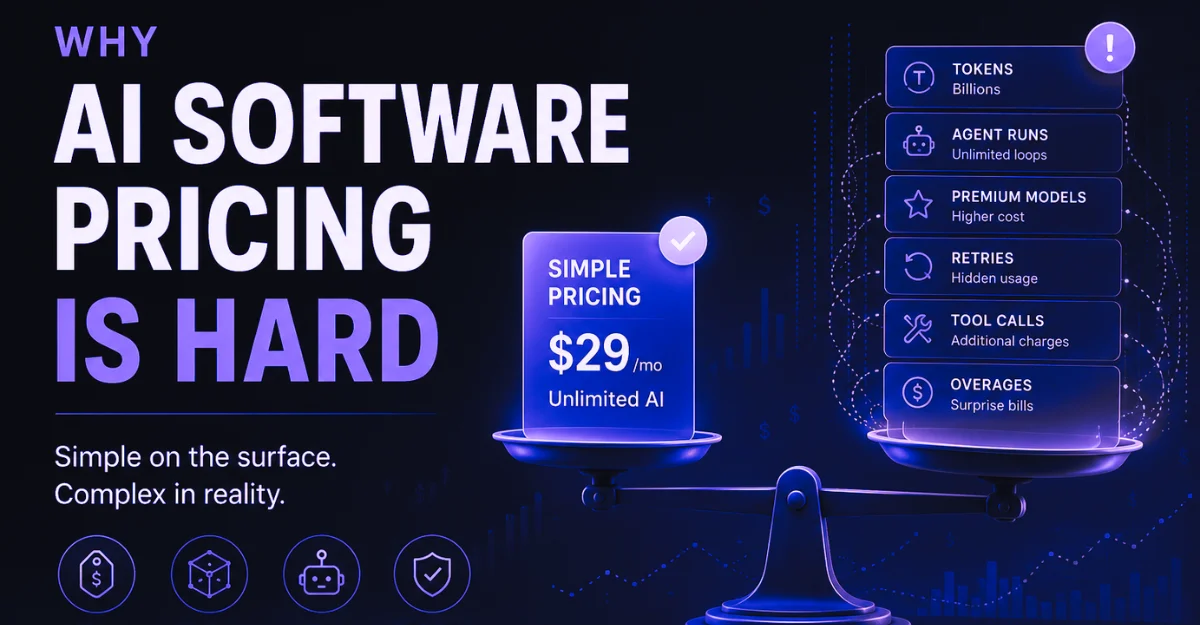
Simple pricing is hard in AI software because vendors must sell predictable subscriptions for products whose marginal costs are triggered at inference time by every token, tool call, retry, agent loop, and automated workflow.
Buyers want fixed monthly cost, clear tiers, and easy comparison. Vendors face variable inference exposure that scales with usage intensity and automation depth.
This forces layered architectures: credits, caps, metering, dashboards, routing, and governance that add operational and buyer-facing complexity.
What Is Simple Pricing in AI Software?
Simple pricing usually means:
Predictable monthly cost
Clear plan tiers with easy buyer comparison
Limited or transparent overages
Simple procurement approval
Low billing surprise
No requirement for buyers to understand tokens, credits, model routing, or automation depth
Why AI Companies Struggle to Keep Pricing Simple
The AI Pricing Compression Problem is the structural challenge of compressing variable, model-dependent, workflow-dependent AI inference costs into buyer-friendly pricing that remains predictable, approvable, and forecastable without destroying vendor margins.
The framework has seven layers:
Base inference expense
Volume and variance
Human-paced to agentic loops
Tiers, credits, metering
Bills, forecasts, controls
Vendor economics
Dashboards, caps, routing
Most teams see the move too late.
I help identify what competitors are changing, what buyers are signaling, and where the market may be moving next.
How Is AI Software Pricing Different From SaaS Pricing?
Traditional SaaS had near-zero marginal cost per additional user after initial build. Seat count served as a reasonable proxy for both value and cost.
AI inference cost is incurred at the point of use and varies by model, output length, tool calls, retries, and whether the workflow is human-paced or machine-paced.
Seat count no longer predicts cost. Unlimited plans that worked in SaaS become margin risks when one power user or automated agent generates sustained high consumption.
Why Average AI Usage Does Not Show Pricing Risk
Average usage signals adoption. It does not define pricing risk. The p95 workflow defines margin exposure.
The p99 deployment defines whether the pricing model survives real-world conditions.
Most companies still price and model against averages. AI breaks that assumption because usage distributions are heavily skewed.
Can support flat or light hybrid plans
Included allowance usually covers
Requires credits, caps, or overages
Current model may need redesign
Why AI Agents Make Usage Harder to Price
Limited by attention. Subscriptions viable.
Moderate variability. Credits or fair-use limits.
Machine-paced. Metering or credits necessary.
High variance and repeatable. Usage-based or contract pricing.
Traditional SaaS Pricing vs AI Software Pricing
What Changed in AI Pricing in 2026?
GitHub announces Copilot move to usage-based billing with GitHub AI Credits
Token-based pricing becomes a visible signal in devtool pricing.
GitHub AI Credits transition begins
Premium features become credit-governed.
Anthropic separates Claude Agent SDK and programmatic usage into dedicated monthly credits
These credits are distinct from interactive subscription pools.
IVVORA pricing data snapshot
Provider pricing signals are captured as a dated market view.
AI Software Pricing Examples From 25 Companies
Full visible dataset (25 providers). All fields use defined terms. “Hybrid” = subscription base + usage or credit elements. “Partial” = some but not full capability. Sources listed per row.
AI pricing units, credits, overages, dashboards, and source references
| Company | Category | AI Pricing Unit | Included Usage | Overage Rule | Credits? | Spend Cap? | Usage Dashboard? | Agentic Usage Separated? | Source (Official, June 14 2026) |
|---|---|---|---|---|---|---|---|---|---|
| OpenAI | Infrastructure | Input/output/cached tokens (model-specific) | Pay-as-you-go; Batch 50% off, caching 90% input | Pay-as-you-go | No | Via sales | Yes | N/A | OpenAI API pricing page |
| Anthropic | Infrastructure | Per-token + separate programmatic credits | Interactive plans have limits; Agent SDK gets dedicated monthly credits | Meters at API rates or blocks after credit | Yes | Yes (admin) | Yes | Yes (effective Jun 15) | Anthropic Claude support docs |
| GitHub Copilot | Devtool | GitHub AI Credits (token-based) | Base credits included in subscription | Additional credits purchasable | Yes | Yes (budgets) | Yes | Partial (agentic features) | GitHub blog & docs (Apr/Jun 2026) |
| Cursor | Devtool | Subscription + usage credits pool | Pro includes usage credits for agent/API calls | Overages available | Yes | Limited | Yes | Yes (heavy agentic) | Cursor pricing page |
| Retool | Workflow/Agent | Per-hour for Agents (model-dependent) | Up to ~20 agent hours free/mo (plan-dependent) | Pay-as-you-go after | Partial | Yes | Yes | Yes (Agents billed separately) | Retool pricing & agent docs |
| Zapier | Automation | Tasks (actions in automations) | Tiered task allowances | Extra tasks billed | No | Limited | Yes | Partial | Zapier pricing page |
| Vercel v0 | App generation | Credits per generation | Free: $5/mo credits; higher plans include more | Purchase additional | Yes | Limited | Yes | N/A | Vercel v0 pricing page |
| Replit | Devtool/Agent | Credits for Agent/Ghostwriter | Core includes monthly credits | Additional available | Yes | Limited | Yes | Yes (Agent features) | Replit pricing page |
| Google Gemini API | Infrastructure | Input/output tokens (model-specific) + caching | Free tier with RPM limits; paid per-token | Pay-as-you-go | No | Via billing | Yes | N/A | Google AI Studio / Gemini API pricing |
| Microsoft Copilot / Copilot Studio | Enterprise | AI Credits + capacity packs | Included credits in M365 plans; Studio capacity packs | PAYG or additional packs | Yes | Yes | Yes | Partial | Microsoft 365 Copilot & Copilot Studio pricing |
| Perplexity | Search/Research | Subscription + usage/search limits | Tiered plans with limits | Higher tiers or overages | Partial | Limited | Yes | N/A | Perplexity pricing & enterprise pages |
| Notion AI | Productivity | Hybrid (subscription base + usage elements) | Varies by plan | Usage-based elements | Partial | Limited | Partial | Partial | Notion pricing & AI docs |
| Intercom Fin | Support | Hybrid (outcome/usage elements) | Included in higher plans | Usage-based | Partial | Limited | Yes | Partial | Intercom pricing & Fin docs |
| Salesforce Agentforce | Enterprise Agent | Agent hours / usage | Included in some licenses | Usage-based | Partial | Yes | Yes | Yes | Salesforce Agentforce pricing |
| Glean | Enterprise Search | Hybrid usage | Enterprise plans | Usage elements | Partial | Yes | Yes | Partial | Glean pricing docs |
| Harvey | Legal AI | Hybrid (subscription + usage) | Enterprise plans | Usage-based | Partial | Yes | Yes | Partial | Harvey pricing (official) |
| Jasper | Marketing AI | Hybrid (subscription + usage/credits) | Plan tiers | Usage or credit overages | Yes | Limited | Yes | Partial | Jasper pricing page |
| Writer | Enterprise AI | Hybrid usage | Enterprise plans | Usage-based | Partial | Yes | Yes | Partial | Writer pricing docs |
| Copy.ai | Marketing AI | Hybrid (subscription + usage) | Plan tiers | Usage overages | Partial | Limited | Yes | Partial | Copy.ai pricing |
| Runway | Video/Generation | Credits / generation units | Plan tiers with credits | Purchase additional | Yes | Limited | Yes | N/A | Runway pricing page |
| ElevenLabs | Audio/Generation | Credits / character or minute units | Plan tiers with credits | Overages or higher tiers | Yes | Limited | Yes | N/A | ElevenLabs pricing |
| Fireflies | Meeting AI | Hybrid (subscription + usage) | Plan tiers | Usage elements | Partial | Limited | Yes | Partial | Fireflies pricing |
| Gong | Sales AI | Hybrid usage | Enterprise plans | Usage-based | Partial | Yes | Yes | Partial | Gong pricing docs |
| HubSpot AI | CRM/Marketing | Hybrid (included + usage add-ons) | Included in higher tiers | Usage-based add-ons | Partial | Limited | Yes | Partial | HubSpot pricing & AI docs |
| Windsurf | AI Coding | Hybrid (subscription + usage credits) | Plan tiers with credits | Overages | Yes | Limited | Yes | Yes (agentic coding) | Windsurf / official docs |
| Make | Automation | Operations / tasks | Tiered allowances | Extra operations billed | No | Limited | Yes | Partial | Make pricing page |
Copy the table above into a spreadsheet to create a working CSV. Full raw dataset with additional fields maintained by IVVORA and updated on major provider changes.
What Do AI Companies Charge For?
Used by: SaaS-style products
Best for: Access
Buyer confusion risk: Hides usage variance
Used by: API / model providers
Best for: Cost alignment
Buyer confusion risk: Hard for non-technical buyers
Used by: AI apps / devtools
Best for: Abstraction & control
Buyer confusion risk: Hard to forecast
Used by: Automation tools
Best for: Workflow completion
Buyer confusion risk: Ambiguous task definition
Used by: Agent platforms
Best for: Labor replacement framing
Buyer confusion risk: Varies by model/task depth
Used by: Vertical AI / Enterprise
Best for: Value alignment
Buyer confusion risk: Attribution difficulty
Used by: Large enterprises
Best for: Predictability
Buyer confusion risk: Sales-heavy / custom
What Makes AI Pricing More Complicated?
Model / Provider layer (base cost)
Routing layer (model selection & optimization)
Usage measurement layer (what gets counted)
Packaging layer (tiers, included allowances, credits)
Billing layer (how it is charged)
Buyer governance layer (dashboards, caps, alerts, export)
Sales / Procurement layer (explanation, approval, forecasting)
Margin reporting layer (internal visibility & P&L)
Common AI Software Pricing Models
Seat-based
Why Used: Easy comparison
Primary Failure Mode: Ignores usage variance & automation depth
Flat unlimited
Why Used: Strong adoption signal
Primary Failure Mode: Power users or agents destroy margins
Credit-based
Why Used: Controls without pure metering
Primary Failure Mode: Abstraction & forecasting friction
Usage-based
Why Used: Aligns revenue with cost
Primary Failure Mode: Bill anxiety & procurement blocks
Hybrid seat + usage
Why Used: Balance predictability & exposure
Primary Failure Mode: Requires dashboards & education
Outcome-based
Why Used: Ties price to value
Primary Failure Mode: Attribution difficulty
Enterprise custom
Why Used: Governance & commitments
Primary Failure Mode: Poor scalability for self-serve
How AI Pricing Changes as Companies Grow
AI included in existing plans
Hidden margin exposure
Fair-use limits added (vague)
Buyer confusion and support burden
Credits introduced
Credit abstraction and forecasting difficulty
Dashboards and spend visibility
Product and billing complexity increases
Governance (caps, routing, audit, enterprise controls)
Longer sales motion and higher CAC
AI Pricing Cost Examples With Real Numbers
OpenAI GPT-5.5 output rate $30 per 1M tokens
A workflow generating 10 million output tokens on a premium model creates $300 in output-token cost alone before input tokens, tools, retries, orchestration, infrastructure, or support.
Cheaper-model comparison
The same 10M output tokens on a lower-cost model at $5 per 1M output costs $50. Routing decisions directly change margin exposure by 6x on identical volume.
Flat-plan margin failure
A $99/month customer generates $300 in output-token cost before other expenses. The account is margin-negative even before normal SaaS operating costs, support burden, or infrastructure.
Credit exhaustion
A developer on a plan with $20 monthly credits for agentic work exhausts the pool in three heavy sessions. Additional usage then meters at full API rates, creating surprise bills that flat-plan buyers did not expect.
Why AI Pricing Models Fail
AI pricing fails when unlimited plans attract undisclosed power users, credits are too abstract for buyers to forecast, sales cannot clearly explain what counts as usage, support is overloaded with billing questions, p99 customers become unprofitable, procurement blocks variable spend, model upgrades quietly raise effective cost, routing decisions are invisible to buyers, customer value is not visibly tied to consumption, or pricing changes after adoption trigger backlash.
Unlimited plans attract undisclosed power users
Credits are too abstract for buyers to forecast
Sales cannot clearly explain what counts as usage
Support is overloaded with billing questions
p99 customers become unprofitable
Procurement blocks variable spend
Model upgrades quietly raise effective cost
Routing decisions are invisible to buyers
Customer value is not visibly tied to consumption
Pricing changes after adoption trigger backlash
Which AI Software Categories Have the Most Pricing Risk?
Agentic + long-context bursts
Continuous machine-paced loops
Task/agent volume scaling
Variable document/record volume
Human-paced but bursty
Predictable per-meeting
Query volume + depth
Human-paced, low variance
Generation cost per asset
Common AI Pricing Mistakes Startups Make
Smaller companies commonly: price against average usage instead of p95/p99, launch unlimited or lightly limited AI tiers without usage instrumentation, treat credits as pure monetization instead of margin defense, fail to separate human-paced from automated usage in packaging, lack dashboards or spend caps at launch, change pricing after adoption without clear communication, and under-invest in sales and support enablement for usage explanations.
Price against average usage instead of p95/p99
Launch unlimited or lightly limited AI tiers without usage instrumentation
Treat credits as pure monetization instead of margin defense
Fail to separate human-paced from automated usage in packaging
Lack dashboards or spend caps at launch
Change pricing after adoption without clear communication
Under-invest in sales and support enablement for usage explanations
How Should Buyers and Vendors Manage AI Pricing Risk?
Buyers should demand:
hard spend/usage caps
usage visibility by team/workflow/user
exportable logs for finance and audit
clear separation of agentic vs interactive usage
model routing controls or transparency
credit rollover or refund policies where relevant
SLAs on billing accuracy and support response for usage questions
What Should Finance Teams Model Before Pricing AI Features?
Finance teams should model:
AI cost per account and per workflow
gross margin by customer segment under p95 and p99 usage
support and billing operations cost at scale
sensitivity of margin to model mix and routing
break-even point for heavy users
What Should Product Teams Track Before Changing AI Pricing?
Product teams should instrument:
model used per workflow
tokens or units per customer and per workflow
output length
retries and failed runs
tool calls
agent steps
cost per completed task
p95 and p99 usage
usage split between human-paced and automated
gross margin by segment
AI Pricing Checklist for Buyers
Before buying, ask:
How Should AI Companies Choose a Pricing Model?
Seat + included usage
Seat + credits
Usage-based or hybrid
Contract + capacity + governance
Custom terms + dashboard + caps
Bundle into base plan
Add-on or metered
What Tools Do Companies Need to Manage AI Pricing? Customer-level usage tracking workflow-level usage tracking model-level cost tracking p95/p99 usage reporting alerting for abnormal usage spend/usage caps admin dashboard (buyer-visible) credit balance display billing event logs support-facing billing explanation tools sales-facing pricing calculator finance-facing margin report by segment
What Metrics Should AI Pricing Dashboards Track?
Customer-level margin visibility
Identifies expensive use cases
Connects seats to real consumption
Links cost to outcome
Stress-tests pricing model
Identifies potential failure cases
Shows routing exposure
Hidden waste indicator
Orchestration cost driver
Buyer friction / packaging signal
Monetization acceptance
AI Pricing Terms to Watch on Competitor Pricing Pages
Track these terms in competitor pages, release notes, and support docs:
What Questions Will Buyers Ask About AI Pricing?
Procurement and finance will ask the questions in the Buyer Risk Checklist above plus:
“Our pricing includes predictable base access. Human-paced usage is included in the plan. Production automation and agentic workflows are governed separately with credits or metering so your team can scale without surprise bills.”
What Should Investors Look for in AI Software Pricing?
Beyond ARR, ask:
How to Choose the Right AI Pricing Model
AI Pricing Checklist Before Launch
When Can Simple AI Pricing Still Work?
Where this thesis can be wrong:
The counterargument: simple AI pricing may survive
The issue is not whether inference gets cheaper in absolute terms. The issue is whether usage variability, automation depth, and buyer demand for predictability move faster than cost declines. Current provider moves (credit separation, token-linked billing, agentic metering) show variability and governance requirements increasing even as headline rates fluctuate.
AI Pricing Terms, Sources, and Article Updates
Why is simple pricing hard in AI software?
Because inference costs are variable and triggered by usage while buyers expect predictable subscriptions. Variable cost + uneven distribution + agentic automation creates structural mismatch.
Why do AI companies use credits?
Credits provide a control and abstraction layer between flat subscriptions and pure usage-based billing, especially useful for agentic or high-variance workloads.
What is agentic usage?
Automated, looped, tool-using AI workflows that run with minimal human intervention and can generate sustained high-volume consumption.
Why are AI agents expensive to run?
They remove the natural limit of human attention and can run continuously, creating cost exposure far beyond typical chat usage.
Is AI pricing moving toward usage-based?
Many providers are moving to hybrid models (base access + metered or credited usage for heavier or agentic workloads) rather than pure usage-based for everything.
How should startups price AI features?
Instrument usage distribution by customer and workflow type. Choose hybrid models with clear definitions of human-paced vs automated usage. Add dashboards and caps early. Test packaging against real p95 workflows before scaling.
What is the difference between seat-based and usage-based AI pricing?
Seat-based charges per user regardless of consumption. Usage-based (or hybrid) ties price more directly to tokens, tasks, credits, or agent hours consumed.
What should buyers ask before buying AI software?
See the full Buyer Risk Checklist above.
AI Pricing Terms Explained
The commercial model for charging for AI capabilities (subscriptions, credits, usage, outcomes).
Predictable monthly cost, clear tiers, easy comparison, limited surprises, low need for buyers to understand technical units.
The compute and model expense incurred when generating an AI response or action.
Unit of text processed by LLMs (input sent by user, output generated by model, or cached).
Tokens sent by user, generated by model, or reused from cache (cached often heavily discounted).
Pre-allocated unit (often dollar-denominated or abstract) representing included consumption.
Automated, non-interactive workflows where AI agents loop through tasks with tools and minimal human intervention.
Non-interactive access via SDK, CLI, GitHub Actions, or background systems.
Directing requests to different models based on cost, capability, or policy.
Usage beyond included allowance, usually billed extra.
Hard limit on consumption or spend.
Vague or soft limit on “reasonable” usage.
Amount of usage or credits bundled in the base plan.
Asynchronous, lower-cost inference option.
Pre-committed compute for predictable pricing and availability.
Discrete units of automated AI work.
Dashboards, caps, alerts, routing, and audit controls that let buyers manage consumption.
AI Pricing Sources Used in This Guide
Primary sources are official pricing pages and support documentation checked June 14, 2026:
Article Updates and Pricing Data Review History
Initial publication. Full 25-provider dataset, row-level sources, methodology, expanded numerical examples, p95/p99 stress test, buyer/vendor checklists, category map, failure patterns, dashboard metrics, counterargument section, fully written sections, and copyable tables.
Major provider pricing or policy changes, new dataset snapshots, expanded categories. Next scheduled review July 2026.
How IVVORA Tracks AI Pricing Changes
IVVORA tracks AI pricing, packaging, and usage-governance changes across infrastructure providers and downstream software categories. Private briefs add competitor-specific pricing logs, category exposure maps, p95/p99 stress analysis, and decision triggers tailored to your current model and roadmap.
Why AI Software Pricing Will Keep Getting More Complex
Simple AI pricing is hard because buyers want predictable access while vendors carry variable inference exposure that scales with usage intensity and automation depth.
Traditional SaaS could hide usage behind seats because marginal cost was low and predictable.
AI software cannot always do that. Once usage becomes agentic, automated, model-dependent, and unevenly distributed, pricing must introduce credits, caps, metering, routing, dashboards, or enterprise controls.
The companies that win will be those that make variable AI economics feel predictable to buyers without hiding the cost structure from their own P&L, sales motion, or product decisions.