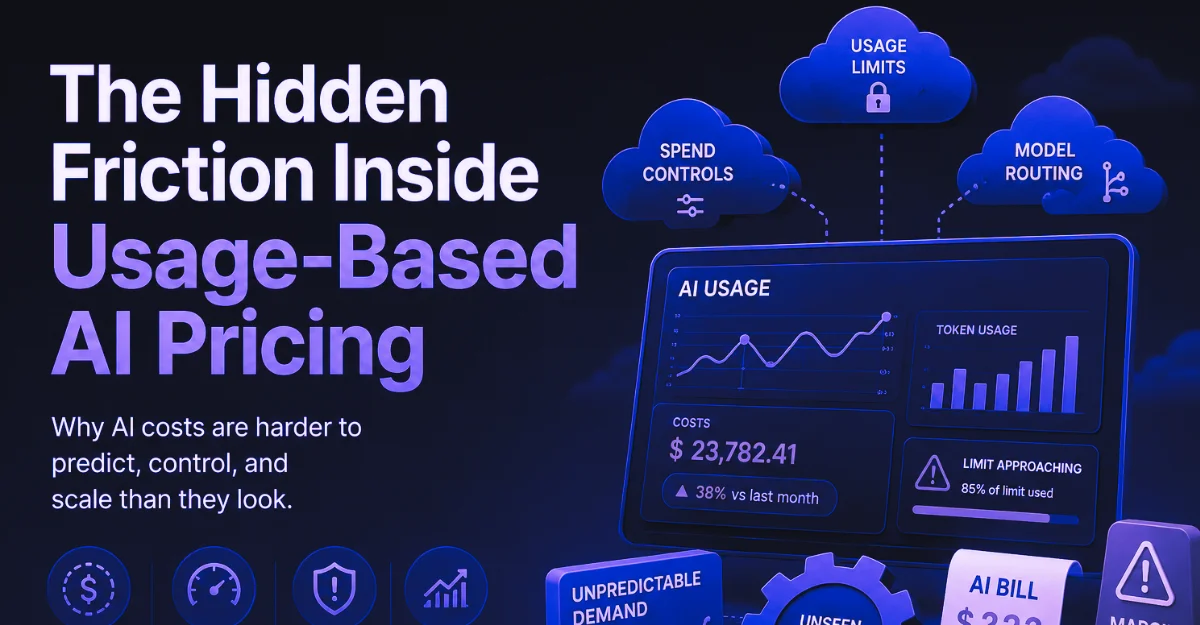
AI providers are moving usage-based access into a governed pricing phase
OpenAI’s June 18, 2026, launch of credit usage analytics and updated spend controls for ChatGPT Enterprise, combined with Anthropic’s earlier rollout of granular spend limits, usage analytics, and admin tooling for Team and Enterprise plans, marks a clear escalation in how frontier providers govern usage-based access.
Credit usage analytics and updated spend controls for ChatGPT Enterprise.
Granular spend limits, usage analytics, and admin tooling for Team and Enterprise plans.
Helpful admin tooling
Large enterprises get clearer controls for managing AI usage, budgets, and internal consumption.
Structural pricing asymmetry
Smaller companies absorb cost volatility, reliability exposure, and margin pressure without equal visibility or negotiating power.
What Changed in OpenAI and Anthropic AI Spend Controls?
If this analysis is useful, let’s talk.
I am open to remote roles and selective strategy work focused on market research, competitor analysis, growth direction, and positioning.
OpenAI and Anthropic are adding more control around AI usage
The visible change is better admin tooling. The strategic shift is that frontier AI usage is becoming easier to measure, limit, audit, and govern at the provider level.
ChatGPT Enterprise spend controls
Admins receive credit usage analytics in the Global Admin Console with breakdowns by user, product, model, and workspace.
Claude Team and Enterprise controls
Admins gained self-serve seat management, granular spend controls, usage analytics, managed policy settings, and observability tooling.
Provider control is expanding beyond OpenAI and Anthropic
Low-cost models and task-based routing signal pressure to manage inference cost by workload.
Lower-cost model positioning increases pressure on teams to justify frontier-model usage.
Spending tiers and AI budget controls are becoming part of enterprise operating discipline.
The common pattern is clear: AI usage is becoming more visible, more enforceable, and more closely tied to budget governance.
Why Does AI Usage-Based Pricing Matter for Smaller Companies?
Smaller companies depend on frontier models, but rarely have the internal systems, usage data, or negotiation leverage needed to manage cost volatility with the same precision as large enterprise buyers.
More visibility and control
- Precise usage analytics
- Spend controls and limits
- Consumption pattern visibility
- Levers to enforce access rules
More volatility and exposure
- No dedicated AI FinOps team
- Limited routing infrastructure
- Less negotiating leverage
- Harder cost predictability
Budget forecasting gets harder
AI infrastructure spend becomes harder to model when usage patterns vary across customers, workflows, and model behavior.
Sales conversations face more friction
Prospects become more cautious when AI add-on costs, usage caps, or overage exposure are difficult to explain upfront.
Product reliability becomes exposed
Rate limits, throttling, or provider-side controls can affect customer workflows when demand spikes or usage exceeds expectations.
Companies that built around relatively open, high-usage access now face a different operating environment: one where AI usage must be forecasted, governed, priced, and defended more carefully.
How Can Companies Track Changes in AI Pricing and Spend Controls?
AI pricing pressure appears first in weak public signals
The risk does not usually arrive through one major announcement. It shows up across small documentation changes, hiring patterns, customer complaints, competitor language, and procurement requirements.
Rate limit changes
Incremental updates to usage limits, context handling, or access rules.
Terms updates
Quiet changes around commercial usage, fair use, or enterprise controls.
Peer hiring signals
New roles focused on LLM cost optimization, AI FinOps, or observability.
Customer complaints
Forum threads and reviews mentioning throttling, bill shock, or usage caps.
Competitor language
Case studies shifting toward cost-efficient, routed, or multi-model stacks.
Procurement pressure
RFPs asking directly about AI cost predictability, caps, and governance.
Usage governance is becoming part of AI pricing itself
Spend limits, analytics, routing, and access rules become standard.
Providers gain clearer data on how customers actually use models.
Tiered access, priority routing, and differentiated pricing become easier to enforce.
The burden moves downstream
Smaller companies absorb the variability without the same internal systems, leverage, or operational flexibility as larger enterprise buyers.
What Are the Early Warning Signs of Rising AI Costs?
The risk is not the announcement. It is the direction of travel.
Most teams notice the provider update. Fewer track what the update reveals: AI access is moving from loose high-growth usage toward governed, efficiency-enforced consumption.
The announcement
Teams read the OpenAI or Anthropic update, test the admin console, and treat the change as a feature release.
The operating shift
Providers are standardizing controls around usage, budget enforcement, routing, and access predictability.
Spend controls and usage analytics launch.
The change is treated as admin tooling, not a pricing risk.
Bills spike, workflows hit limits, or sales teams face cost objections.
Unexpected monthly AI bill
Cost pressure becomes visible after usage has already scaled.
Customer workflow hits limits
Reliability exposure appears during peak usage or heavy model demand.
Sales objections increase
Prospects question whether AI costs can be predicted or controlled.
Options narrow when the signal reaches the numbers
Which Companies Are Most Affected by AI Usage-Based Pricing?
The same provider-side pricing shift does not hit every company equally. The exposure depends on how deeply frontier model calls sit inside the product, workflow, delivery model, or customer promise.
Core features depend on frontier model calls
Costs become difficult to forecast or pass through cleanly when AI usage sits inside the product’s main value proposition.
Per-workflow usage can swing widely
Limits or throttling can break reliability guarantees or force expensive fallback logic when agentic workflows require multiple model calls.
AI features scale with adoption
Generative capabilities introduce a variable infrastructure cost that grows with customer usage but remains difficult to price predictably.
Client work becomes harder to quote
Project economics become exposed when underlying model costs, limits, or access terms change after delivery assumptions are set.
How Do AI Spend Controls Affect Smaller Companies?
Provider-side usage controls do not stay inside admin consoles. They move downstream into margin planning, infrastructure strategy, product packaging, customer reliability, and sales conversations.
OpenAI and Anthropic spend controls
Exposes internal visibility gaps and raises the risk of unforecasted spend or throttled workflows.
Rate limit documentation, terms updates, AI cost roles, LLMOps hiring, and forum volume around throttling or bill surprises.
Efficiency routing and lower-cost models
Creates competitive pressure around cost-to-serve, feature differentiation, and model selection.
Competitor case studies, sales collateral, optimization partnerships, and multi-model infrastructure announcements.
Sustained provider focus on usage governance
Normalizes tighter access management and increases the risk of future tiering or priority-access effects.
Provider capacity updates, enterprise procurement language, AI cost predictability requirements, and funding in spend governance tooling.
Different company types feel the pricing shift in different decisions
The risk depends on where frontier model usage sits inside the business model: product margin, workflow reliability, roadmap economics, or client delivery.
Variable input costs affect subscription models, hybrid credit systems, margin planning, and spike scenario modeling.
High token variance and reliability risk push decisions around multi-provider setups, caching, optimization layers, packaging, SLAs, and sales enablement.
AI features create a volatile cost line that affects roadmap sequencing and positioning around efficiency or predictability.
Project economics become harder to control, forcing clearer choices between fixed pricing, variable usage, client education, and change management.
The strategic question is not whether AI usage costs are rising. It is which business decision becomes exposed first when provider governance changes.
When Can AI Usage Costs Become a Business Risk?
The pressure does not arrive all at once. It moves through budget exposure, margin pressure, and eventually fewer low-cost strategic options for companies without a documented response plan.
Budget surprises and throttled workflows
Teams already running heavy frontier usage may encounter unexpected spend, throttling, and longer sales cycles when prospects demand cost predictability.
Margin compression and win-rate pressure
As enterprises adopt governance and routing, smaller companies without optimization layers or diversified stacks face pressure on cost absorption and competitive positioning.
Tighter limits and fewer low-cost options
Provider unit-economics pressure can appear as stricter baseline limits, more aggressive routing defaults, or new commercial usage tiers.
AI pricing changes should influence six operating decisions
The companies with more room to respond will be the ones that connect AI cost signals to infrastructure, pricing, sales, margin, and roadmap decisions before the pressure shows up in the numbers.
Infrastructure dependency
Map provider reliance and define explicit multi-model or fallback strategies.
Product pricing
Review credits, caps, overage handling, and hybrid pricing models.
Provider watchlist
Track governance changes, cost signals, rate limits, and provider terms.
Sales narrative
Equip teams to explain cost predictability, transparency, and usage controls.
Margin planning
Model cost spikes, usage growth, access changes, and margin sensitivity.
Roadmap prioritization
Decide which workflows justify frontier models versus optimized alternatives.
The response window narrows as pricing risk moves from provider signal to customer workflow, sales objection, and margin review.
What Should Companies Ask Before AI Usage Costs Increase?
Teams should not only track provider announcements. They need to identify which customer workflows, internal processes, margin assumptions, and sales conversations become exposed when usage limits or routing defaults change.
If our primary frontier AI provider introduced stricter spend caps or more aggressive routing tomorrow, what would break first?
Move the conversation from awareness to exposure
The question is not whether the team saw the OpenAI or Anthropic update. The question is whether the company knows which part of the business becomes exposed when usage governance tightens.
AI cost changes affect gross margin and unit economics.
Limits or routing changes affect workflow performance.
Buyers ask harder questions about predictability and caps.
AI pricing changes companies should monitor
The strongest signals will not always come from headline announcements. They will appear across documentation, hiring patterns, customer complaints, competitor positioning, procurement language, and provider packaging.
Track updates to rate limits, context handling, commercial terms, and provider documentation.
Watch job postings for AI cost optimization, LLMOps, AI FinOps, and observability roles.
Monitor reviews and forum threads mentioning bill shock, throttling, unexpected limits, or usage caps.
Look for case studies and sales collateral emphasizing routing, caching, or cost-efficient stacks.
Track new partnerships and products around AI spend visibility, controls, and optimization.
Watch RFPs for explicit questions about AI cost predictability, caps, and usage governance.
Track infrastructure deals, capacity announcements, enterprise plan changes, and commercial packaging updates that could affect access or pricing.
The goal is to connect provider-side pricing signals to business exposure before the impact appears in customer workflows, margin reviews, or lost sales conversations.
Which AI Pricing Signals Are Less Important?
Companies should avoid reacting to isolated pricing details, one-off model launches, or temporary capacity changes. The stronger signal is how provider data, routing, limits, and governance tools shape future access and pricing decisions.
Free admin tools and headline pricing numbers can distract from the more important question.
How usage data informs future access rules, pricing tiers, and provider-side control decisions.
A single low-cost model launch does not explain the full market direction.
The adoption rate of routing, auto-selection, and enterprise-scale model switching.
Promotions or one-off limit increases can make the market look looser than it is.
The baseline direction of limit strictness and real-world complaint volume.
The risk case weakens only if effective access improves without heavier optimization pressure
The reading would weaken if OpenAI and Anthropic expanded effective capacity while loosening controls and maintaining or lowering effective per-useful-output costs without pushing customers toward heavy optimization.
Track provider changes before they appear in the client’s numbers
A useful watchlist connects provider behavior to downstream cost, reliability, sales, and churn signals.
OpenAI and Anthropic changelogs, documentation diffs, admin console updates, terms changes, and enterprise packaging.
Peer commentary, earnings mentions, developer threads, infrastructure cost discussions, and AI spend governance tooling.
Monthly AI spend, margin reviews, win rates, reliability issues, and churn signals tied to cost concerns.
The goal is to surface shifts in effective access cost, reliability, or competitive dynamics before they appear in spend reports, margin reviews, lost deals, or customer churn.
What Is the Difference Between Public AI Pricing Research and Private Market Intelligence?
The public article explains the market signal, affected company types, core mechanism, priority watch points, and decision implications. A private IVVORA brief goes deeper into the client’s exact category, competitors, workflows, pricing exposure, and response options.
Market-level signal
Surfaces the broader shift in usage-based AI pricing, provider controls, affected company types, and strategic watch points.
- Market signal
- Affected company types
- Core mechanism
- Priority watch points
- Decision implications
Client-specific exposure map
Adds competitor tracking, provider movement analysis, positioning recommendations, scenario planning, and a maintained signal log built around the client’s exact business model.
- Competitor-specific tracking
- Pricing page, rate limit, and tier analysis
- Workflow and packaging implications
- Positioning recommendations
- Scenario planning and trigger points
- Leadership-ready briefing cadence
Build a private watchlist before pricing pressure reaches your margins, sales cycle, or product reliability.
I build private market signal briefs and AI infrastructure dependency watchlists for vertical AI SaaS companies, AI agent startups, and devtool teams. These track provider control changes, effective cost and access movements, and peer responses before they surface in unit economics, sales objections, or reliability issues.
Common questions about AI usage-based pricing
What exactly changed?
OpenAI added credit usage analytics with breakdowns by user, model, and workspace plus granular spend controls for ChatGPT Enterprise on June 18, 2026. Anthropic added spend controls, usage analytics, and admin tooling for Team and Enterprise plans in 2025.
Why does usage-based AI pricing create hidden friction for smaller companies?
Token consumption varies widely, especially in agentic or variable-length workflows. Smaller companies face unpredictable costs, potential throttling, and sales friction without the scale or tooling to manage usage as precisely as larger buyers.
Which types of companies are most exposed?
Vertical AI SaaS companies, AI agent startups, devtool companies adding generative features, and agencies quoting projects that depend on frontier models.
What should companies monitor next?
Rate limit changes, terms updates, peer hiring for AI cost roles, customer discussions about throttling or bill shock, competitor language around routing, and new AI spend governance tooling.
Does this mean AI prices will rise dramatically soon?
Not necessarily in list price. The more immediate pressure is effective cost per useful output, tighter limits, routing changes, future tiering, and heavier operational burden around forecasting and governance.
What does this not mean?
It does not mean usage-based pricing is disappearing or that frontier models will become irrelevant. It means loosely governed, high-growth access is normalizing into a more managed, efficiency-focused regime.