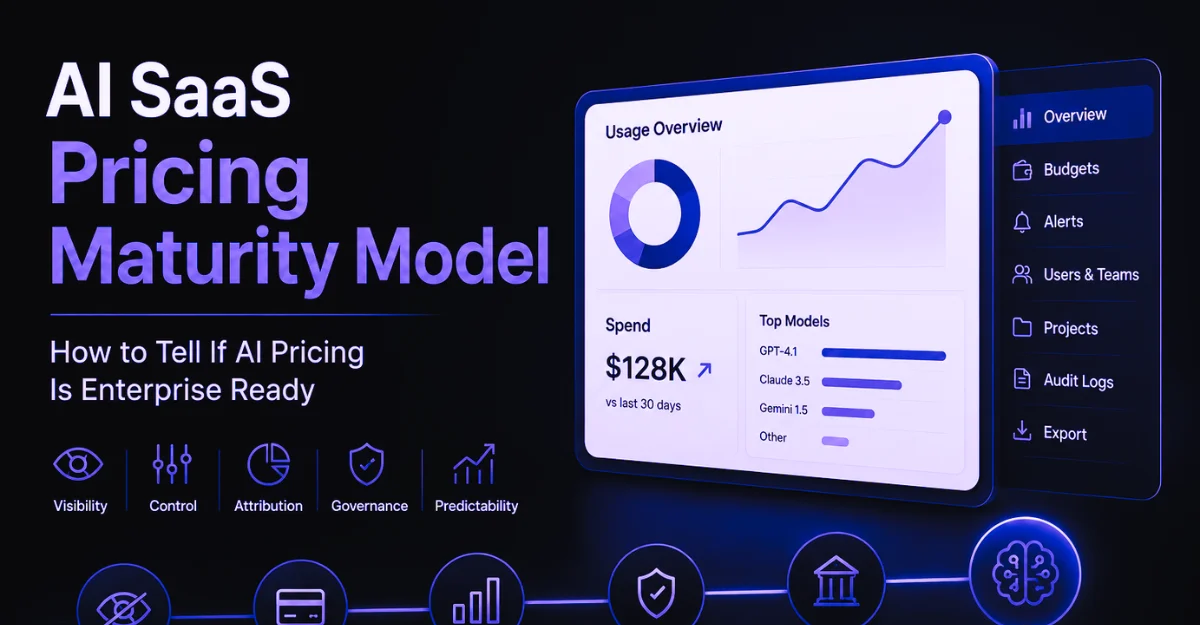
AI SaaS pricing is becoming a public test of enterprise readiness
The pricing page, admin console, and governance documentation now reveal whether an AI SaaS vendor understands usage, cost, control, and enterprise risk.
The fastest public signal is no longer only the demo
One of the fastest public ways to assess whether an AI SaaS product is ready for enterprise adoption is the pricing page, admin console, and governance documentation. If the product cannot clearly explain what drives usage, how spend becomes visible and controllable by admins, and how variable AI economics map to buyer value and risk, the vendor is publicly signaling that its AI product architecture and commercial operations remain immature.
This is not about benchmark performance
A strong model or demo does not prove the product is ready for governed enterprise adoption.
The maturity test is operational
Buyers need observability, cost attribution, admin controls, and spend governance before usage scales.
This is a statement about whether the company has built the observability, cost attribution, and control layers required to make AI usage understandable, governable, and economically safe at scale for both buyer and vendor.
What Is AI SaaS Pricing Maturity?
AI SaaS pricing maturity shows whether usage is understandable, controllable, and scalable
Mature AI pricing does not only charge for AI. It makes consumption, cost drivers, buyer value, admin oversight, and enterprise risk visible.
What AI SaaS pricing maturity means
AI SaaS pricing maturity is the degree to which a company’s pricing model, usage units, visibility tools, and admin controls make AI consumption, cost drivers, buyer value, administrative oversight, and enterprise risk visible and manageable.
Usage is clearly defined
Buyers can see what consumes usage: tokens, tasks, agent steps, workflow runs, retrieval calls, context windows, or model tiers.
Usage converts into cost
The pricing model explains how consumption becomes spend instead of hiding cost behind vague credits or bundles.
Admins can govern spend
Buyers can see, limit, approve, audit, and forecast usage before adoption scales across teams.
The vendor protects margin
The company can manage its own economics as automation depth, model usage, and customer adoption increase.
Immature pricing hides the operating model
Immature AI SaaS pricing hides these mechanics behind vague “AI included” bundles, undifferentiated credits, sales-only overage conversations, or the absence of admin-layer controls.
Buyer-side risk
Buyers cannot govern spend or attribute AI cost to business value when pricing and admin controls do not surface usage drivers.
Vendor-side risk
The vendor may lack the internal observability needed to protect gross margins as adoption, automation, and model usage scale.
What Are the Levels of AI SaaS Pricing Maturity?
The six observable stages of AI SaaS pricing maturity
Each stage reflects stronger alignment between technical economics, buyer-facing pricing units, and administrative control.
AI SaaS pricing maturity increases when vendors make usage easier to understand, cost easier to attribute, and spend easier to govern.
AI bundled, no visibility
“AI included” or unlimited claims with zero usage explanation, no model differentiation, and no admin console for AI consumption.
Buyer signal: experimentalCredit-based abstraction
Credits or points are used, but conversion logic to tokens, tasks, agents, models, or workflows is hidden or undocumented. Overage requires sales contact.
Buyer signal: commercially unclearUsage-aware pricing
Clear units such as tokens, tasks, or runs are defined and some consumption logic is published. Basic usage dashboards may exist, but governance remains weak or absent.
Buyer signal: partially matureGoverned usage pricing
Budgets, alerts, role-based controls, usage dashboards, and overage visibility are present. Seat or access fees may be separated from variable usage.
Buyer signal: procurement-readyEnterprise-ready AI pricing
Seat/access fee plus metered usage, published rates, model-tier cost attribution, org- and user-level spend controls, audit logs, Compliance APIs, or exportable records.
Buyer signal: enterprise-readyAdaptive AI commercial control
Pricing, governance, model routing, real-time cost attribution, forecasting, compliance workflows, and customer-success tooling operate as one integrated system.
Buyer signal: operating-model maturityMature pricing is not always more granular
A support automation product may correctly price per resolved conversation. A developer tool may correctly use seat plus included usage. The maturity test is whether the vendor can connect usage, cost, value, and control in a way the buyer can understand and govern.
Strategy starts before the obvious trend.
I help teams read market movement early, understand what is changing, and decide where to focus before the signal becomes crowded.
What Is the Difference Between Mature and Immature AI Pricing?
Mature AI SaaS pricing makes usage visible, governable, and procurement-ready
The difference between immature and mature AI pricing is not whether AI is monetized. The difference is whether buyers can understand, forecast, and control the economics behind usage.
Immature AI SaaS pricing
Mature AI SaaS pricing
What AI SaaS pricing maturity does not mean
Always using token-based pricing.
Always making pricing more complex.
Always copying OpenAI or Anthropic.
Always exposing every backend cost driver to the buyer.
Always replacing seats with usage.
Always publishing every enterprise term publicly.
How Should AI SaaS Pricing Maturity Differ by Product Type?
AI SaaS pricing maturity looks different by product category
Mature pricing does not use the same unit everywhere. The pricing signal should match how the product creates value, where usage expands, and what buyers need to govern.
AI coding tools
Seat pricing combined with AI credits or token mapping, plus user and organization-level budgets.
Developer usageAI support automation
Resolved conversation pricing supported by auditability and escalation visibility.
Outcome unitAI agent platforms
Task, run, or agent-step visibility with approval controls for autonomous execution.
Agentic usageAI writing and content tools
Seat pricing with credit limits, team usage dashboards, and feature-level visibility.
Team adoptionVertical AI SaaS
Business-object or workflow pricing paired with admin controls and buyer-facing governance.
Workflow valueAI infrastructure and APIs
Token or model-based pricing with rate limits, spend limits, and usage exports.
Compute layerEnterprise AI search
Seat pricing supported by adoption analytics, audit logs, and access controls.
Knowledge accessThe maturity signal depends on the product’s value unit
A mature pricing model should make the buyer’s main usage risk visible. For coding tools, that may be credits and user budgets. For agent platforms, it may be task-level or run-level control. For infrastructure, it is usually token, model, rate, and spend visibility.
How Has AI SaaS Pricing Changed Over Time?
AI SaaS pricing has moved from bundled access to governed usage
The pricing shift shows how AI SaaS has moved from simple feature packaging toward usage visibility, spend controls, and enterprise governance.
AI features were bundled into SaaS plans
AI was often positioned as a novelty feature, upsell, or product enhancement inside existing subscription plans.
Bundled AIToken pricing became the foundation norm
Model access made token-based API pricing the core economic unit for foundation-layer AI usage.
Token economicsCredits became the buyer-facing abstraction
AI SaaS products used credits to simplify buying while abstracting the underlying cost drivers.
Credit abstractionEnterprise plans began exposing governance controls
Admin controls, usage visibility, Compliance APIs, multi-level spend limits, and clearer access-plus-usage structures became more visible.
Governed usageBuyers evaluate operational maturity
AI capability remains important, but enterprise buyers increasingly evaluate cost governance, spend visibility, and operational readiness.
Enterprise readinessWhat Is the Difference Between Soft and Hard Spend Controls in AI SaaS?
Mature AI SaaS governance moves from visibility to enforcement
The important distinction is not whether a vendor shows usage. It is whether buyers can monitor, limit, approve, or prevent usage before spend becomes difficult to control.
Usage visibility
Shows what happened through a dashboard, report, or export.
Budget alert
Warns admins after a usage or spend threshold has been crossed.
Soft cap
Signals budget risk but does not necessarily stop additional usage.
Hard cap
Stops or restricts additional usage when a defined limit is reached.
Approval workflow
Requires explicit permission before additional usage or spend is allowed.
Policy control
Prevents specific models, tools, users, or workflows from being used at all.
Why Are AI Credits Risky in SaaS Pricing?
AI credits simplify buying until they hide the real usage risk
Credits can make AI SaaS easier to package, but they become a maturity risk when buyers cannot connect credits to cost, usage, control, and forecastability.
Why credits are attractive
Credits reduce pricing friction by giving buyers one simplified commercial unit instead of exposing every backend cost driver.
Where credits become a maturity trap
The abstraction breaks down when buyers cannot see what drains credits, how fast usage scales, or who is driving spend.
The pricing page is now part of the product
Which Public Sources Support This AI SaaS Pricing Benchmark?
Public AI SaaS pricing documentation shows uneven enterprise readiness
The benchmark separates source-backed public signals from broader market observations. The goal is to measure what a buyer can verify before a sales call, not what may exist in private enterprise contracts.
Dataset note
This is a public-documentation maturity benchmark, not a full product audit. A vendor may offer private enterprise controls that are not visible on public pages. IVVORA scores the public buyer signal because public documentation shapes early evaluation, procurement confidence, and competitive perception.
Scored provider maturity signals
Anthropic Claude Enterprise
Level 4Seat fee covers access only. Usage is metered and billed separately at standard API rates. Public signals include no included token allowance, org/user spend limits, audit logs, Compliance API, and Analytics API.
GitHub Copilot
Level 3–4Usage-based AI Credits tied to token consumption, with admin budgets at enterprise, organization, cost center, and individual user levels plus preview bill visibility.
OpenAI API Platform
Level 3Clear per-model token pricing and project-level usage visibility. Monthly budget settings function as soft spending thresholds and alerts, not hard enforcement caps.
OpenAI ChatGPT Enterprise
Level 3Custom pricing with enterprise-grade admin, security, compliance, and data controls. This is a distinct buyer surface from the API platform.
Jasper Enterprise
Level 2–3Credits-based model with per-user monthly credit limits and alerts, plus admin visibility into credit balance and usage breakdowns by feature and over time.
Perplexity Enterprise
Level 2–3Strong enterprise admin and security signals, including SSO + SCIM, user management, Insights dashboard, data retention options, and audit logs. Less public detail is visible on model-level cost attribution or hard enforcement.
How Can You Score AI SaaS Pricing Maturity?
Score your AI SaaS pricing maturity
Use this quick 12-point scorecard to estimate whether an AI SaaS pricing model is immature, partially mature, scaling-ready, or enterprise-ready.
How to use the scorecard
Score each dimension from 0 to 2. Use 0 when the capability is absent or hidden, 1 when it is partial or unclear, and 2 when it is clearly documented and usable by buyers or admins.
Does the pricing page define the exact AI usage unit?
Does it explain what consumes usage, such as model, context, agent steps, or workflow?
Does it separate seat/access fees from variable AI usage?
Does it show model-tier or capability cost differences?
Does it publish overage or credit conversion logic?
Does it provide a usage dashboard?
Does it allow org-level spend limits or budgets?
Does it allow user or team-level spend controls?
Does it provide audit logs or exportable usage records?
Does it support procurement or security review with documented controls?
Does it explain how automation depth or agentic usage affects spend?
Does the pricing page give real workflow cost examples?
Start by scoring each dimension. Low scores usually mean the pricing page hides usage, cost, or governance details.
What Questions Should Buyers Ask About AI SaaS Pricing?
Questions buyers should ask before approving AI SaaS spend
Enterprise buyers should test whether the vendor can explain usage, control spend, expose auditability, and help finance forecast cost before broad deployment.
The buyer test is simple
If a vendor cannot answer these questions from public documentation, pricing materials, or admin controls, the pricing model may not be mature enough for scaled enterprise adoption.
What exactly consumes usage?
Buyers need to know whether usage comes from tokens, tasks, runs, agents, workflows, retrieval, or context length.
Usage unitAre credits mapped to real cost drivers?
Credits or units should map to tokens, tasks, runs, agents, or workflows with clear conversion logic.
Credit logicCan admins see usage by source?
Admins should be able to view usage by user, team, model, project, workflow, or other relevant business layer.
VisibilityCan spend be capped or only monitored?
The vendor should clarify whether controls are hard caps, soft caps, alerts, or reporting-only mechanisms.
Spend controlWhat happens when usage exceeds the plan?
Buyers need to know whether usage stops, overages begin, alerts fire, approvals trigger, or sales intervention is required.
Overage behaviorAre audit logs and usage exports available?
Enterprise buyers need exportable records, audit logs, or compliance-ready usage data for review and governance.
AuditabilityIs model-level cost attribution visible?
Admins should know whether different models, tiers, or capabilities create different cost profiles.
Cost attributionDoes agent depth change spend?
The vendor should explain how automation, multi-step agents, workflow runs, or background execution affect cost.
Automation riskAre overage rates published and self-serve?
Overage logic should be visible, predictable, and governable without requiring every edge case to go through sales.
Overage clarityCan finance forecast monthly cost before rollout?
The pricing model should give finance enough visibility to estimate spend before adoption expands across teams.
ForecastabilityHow Can AI SaaS Vendors Tell If Their Pricing Is Immature?
Signs your AI SaaS pricing is not ready for enterprise scrutiny
An immature pricing and governance layer usually fails before the product does. The warning signs appear when finance, procurement, and admins ask for clarity the vendor cannot document.
You cannot explain what one credit consumes
The buyer cannot map included units to tokens, tasks, runs, agent steps, models, or workflows.
Unit clarityYou cannot show usage by source
The admin console does not expose usage by customer, team, user, workflow, project, or model.
Usage visibilityYou cannot tell finance what happens after limits
The vendor cannot clearly explain whether usage stops, overages begin, alerts trigger, or approval is required.
Overage logicYou mix human access with agent execution cost
Seat access and autonomous AI or agent execution costs are bundled without clear economic separation.
Cost separationYou cannot estimate margin under heavy usage
The internal model does not show how gross margin changes when automation depth or agentic usage scales.
Margin riskYou cannot give procurement a documented answer
Admin controls, auditability, and spend governance require manual explanation instead of source-backed documentation.
Procurement riskYour sales team explains common pricing edge cases manually
If every pricing question requires a custom explanation, the pricing model is not self-evident enough for scale.
Sales frictionYour internal cost model is clearer than your pricing page
If the company understands the economics internally but cannot expose them clearly to buyers, the public maturity signal remains weak.
Public signalWhat Are Common Problems With Immature AI SaaS Pricing?
Common AI SaaS pricing maturity failures
Immature AI pricing usually fails when usage grows, automation deepens, or procurement asks for controls the vendor cannot show publicly.
The product becomes more expensive as it becomes more useful
Value expansion also increases cost exposure when pricing does not explain how usage scales.
Value-cost tensionCredits hide cost until the buyer scales
The buyer does not see how fast credits drain until usage expands across teams or workflows.
Credit opacityAgents create usage admins cannot attribute
Multi-step execution creates cost across tasks, tools, models, and workflows without clear ownership.
Agent attributionFinance cannot forecast cost before rollout
The pricing page does not give finance enough information to estimate usage and spend before deployment.
Forecast riskSales explains pricing because the page cannot
Common pricing questions require manual explanation instead of clear documentation.
Sales frictionDiscounts hide margin risk
Commercial concessions can mask weak cost control until usage grows beyond early assumptions.
Margin exposureProcurement blocks expansion despite product interest
The product may be valuable, but unclear governance makes broader approval harder.
Procurement blockInternal controls are not visible publicly
The vendor may have controls, but buyers cannot verify them during early evaluation.
Public signal gapThe buyer-facing unit does not match the cost driver
The pricing unit looks simple but does not reflect the actual economics of model, workflow, or agent usage.
Unit mismatchThe vendor prices access but absorbs automation cost
Seat pricing can become risky when autonomous execution creates variable cost that is not governed.
Automation costWhen this maturity model does not fully apply
This framework applies most directly to B2B AI SaaS, vertical AI applications, agent platforms, and AI infrastructure products sold to organizations with procurement, finance, and compliance stakeholders.
Pure consumer AI apps may not need enterprise-grade pricing governance.
Very early startups may intentionally use simple pricing while learning usage behavior.
Highly vertical products may use outcome-based pricing instead of exposing backend AI units.
Public pricing pages do not always reveal custom enterprise terms or offline governance controls.
What Does AI SaaS Pricing Maturity Mean for Smaller Vendors?
Smaller AI SaaS vendors face asymmetric pricing pressure
Enterprise buyers are learning what mature AI governance looks like from frontier platforms. Smaller vendors that remain at Level 1–2 risk longer sales cycles, more procurement objections, and higher margin variance as adoption scales.
The pressure moves from buyer expectation to revenue impact
The gap does not begin as a pricing problem. It begins when buyers expect controls that the vendor cannot yet document, expose, or operationalize.
Frontier platforms reset the baseline
Spend controls, usage visibility, auditability, and admin governance become expected in enterprise review.
Level 1–2 pricing creates friction
Vague credits, unclear overage logic, and weak admin controls become visible during procurement.
Sales and margin risk increase
Longer sales cycles, more objections, lower expansion velocity, and margin variance become more likely.
Competitor enterprise plan documentation
Track pricing page changes, enterprise plan language, and admin console feature releases.
Usage metering and enforcement changes
Monitor how competitors define, attribute, limit, cap, or enforce AI usage.
Procurement language in RFPs and case studies
Watch for references to spend governance, auditability, budget controls, and usage visibility.
Hiring signals in billing and platform operations
Roles in billing, compliance, RevOps, and platform operations can signal internal pricing maturity work.
Upstream model provider pricing changes
Provider terms can affect pass-through economics, credit abstraction, overage rules, and margin exposure.
When Do AI SaaS Pricing Risks Start Affecting Growth?
AI SaaS pricing maturity gaps become more expensive over time
Pricing maturity starts as a procurement issue, then becomes a competitive issue, and eventually becomes a margin and expansion issue.
Procurement friction
Governance questions surface in active enterprise evaluations and slow approval.
Competitive displacement
Categories with one or two visible Level 3–4 players begin filtering weaker vendors earlier.
Margin and expansion pressure
Weak cost observability creates margin compression or stalls broader rollout.
Pricing unit definition
Clarify whether value is priced through seats, tokens, credits, tasks, runs, workflows, or outcomes.
Admin console roadmap
Prioritize visibility, spend controls, auditability, and usage attribution before procurement demands them.
Enterprise sales enablement
Equip sales teams with documented answers on usage, limits, overages, and governance.
Margin planning
Connect customer-facing units to internal cost attribution before usage scales.
Competitive monitoring
Track pricing pages, enterprise plan changes, spend controls, and admin feature releases.
Infrastructure dependency review
Monitor upstream model provider changes that affect cost pass-through, credits, and overage exposure.
What would your largest enterprise prospect still need to ask sales?
If the CFO and CISO reviewed your pricing page and admin documentation today, the unanswered question reveals where your pricing maturity gap is most visible.
The issue is not whether the AI feature works in a demo
The issue is whether the pricing page and admin layer prove the company understands its AI economics well enough for a CFO to approve scaled spend and a CISO to approve the governance posture.
How this AI SaaS pricing maturity benchmark was created
IVVORA reviewed public pricing pages, help centers, API documentation, product terms, changelogs, and enterprise plan descriptions. No private contract data, non-public enterprise terms, or paid analyst reports were used.
Common Questions About AI SaaS Pricing Maturity
Common questions about AI SaaS pricing maturity
These questions summarize how the maturity model should be used by buyers, vendors, and teams evaluating enterprise readiness.
What is the core claim?
What are the six levels of the IVVORA AI SaaS Pricing Maturity Model?
Why did specific providers appear in the benchmark?
How should AI SaaS companies use this?
What should buyers do before approving spend?
How companies can benchmark AI SaaS pricing maturity
IVVORA builds private AI SaaS Pricing Maturity assessments for product, RevOps, sales enablement, and strategy teams. Each assessment scores a vendor and its competitors across the 12-dimension maturity model, identifies gaps against Level 3–4 peers, and translates pricing/governance signals into packaging, roadmap, and buyer-objection decisions.
Vendor and competitor scoring across the 12-dimension maturity model.
Gap analysis against Level 3–4 peers in the same category.
Packaging, governance, and admin-console roadmap implications.
Buyer-objection mapping for procurement, finance, and security review.
Need a private benchmark before procurement asks the hard questions?
I build tailored maturity scorecards, competitor governance comparisons, and packaging roadmap recommendations for AI SaaS, vertical AI, and agent platform companies that need decision-ready market intelligence.
AI SaaS pricing maturity is now a visible enterprise adoption filter
AI SaaS pricing maturity is now a visible, scorable, and increasingly non-negotiable filter for enterprise adoption. The vendors that read this signal early will redesign pricing and governance from a position of control. The vendors that wait will redesign it under procurement pressure, margin pressure, or competitive loss. The signal is already public in the documentation of the companies furthest along. The only remaining variable is how quickly other vendors choose to act on it.