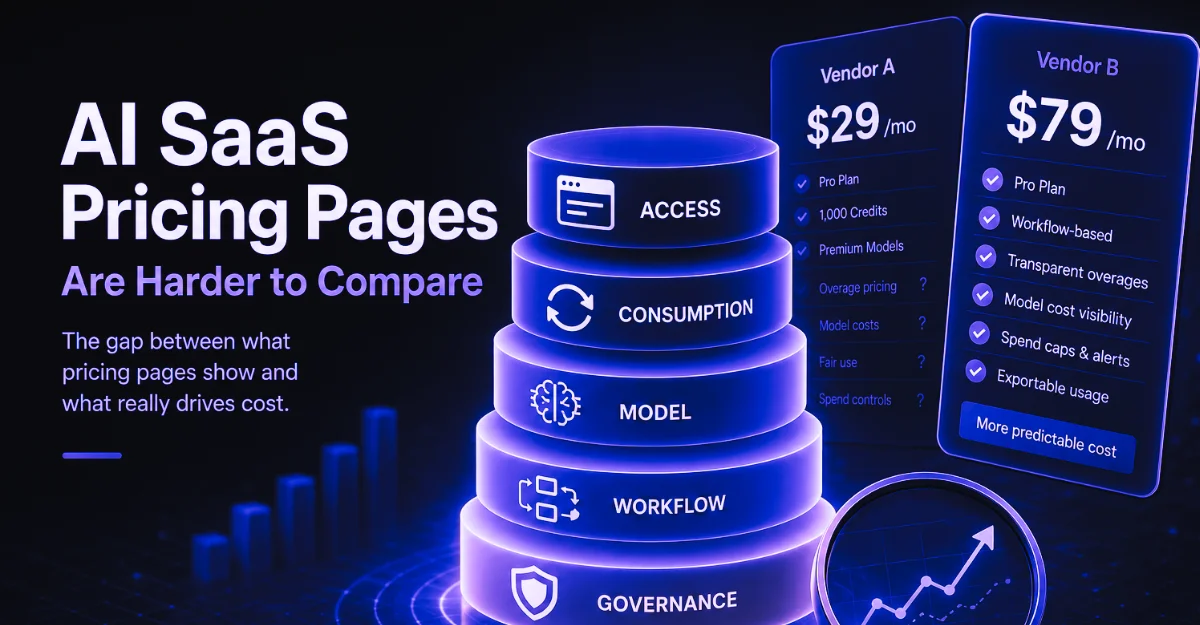
AI SaaS pricing pages are harder to compare because vendors no longer price only software access. They combine subscription plans with variable consumption units such as tokens, credits, messages, workflow runs, agent steps, model tiers, overages, and governance controls.
Two tools with similar monthly prices or plan names can create materially different total costs once real usage begins. The better comparison method is cost per completed outcome under realistic workload assumptions, not headline monthly price or credit count.
Buyers see plan names and credits. Actual cost depends on usage behavior, model choice, workflow volume, and governance limits.
The real question is how much each completed workflow costs under realistic usage.
Why Are AI SaaS Pricing Pages Hard to Compare?
The central problem in AI SaaS pricing is not price visibility. It is unit translation. Buyers see seats, credits, and plan names, but actual cost is shaped by tokens, model choice, context length, agent steps, workflow frequency, and governance limits.
A $30/user plan usually means access to a bounded product tier with predictable marginal cost.
A $30/user plan may sit above token metering, credit burn, model routing, workflow runs, overages, throttling, and admin controls.
The question is no longer only “How does this vendor charge?”
The stronger question is whether a buyer can translate the pricing page into a reliable estimate of cost per real workflow before adoption and scaling.
Pricing comparability gap
The distance between what the pricing page shows and what actually determines cost and risk after usage begins.
Pricing unit translation risk
The risk that credits, messages, tasks, or agent runs do not map cleanly across vendors or even within the same product.
Cost-per-outcome comparison
The better evaluation method for AI SaaS because it compares real workflow cost instead of headline plan price or credit count.
Traditional SaaS Pricing vs AI SaaS Pricing: What Changed?
Traditional SaaS priced access. AI SaaS prices usage exposure.
The comparison problem starts because the old pricing page format was built for a different cost structure.
- Main pricing proxySeat/user or feature tier
- Marginal costLow / near-zero
- Buyer comparison methodPlan vs plan
- Vendor riskUnderpricing access
- Hidden driverFeature limits
- Scaling behaviorMore users = more revenue
- Governance needLicense management
- Procurement focusFeature checklist + seat count
- Main pricing proxySeat + usage + model + workflow + governance
- Marginal costVariable and material
- Buyer comparison methodUsage-adjusted cost per outcome
- Vendor riskUnderpricing compute/inference
- Hidden driverTokens, credits, context, agent steps, model routing
- Scaling behaviorMore usage can increase both revenue and cost
- Governance needSpend caps, logs, throttles, model controls, audit rights
- Procurement focusForecastable cost per workflow + exposure mapping
Strategy starts before the obvious trend.
I help teams read market movement early, understand what is changing, and decide where to focus before the signal becomes crowded.
What Is the AI SaaS Pricing Comparability Gap?
The visible plan is only the top layer of AI SaaS pricing
The AI SaaS Pricing Comparability Gap is the distance between what a pricing page shows and what actually determines customer cost after usage begins.
Seats, plans, feature gates, base subscription.
Tokens, credits, messages, generations, workflow runs.
Model tier selection, routing logic, context window, quality settings.
Agent steps, tool calls, automations, retries, multi-turn reasoning, orchestration overhead.
Caps, alerts, throttling, audit logs, overage rules, admin controls, fair-use enforcement, exportable usage data.
What Are the Main AI SaaS Pricing Models and Units?
AI SaaS vendors are pricing different units, not just different plans
Vendors now price seats, tokens, credits, messages, workflow runs, agent steps, and runtime. The problem is not that these units exist. The problem is that pricing pages often combine several without translating them into comparable cost per outcome.
Human access
Input, output, and cached model metering
Abstraction over tokens or compute
User-facing interaction count
Output-based unit
Completed automation execution
Each tool call, reasoning turn, or action inside an agent loop
Outcome-based unit, still rare
Runtime-based metering
Most AI SaaS pricing pages are hybrids
The hybrid structure itself increases comparison difficulty because two vendors may use the same plan name while pricing completely different economic behavior.
OpenAI API-style direct per-token pricing.
Cursor, v0, and parts of GitHub Copilot.
Common in AI productivity and writing tools.
Zapier-style completed automation actions.
Retool-style runtime for autonomous workers.
Emerging model, still rare in public pricing.
Negotiated large-buyer agreements that combine access, usage, governance, and commercial protections.
Why Is It Hard to Compare AI SaaS Plans Side by Side?
AI SaaS plans look comparable until the usage unit changes
Similar prices, plan names, or feature tables can hide different cost mechanics. The comparison breaks when the visible unit does not match the unit that actually drives spend.
Seat-based budgets fail under agentic adoption.
$20 credits on one tool may not equal $20 credits on another.
Apparent limits understate real consumption.
Linear plan limits meet nonlinear usage.
Headline unlimited does not equal predictable cost.
Side-by-side evaluation becomes difficult.
Similar plan names can hide different economic products
The Pricing Page Illusion is the belief that two AI SaaS products are comparable because their pricing pages use similar plan names, monthly prices, or feature tables.
Credits + premium model burn
Workflow allowance + usage caps
Ten questions every AI SaaS pricing page should answer
The more questions a pricing page leaves unanswered, the larger the Comparability Gap.
How Do OpenAI, Cursor, GitHub Copilot, v0, Retool, and Zapier Price AI Usage?
AI SaaS vendors are pricing different economic units
The market has not converged on one pricing model. Tokens, credits, tasks, agent hours, and workflow runs expose buyers to different comparability risks.
Buyer sees $/1M input, output, and cached tokens. Actual cost depends on token volume and model choice.
Buyer sees monthly credit allowance. Actual cost depends on token use converted to credits by model.
Buyer sees monthly plan plus credit pool. Actual cost depends on model-specific input, output, and cached token usage.
Buyer sees plan tiers with credit pools. Actual cost depends on premium model burn rate and agent usage.
Buyer sees high base price plus credit pool. Actual cost depends on credit use in agentic and Computer workflows.
Buyer sees plan runs and included agent hours. Actual cost depends on runtime and agent work separate from token pools.
Buyer sees task allowance. Actual cost depends on completed automation volume, including AI steps.
OpenAI exposes token pricing directly. v0 converts model usage into credits. GitHub Copilot combines seats with AI Credits. Cursor’s burn rate changes by model and agent use. Retool separates agent runtime from standard workflow usage. These are structural pricing differences, not cosmetic packaging choices.
How Should Buyers Compare AI SaaS Pricing by Real Usage Cost?
The cheaper AI SaaS plan is not always the cheaper workflow
AI SaaS pricing should be compared by completed outcomes, not by the monthly plan price shown on the pricing page.
$30/month
- 1,000 credits included
- 10 credits per agent step
- 8 steps per workflow
- 100 workflows = 8,000 credits
$80/month
- Higher base price
- Workflow-oriented allowance
- Transparent overage pricing
- Hard caps available
Estimate your AI SaaS cost per completed workflow
Use this to convert a pricing page into a workflow-level cost estimate before adoption or renewal.
This is the unit buyers should compare across vendors.
How hard is this pricing page to forecast?
Add the risk points that apply. The higher the score, the harder it is to estimate future cost before deployment.
Highly transparent
Why this pricing problem became more visible in 2025–2026
AI moved from chat feature to workflow layer, and pricing units began shifting from simple access to variable consumption.
Fixed message counts became less aligned with model-dependent usage.
Credits and multipliers became common as premium model use increased.
Seat pricing began combining more directly with token-based consumption.
Agent runtime became a separate pricing unit alongside workflow usage.
How Does AI SaaS Pricing Affect Buyers, Budgets, and Margins?
AI SaaS pricing opacity shifts risk from vendors to buyers
Pricing opacity gives vendors more flexibility in the short term, but it makes buyer forecasting, procurement, margin planning, and product decisions harder.
Vendors gain pricing flexibility
- More room to manage infrastructure cost
- Less direct head-to-head comparison
- More control over model routing changes
- More enterprise negotiation leverage
- Some usage risk shifts to the buyer
Buyers absorb forecasting uncertainty
- Small teams buying public plans
- Power users and agencies with variable volume
- Embedded AI product teams with COGS exposure
- Finance teams managing bill shock
- Sales teams facing TCO objections
Questions buyers should ask before choosing an AI SaaS vendor
Large enterprises can negotiate caps, audit rights, and discounts. Smaller companies often discover usage behavior only after production adoption.
Finance teams need to model base subscription, variable consumption, worst-case usage, model-tier sensitivity, overage liability, and gross-margin impact.
For vertical SaaS vendors, token pricing, credit mapping, or model-routing changes can affect margin, customer pricing power, and renewal economics.
Sales teams struggle to explain usage economics, while competitors with clearer pricing can appear safer to buyers.
Agentic features, long context, premium model defaults, and background automation can increase invisible usage and make governance a product differentiator.
Model routing and agent loops break seat-based pricing
The same workflow can produce different cost outcomes depending on the selected model, fallback model, context window, output length, tool calls, retry behavior, routing policy, and latency or quality setting.
Buyers should ask whether failed runs, retries, and partial agent runs still consume units.
Verify expiration, rollover, pooling, transferability, refunds, and whether purchased credits differ from included credits.
Ask which model is used by default and whether admins can restrict upgrades to premium models.
Frontier model access matters only if buyers know whether it is included, limited, throttled, or charged separately.
Where AI SaaS pricing risk is highest
Long sessions, agent loops, premium model usage.
Variable ticket volume and outcome pressure.
Context length and retrieval depth.
Generation cost, retries, output quality variance.
Background runs and task multiplication.
More predictable usage volume.
Output volume varies, but usage is less agentic.
Direct COGS exposure in customer-facing products.
Which pricing unit fits which AI SaaS use case?
The best pricing unit depends on whether usage is predictable, workflow-based, autonomous, creative, or embedded into product COGS.
Stable volume, lower governance burden.
Direct mapping to actual consumption.
Aligns with completed business outcomes.
Captures recursive and variable effort.
Ties cost to business value delivered.
Output volume and quality vary.
Direct margin impact requires more predictable unit economics.
What Should Buyers Check Before Choosing an AI SaaS Vendor?
What buyers should check before trusting an AI SaaS pricing page
The strongest pricing page is not the simplest one. It is the one that lets buyers model future cost before usage scales.
Pricing looks simple, but cost behavior is unclear
- Credits without conversion logic
- “Unlimited” with vague fair-use rules
- Premium models without cost context
- Agent features not separately explained
- Overage requires contacting sales
- No admin caps on lower tiers
- No exportable usage logs
- Hidden model routing
- Terms allow pricing-unit changes without notice
Pricing makes future usage easier to model
- Clear unit definition
- Backend mapping explained
- Published overage rates
- Model-specific consumption tables
- Usage simulator or forecasting tool
- Hard spend caps available early
- Workspace-level budgets and alerts
- Exportable logs by default
- Published workflow cost examples
It should include clear unit definition, model-specific usage visibility, predictable overage rules, hard caps, alerts, exportable logs, calculators, workspace controls, transparent fair-use policy, and stable pricing-change notice.
What to monitor and what to ignore
AI pricing risk does not appear only on the pricing page. It shows up across documentation, product updates, terms, customer signals, and vendor hiring patterns.
Monitor
Credits, overages, fair-use language, unit changes.
Token rates, model-specific changes, caching economics.
Agent or workflow features that multiply calls.
Throttling, limits, refunds, caps.
Fair-use enforcement, abuse language, change rights.
Bill shock, credit burn, confusion patterns.
AI cost optimization, usage analytics, platform economics roles.
Margin pressure and infrastructure cost language.
Ignore in isolation
Five questions leaders should ask before adopting an AI SaaS vendor
Are we buying access, consumption, outcomes, or risk transfer?
Which usage behavior makes this vendor expensive?
Can we forecast cost before adoption with realistic workload assumptions?
Can we cap or route usage before it damages margin or customer experience?
Does this pricing model become better or worse as usage scales and agentic features expand?
What this analysis reviews
This article reviews public pricing pages, API documentation, billing documentation, release notes, support pages, terms, and public customer or community reactions for AI infrastructure, devtool, agent, automation, and productivity software vendors.
The analysis focuses on pricing-unit structure, translation mechanics, and comparability risk rather than exact cost ranking because public pricing changes frequently.
What public pricing pages cannot show
Public pricing may not reflect negotiated enterprise contracts, private discounts, committed-use agreements, or internal model-routing decisions.
The article evaluates public comparability and structural risk, not private enterprise TCO or negotiated outcomes.
Key terms in AI SaaS pricing comparison
Basic unit of language model input, output, or cached processing.
Discounted token pricing for previously processed context.
Abstraction layer that maps to tokens, compute, or actions.
Each tool call, reasoning turn, or action inside an agent loop.
Completed execution of an automation or multi-step process.
Logic that directs tasks to different models based on cost or capability.
Maximum tokens a model can process in one interaction.
Charges incurred after included usage is exhausted.
Policy limiting “unlimited” plans to prevent abuse.
Speed or capability reduction under high usage.
Total cost divided by successful completed business outcomes.
Third-party AI spend embedded into product cost of goods sold.
Caps, alerts, logs, and admin controls over consumption.
Degree to which a pricing page prevents cost forecasting.
Common questions about AI SaaS pricing comparison
Why are AI SaaS pricing pages harder to compare?
Because they compress seats, tokens, credits, model tiers, workflow volume, agent steps, overages, and governance into one buyer-facing interface.
What is the AI SaaS Pricing Comparability Gap?
The measurable distance between what a pricing page shows and what actually determines cost and risk after real usage begins.
What is the difference between tokens and credits?
Tokens are direct language-model consumption units. Credits are an abstraction layer whose real value depends on how the vendor maps them to tokens, model tiers, or actions.
Why do AI credits make comparison harder?
Because credit value is rarely standardized across vendors and can vary inside the same vendor depending on model choice and prompt complexity.
Is usage-based AI pricing bad?
No. The issue is opacity and poor unit translation that prevent buyers from forecasting cost per outcome before adoption.
What is cost-per-outcome in AI SaaS?
Total cost divided by the number of successful completed workflows or business outcomes under realistic usage.
What does “unlimited” mean in AI SaaS?
It usually means subject to fair-use limits, throttling, model downgrades, daily caps, or workspace controls.
Why do AI agents increase SaaS costs?
Because one visible user action can trigger multiple backend model calls, tool uses, retrievals, reasoning steps, and retries.
How does model choice affect AI SaaS pricing?
Frontier models can consume several times more units per step than lightweight models, making routing policy and default model selection direct cost variables.
How should startups evaluate AI vendor pricing?
They should model realistic workflow volume, test credit or token burn on representative tasks, verify governance controls, and calculate cost per completed outcome.
What makes an AI pricing page transparent?
Clear unit definition, backend mapping, model-specific visibility, published overage rates, hard caps, exportable logs, and usage simulation tools.
How does AI SaaS pricing affect gross margins?
When AI is embedded in customer-facing products, third-party consumption becomes product COGS and can compress margin if pricing units or model routing change.
The pricing page is no longer the source of truth
AI SaaS pricing pages are harder to compare because the visible plan does not show the full economic system behind the product. Traditional SaaS pricing was built around access. AI SaaS pricing adds variable consumption: tokens, credits, model tiers, workflow runs, agent steps, overages, and governance controls.
Buyers should evaluate AI SaaS by cost per completed outcome, pricing-unit transparency, overage rules, model-routing visibility, and usage governance rather than headline monthly price or credit count.