What Are AI SaaS Pricing Models?
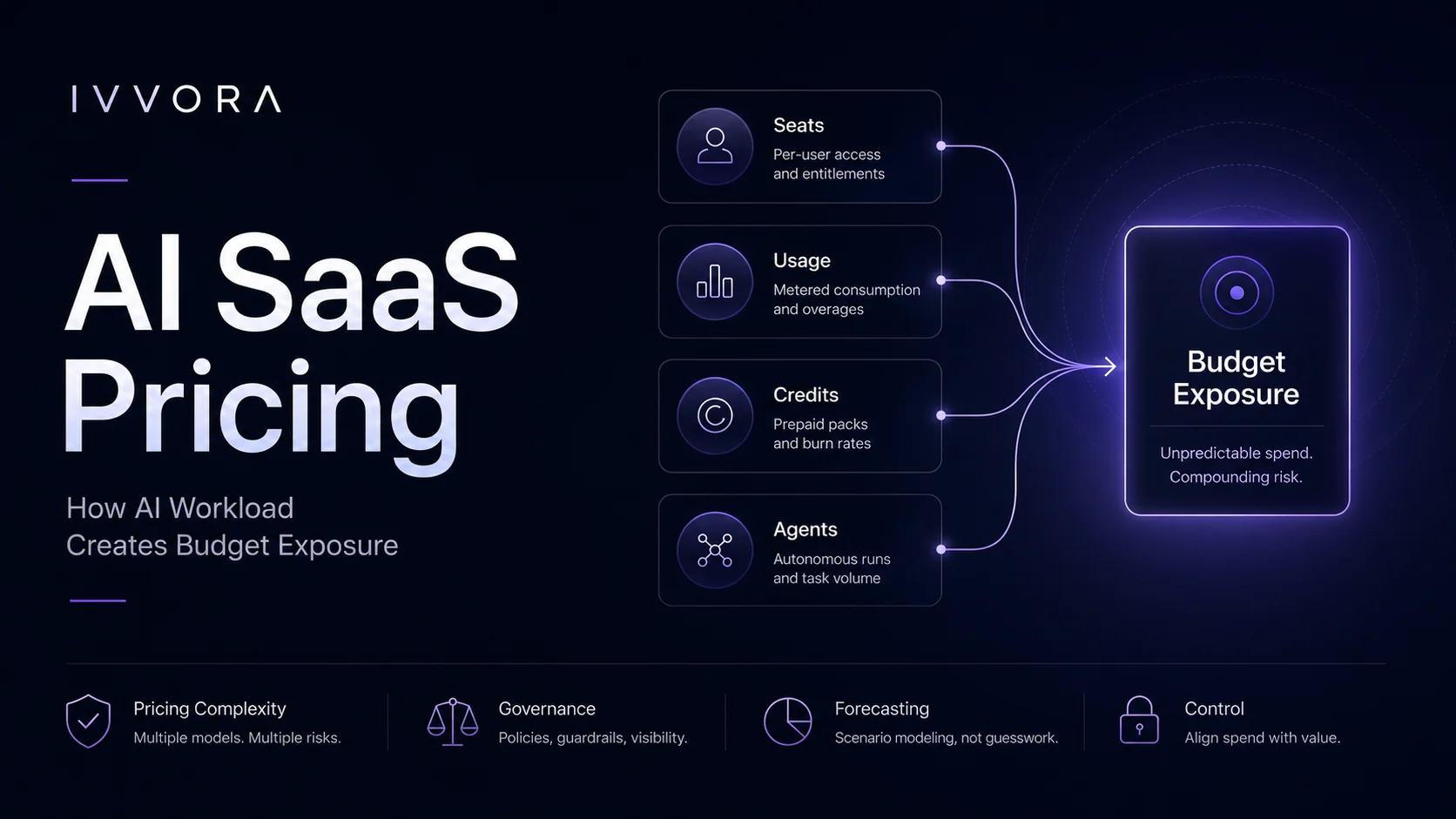
AI SaaS pricing is the way software companies charge for AI-enabled products. The main pricing models are seat-based pricing, usage-based pricing, credit-based pricing, hybrid pricing, agent pricing, and outcome-based pricing.
Access pricing
Traditional SaaS pricing mostly charged for who could use the software.
Workload pricing
AI SaaS pricing increasingly charges for what the software processes, generates, automates, or resolves.
Seat-based pricing
Charges by user access, licensed users, or named users.
Usage-based pricing
Charges by activity such as tokens, API calls, conversations, or workflow runs.
Credit-based pricing
Converts different AI actions into a vendor-defined credit allowance.
Hybrid pricing
Combines fixed access fees with variable consumption charges.
Agent pricing
Charges for autonomous or semi-autonomous AI actions, runs, or escalations.
Outcome pricing
Charges for completed business results such as resolved tickets or qualified leads.
Which AI SaaS pricing model is right?
The right model depends on whether the product creates value through employee access, measurable usage, flexible AI actions, autonomous workflows, or completed business results.
AI pricing is no longer just a plan comparison.
Most SaaS pricing guides compare plans. AI SaaS pricing needs a different lens because the pricing model decides how infrastructure cost, workload growth, model selection, agent autonomy, credit exhaustion, and budget accountability move between vendor and buyer.
Cheap can still be wrong.
A company can choose the cheapest AI SaaS plan and still make the wrong decision if the pricing model gives the business no control over usage growth.
Important AI SaaS pricing terms
These terms matter because AI SaaS vendors often sell a visible feature while pricing the hidden workload behind that feature.
Why Is AI SaaS Pricing Different From Traditional SaaS Pricing?
Traditional SaaS made access the commercial unit. AI SaaS makes activity the economic unit. The shift matters because every prompt, generation, retrieval event, agent step, or automated workflow can create marginal infrastructure cost.
Access decides price
The commercial question was how many employees needed access to the software.
User seatsWorkload decides cost
The commercial question becomes how much AI activity the business consumes.
AI workloadAI usage is now visible in margin structure.
How many users need the tool?
Seat count was the main planning unit.
How much AI workload will the business consume?
Usage volume, model selection, agents, and overages become the real exposure.
How is traditional SaaS pricing different from AI SaaS pricing?
Traditional SaaS pricing mostly managed access risk. AI SaaS pricing must manage access risk, consumption risk, model risk, credit risk, agent risk, and renewal risk.
Vendors are moving from adoption subsidy to workload discipline.
Early AI SaaS packaging bundled AI features into familiar plans to accelerate experimentation. As usage grows, the harder question becomes how much variable AI cost vendors can absorb before usage pressures margins.
Higher-capability models create higher processing cost.
Larger prompts, files, and histories increase workload.
Agents create repeated calls, retries, and tool actions.
Image, audio, voice, and video follow different cost curves.
What drives the cost of AI SaaS products?
AI SaaS pricing contains three cost layers. These layers explain why seat pricing, usage pricing, credits, hybrid pricing, and agent pricing now coexist.
Access economy
Measures who can use the software.
Determines seat count and adoption scope.Workload economy
Measures how much AI activity happens.
Determines variable cost and margin pressure.Autonomy economy
Measures how much work AI performs without human prompting.
Determines agent risk and runaway usage exposure.Why does one AI feature create multiple hidden costs?
The user sees a feature. The vendor sees a chain of cost events. A button labeled “summarize this contract” may involve file upload, parsing, retrieval, input tokens, cached context, model selection, output tokens, citation generation, audit logging, follow-up questions, and workflow actions.
The pricing risk is that buyers compare visible features while vendors price invisible workload.
What can happen behind one “summarize contract” feature?
May count toward storage or processing limits.
May be included or metered.
May create indexing cost.
Larger contracts increase input volume.
May cost less than fresh input.
Premium models may cost more.
Longer outputs increase cost.
Source-grounded output may cost more.
May be enterprise-tier functionality.
Extends the original workflow.
May count as an automation event.
Looking for research-led strategic thinking?
I work with teams that need sharper judgment around markets, competitors, buyer behavior, growth opportunities, and strategic risk.
How Do Seat-Based, Usage-Based, Credit-Based, and Hybrid AI SaaS Pricing Work?
What Are the Four Main AI SaaS Pricing Models?
The four core AI SaaS pricing models are seat pricing, usage pricing, credit pricing, and hybrid pricing. Each model measures a different economic unit and shifts risk differently between the vendor and the buyer.
Seat pricing
Charges by licensed users.
Usage pricing
Charges by measured activity.
Credit pricing
Uses a vendor-defined allowance.
Hybrid pricing
Combines access and consumption.
Seat pricing measures access. Usage pricing measures activity. Credit pricing converts multiple AI actions into one allowance. Hybrid pricing combines fixed subscription access with variable consumption.
What Is Seat-Based AI SaaS Pricing?
Seat pricing charges by user, usually monthly or annually. It remains useful when AI is a broad productivity layer and usage intensity is moderate.
Microsoft 365 Copilot is listed at $30 per user per month, paid yearly, with a qualifying Microsoft 365 plan required.
Budget clarity
Finance can forecast cost by headcount. Procurement can compare license counts. IT can assign access.
Workload mismatch
One user may ask five questions per week, while another runs document analysis, slide generation, meeting summaries, and agent workflows every day.
Seat pricing is simple, familiar, and procurement-friendly.
It works when AI usage is moderate, user count maps to value, and the buyer wants budget predictability.
Seat pricing solves access, not workload governance.
It does not automatically control consumption, model choice, agent autonomy, or overage exposure.
What Is Usage-Based AI SaaS Pricing?
Usage pricing charges for activity. The measured unit may be tokens, API calls, conversations, generations, minutes, workflow runs, image outputs, video outputs, or agent actions.
Usage pricing aligns revenue with cost.
OpenAI’s API pricing shows direct workload pricing across models, context lengths, input tokens, cached input tokens, output tokens, audio, text, image, and realtime translation.
Usage pricing transfers volatility to the buyer.
If usage is tied to customer interactions, employee behavior, agent loops, or creative bursts, the bill can change faster than the budget cycle.
Usage pricing is economically accurate, but it does not replace every AI SaaS model because enterprises need predictability, caps, accountability, and vendor comparability.
What Is Credit-Based AI SaaS Pricing?
Credit pricing turns different AI actions into one vendor-defined allowance. It simplifies packaging while making vendor comparison harder.
GitHub Copilot reporting described one AI credit as $0.01, with heavier usage and advanced models increasing cost exposure for power users.
Adobe Firefly uses monthly generative credits, and premium features such as video generation can consume those credits.
Why Are AI Credits Hard to Understand?
Can AI credits lose value over time?
A vendor may keep the subscription price stable while changing how many credits are included, how many credits each action consumes, which actions become premium, whether credits expire, and whether rollover is allowed.
A vendor-defined credit is not a universal unit of value. It is a private exchange rate.
What Is Hybrid AI SaaS Pricing?
Hybrid pricing combines a fixed subscription with variable consumption. It is spreading because vendors want recurring revenue and margin protection while buyers want predictable entry cost and controlled expansion.
Baseline revenue and margin protection
Hybrid pricing gives the vendor recurring revenue, expansion upside, and a way to segment heavy users.
Predictable entry cost and usage control
Hybrid pricing gives the buyer adoption flexibility, spend caps, usage visibility, and negotiation control.
Hybrid pricing expands when AI work becomes measurable.
Hybrid pricing gives the buyer a fixed starting point and gives the vendor a path to monetize workload growth. The buyer risk is contract complexity.
How Do Agent Pricing and Outcome-Based AI Pricing Work?
Agent pricing charges for AI work performed by autonomous or semi-autonomous agents. Outcome pricing charges for completed business results. Both models matter because AI can now create cost through delegated work, not only through direct user activity.
What is AI agent pricing?
Agent pricing deserves separate treatment because agents can generate cost through autonomous action. A human user creates cost when they click, ask, search, or generate. An AI agent can create cost through repeated runs, background tasks, tool calls, escalations, retries, and multi-step workflows.
The pricing risk is no longer only how often humans use AI. It is how much work AI performs after humans delegate authority.
Measures activity
Usage pricing measures what a user or system consumes: tokens, API calls, generations, conversations, or workflow runs.
Measures delegated work
Agent pricing measures activity that can be initiated, repeated, and escalated by software after a human delegates authority.
Agent pricing moves from access to actions.
Salesforce’s Agentforce Flex Credits show the shift toward action-level pricing, where autonomous work can be measured and billed by action.
How does AI agent autonomy affect pricing risk?
Agent autonomy changes pricing because cost can grow after the original human request. The more autonomy the agent has, the more the buyer needs run limits, escalation thresholds, audit logs, retry controls, and approval gates.
AI responds to user prompts.
AI performs steps with user approval.
AI takes actions within rules.
AI executes workflows across systems.
AI is paid based on business result.
What is outcome-based AI pricing?
Outcome pricing charges for completed business results instead of user access or raw usage. Examples include resolved support cases, qualified leads, generated reports, completed workflows, automated claims, and verified research outputs.
Intercom Fin AI Agent is billed per resolution, showing how support AI can be priced around completed outcomes instead of only seats.
Why is outcome-based AI pricing difficult to manage?
Outcome pricing sounds clean because it connects cost to value. The contract becomes harder when completion, attribution, quality, compliance, and liability are not clearly defined.
Outcome pricing is easiest when the outcome is narrow, measurable, and auditable. It is hardest when the work is judgment-heavy, collaborative, regulated, or dependent on human approval.
How do AI agent and workload pricing models differ by product category?
Resolution and conversation pricing
Customer service is where AI pricing shifts fastest because volume is measurable. The key buyer question is whether pricing follows contact volume, agent activity, or verified resolution.
Model and credit exposure
Developer tools expose model risk quickly because developers can generate frequent, long-context, premium-model interactions.
Campaign burst usage
Creative AI often uses credits because text, image, video, upscaling, voice, and design variation can consume different amounts of capacity.
Depth-based workload
AI research tools create variable cost through search depth, retrieval, crawling, synthesis, citation generation, and report creation.
One user action can trigger many system actions
A single request may read a record, classify it, update CRM, send an email, create a task, notify a manager, log an audit trail, and trigger another automation. If pricing is tied to actions or runs, workflow design becomes cost design.
What Drives the Real Cost of AI SaaS?
How Do You Calculate the Real Cost of AI SaaS?
AI SaaS cost is no longer only users multiplied by monthly price. A tool can look affordable at the seat level and become expensive at the workload level.
Users × Monthly Price
Works when software cost mostly follows access.
Seats + Usage + Credits + Models + Agents + Overages
Works when cost follows workload, premium models, agent runs, and renewal expansion.
Total AI SaaS Cost = Seats + Usage + Credits Burned + Premium Model Usage + Agent Runs + Overage Charges + Renewal Expansion
What Hidden Costs Affect AI SaaS Pricing?
Most buyers do not see these drivers in the demo. They discover them in the invoice.
Why Does AI Model Choice Affect SaaS Pricing?
Model selection is now a financial control. A company should define the default model, premium model access, approval rules, agent model selection, long-context permissions, usage logging, and renewal review.
In AI SaaS, model choice is no longer only a quality decision. It is a budget decision.
How Do Prompt Length and Context Affect AI SaaS Cost?
Long documents, large knowledge bases, multi-file uploads, long conversation histories, and retrieval-heavy prompts can increase cost exposure.
Context management becomes part of pricing governance when the platform bills for size, credits, or workload intensity.
How Do Text, Image, Audio, and Video Affect AI SaaS Pricing?
Text, image, audio, video, code, and realtime interaction do not carry the same cost structure. A plan that works for text summarization may fail for video generation, realtime voice agents, transcription, translation, or multimodal analysis.
The buyer should not assume that “AI usage” is one category. Each modality has its own cost profile.
What Is the Difference Between Embedded AI and Standalone AI Pricing?
Included inside existing SaaS
Risk: hidden usage limits.
Sold as a premium module
Risk: seat expansion cost.
Direct subscription or credits
Risk: user-level budget control.
Token or usage-based
Risk: high variability.
Action, run, or outcome pricing
Risk: autonomous expansion. Agent platforms can feel outcome-oriented but require stronger governance.
Direct cost unit
API pricing usually exposes tokens, requests, images, audio minutes, or model calls.
Packaged cost unit
SaaS pricing often hides the cost unit inside seats, credits, tiers, fair-use rules, or add-ons.
How Do AI SaaS Vendors Package Pricing?
Simplicity is useful when it supports adoption. Simplicity becomes dangerous when it hides the cost drivers that determine renewal exposure.
What Is the Difference Between AI Access and AI Usage?
Entitlement tells the buyer who can use the tool. Consumption tells the buyer what the tool actually costs.
Shelfware risk
Power-user overage risk
Strategic adoption with cost exposure
Underdeveloped AI adoption
How Does AI SaaS Pricing Change User Behavior?
Pricing does not only recover cost. It changes how people use AI.
If the pricing model punishes experimentation too early, users hold back. If it hides cost too long, finance loses control.
What Risks Should Buyers Check Before Choosing an AI SaaS Pricing Model?
Traditional SaaS pricing mainly managed access risk. AI SaaS pricing must manage the full stack: access, adoption, consumption, model selection, context size, output volume, modality, retrieval, agents, workflows, credits, overages, renewal data, and governance ownership.
AI SaaS pricing risk expands beyond seats.
Each layer creates a different pricing exposure and requires a different control mechanism.
Exposure: seat count and license cost.
Control: role-based access, seat hygiene.Exposure: shelfware or underuse.
Control: adoption tracking.Exposure: usage charges and overages.
Control: usage caps.Exposure: premium model cost.
Control: model-tier controls.Exposure: long-context cost.
Control: file limits, prompt controls.Exposure: output token or media cost.
Control: output limits.Exposure: different cost curves.
Control: feature-specific limits.Exposure: retrieval, embedding, indexing cost.
Control: data-source controls.Exposure: autonomous cost expansion.
Control: agent-run limits.Exposure: process-level spend.
Control: approval gates.Exposure: vendor comparison difficulty.
Control: conversion-table disclosure.Exposure: budget surprise.
Control: approval-based overages.Exposure: negotiation asymmetry.
Control: exportable usage data.Exposure: accountability failure.
Control: finance, IT, procurement policy.What Can Go Wrong With AI SaaS Pricing?
These failure modes explain why pricing cannot be reviewed as a purchasing detail. The model determines where operational risk lands.
A small number of heavy users consume far more AI than expected.
Adoption grows faster than budget planning.
Buyers cannot understand what credits actually buy.
Users select expensive models without approval.
Agents repeat actions, retries, or workflows without limits.
Vendor bundles AI too generously and compresses margins.
Vendor has usage data but buyer does not.
Contract is evaluated by seat count while cost is driven by workload.
One team uses AI while another team owns the budget.
Vendor and buyer disagree over what counts as completed work.
Buyer pays for unused seats and variable AI charges.
Teams buy overlapping AI tools with separate usage pools.
What Does “Unlimited AI” Really Mean in SaaS Pricing?
Unlimited AI usually means fair-use boundaries, lower-cost models, throttling, standard-action limits, or temporary adoption-phase subsidy.
The word “unlimited” should trigger more procurement scrutiny, not less.
Why Does AI SaaS Pricing Transparency Matter?
AI pricing becomes a trust issue when buyers cannot understand how a bill was created.
- Clear usage definitions
- Predictable overage rules
- Visible credit conversion
- Model-level reporting
- Budget alerts
- Cost-center mapping
- Renewal usage exports
- Transparent plan changes
- Vague AI allowances
- Unexplained credit burn
- Retroactive pricing changes
- Automatic overages
- Hidden premium-model charges
- Vague fair-use limits
The more autonomous AI becomes, the more pricing transparency becomes part of vendor credibility.
How Does Shadow AI Affect SaaS Pricing and Costs?
Employees may use separate AI tools outside the approved enterprise stack. The AI SaaS pricing problem is not only vendor-by-vendor. It is portfolio-wide.
One company can pay for many AI tools without one view of total AI workload.
Shadow AI creates duplicate spend, fragmented usage data, inconsistent governance, and unclear renewal leverage.
What Are AI SaaS Pricing Red Flags Buyers Should Watch For?
These red flags should be reviewed before signature, not after adoption.
AI SaaS pricing is not only a price. It is the control system around AI usage.
Most explainers compare pricing models as commercial options. That misses the operating reality. AI SaaS pricing decides how usage is encouraged, how work is measured, how margin is protected, how budget risk moves, how agents are governed, how credits are interpreted, how model choice is controlled, how renewal leverage is created, how finance sees AI adoption, and how procurement compares vendors.
How Should Buyers Evaluate, Negotiate, and Manage AI SaaS Pricing?
The right AI SaaS pricing model depends on what creates value, how predictable usage is, whether premium models are involved, whether AI can act autonomously, and whether the buyer can govern usage by team.
Is value created by access or activity?
Access points to seats. Activity points to usage.
Is usage predictable or volatile?
Predictable usage supports seats. Volatile usage needs caps.
Does the workload involve premium models?
Model controls become mandatory.
Can AI act autonomously?
Agent pricing or agent caps are needed.
Can the buyer measure outcomes?
Outcome pricing may be possible.
Can the buyer govern usage by team?
Hybrid or usage pricing becomes safer.
If value equals access, seats may work. If value equals activity, usage pricing may fit. If actions vary, credits may fit. If predictability and growth both matter, hybrid pricing may fit. If AI acts autonomously, agent-run or task pricing is needed. If outcomes are measurable, outcome pricing may be possible.
How Can Buyers Pick the Best AI SaaS Pricing Model?
The decision tree should be used before vendor comparison. A buyer cannot compare prices until the buyer knows what unit should be priced.
What Should Buyers Negotiate in an AI SaaS Contract?
The goal is not to get the lowest unit price. The goal is to prevent the pricing model from transferring unmonitored workload risk to the buyer.
What Usage Data Should Buyers Review Before AI SaaS Renewal?
In traditional SaaS, renewal leverage came from seat count. In AI SaaS, renewal leverage comes from workload evidence.
How Should Buyers Forecast AI SaaS Costs?
The right question is not what this will cost this month. The right question is what this will cost if the product succeeds.
Estimate how AI SaaS cost can change when seats, credits, usage, premium models, agent runs, and overages start moving together.
Estimate hidden budget exposure before AI SaaS adoption scales
AI SaaS tools can look affordable at the seat level but become expensive at the workload level. This calculator gives a directional estimate of monthly exposure based on users, credits, AI actions, premium model usage, agent activity, and overage assumptions.
This tool is illustrative. It is not financial, legal, procurement, accounting, or vendor-pricing advice. Final decisions should be based on the vendor’s actual contract terms, usage definitions, credit rules, overage rates, renewal language, and your internal workload data.
Enter your assumptions
Enter assumptions and run the model.
The result will estimate monthly cost, credit burn, overage exposure, and risk level.
Use the output to pressure-test vendor claims. The most important question is not whether the plan looks affordable on day one, but whether the pricing model still works when usage, premium models, agent actions, and department adoption increase.
Baseline
Current expected usage.
Purpose: budget planningAdoption growth
2x–3x usage increase.
Purpose: expansion riskHeavy-use case
Power users, agents, premium models.
Purpose: stress testAI pilots often look cheap because usage is limited, users are few, and workflows are narrow. Production introduces more users, larger files, more integrations, longer context, higher output volume, more workflow triggers, more audit requirements, more security reviews, more agent runs, more failure retries, and more departments using the same tool.
Why Should Buyers Track Cost per AI Outcome?
The most mature buyers will not only track subscription cost. They will track cost per resolved case, generated lead, completed analysis, accepted code suggestion, reviewed document, campaign asset, completed workflow, customer interaction, and hour saved.
What AI SaaS Pricing Metrics Should Buyers Track?
These metrics turn AI pricing from invoice review into operating intelligence.
How Should Buyers Compare AI SaaS Vendors?
Do not compare Vendor A’s credits to Vendor B’s credits. Compare the cost of the same business workflow under each vendor’s pricing rules.
Review 1,000 support tickets
Summarize each case, draft a response, update CRM, and escalate unresolved cases. Compare seat cost, usage cost, credits consumed, agent actions, overages, reporting, admin controls, and human review cost.
What AI SaaS Pricing Comparison Template Can Buyers Use?
The blank cells are deliberate. The buyer should fill them using each vendor’s actual pricing rules.
This template prevents false comparison between credits, seats, and usage units.
How Should Companies Control AI SaaS Spending and Governance?
AI SaaS pricing fails when the contract is centralized but usage is decentralized. Procurement may negotiate the tool, IT may enable access, business units may create consumption, and finance may receive the bill without one owner controlling the full cost loop.
Who Should Own AI SaaS Pricing Inside a Company?
Contract control
Owns contract terms, pricing model, and negotiation.
Budget control
Owns forecasting, budget exposure, and cost-center accountability.
Usage control
Owns access, controls, integrations, and usage monitoring.
Value control
Own use-case selection, workflow adoption, and value measurement.
Risk control
Owns data review, audit requirements, retention rules, and compliance exposure.
AI SaaS pricing fails when no single function can connect contract terms, usage behavior, budget ownership, and renewal evidence.
Departments can see their AI usage and cost.
Showback creates visibility before finance enforces accountability.
Departments are financially accountable for AI usage.
Chargeback connects consumption to the team creating the cost.
AI costs can be created by one team while paid from another budget. Without chargeback or showback, AI cost governance becomes political instead of operational.
How Should Companies Budget for AI SaaS?
AI SaaS budgets should be modeled like variable operating costs, not only like software subscriptions.
How Can Companies Control AI SaaS Spending?
Spend control is not a finance-only function. It must be designed into access, workflow, model selection, and renewal management.
Limits who can use the product.
Controls premium model access.
Prevents allowance overrun.
Warns before budget pressure.
Adds consent before high-cost actions.
Blocks uncontrolled spend.
Controls autonomy exposure.
Prevents process-level overrun.
Assigns accountability.
Supports analysis and renewal.
Tracks negotiating evidence.
Flags unusual usage spikes.
How Should Companies Track AI SaaS Costs Across Vendors?
Mature companies need to govern AI cost across the full software portfolio. AI pricing becomes a finance, procurement, IT, and operations issue at the same time.
How Should Companies Manage AI SaaS Spending Like FinOps?
Cloud cost management taught companies to monitor compute, storage, data transfer, and usage by team. AI SaaS pricing is creating a similar need for AI FinOps.
Why Does AI SaaS Usage Data Matter for Governance?
Pricing data is operational intelligence. It should be governed like sensitive business metadata.
- Who used the AI
- What feature was used
- What file was processed
- Which model was selected
- Which workflow was triggered
- Which department consumed credits
- When an agent acted
- Whether the result was accepted
What Security and Compliance Questions Should Buyers Ask About AI SaaS Pricing?
Security features can become pricing levers. Buyers should identify which governance controls are included and which are gated behind higher tiers.
What Is Dedicated AI Capacity Pricing?
Dedicated capacity changes pricing from pure usage to capacity planning. It may give buyers better predictability, stronger performance, data isolation, negotiated throughput, and lower marginal cost at scale.
It can create underutilization risk if the company reserves more AI capacity than it uses.
What Is Committed Spend in AI SaaS Pricing?
AI vendors may offer discounts when buyers commit to minimum spend. The risk is that a usage commit becomes a liability if adoption is lower than expected.
The key question is whether the buyer is committing to real expected workload or buying optimism.
What Is the Difference Between Prepaid AI Credits and Postpaid AI Usage?
Budget control
Risk: unused credits may expire.
Pay for actual activity
Risk: bill shock.
Discount potential
Risk: underuse.
Flexibility
Risk: weak predictability.
The better model depends on forecast confidence. If usage is uncertain, hard caps and short pilot windows matter more than discounts.
How Should AI SaaS Overages Work?
- Alerts before overage
- Soft limits
- Hard caps
- Approval workflows
- Cost-center owner approval
- Temporary burst limits
- Post-overage reporting
Overages should be designed around consent.
- Automatic unlimited overages
- Unclear overage rates
- Retroactive charges
- No usage notifications
- No admin control over high-cost actions
How Can AI SaaS Pricing Changes Affect Buyers?
Vendors may change included usage, model availability, credit conversion, premium features, overage rates, fair-use thresholds, enterprise packaging, and agent-action definitions.
Why Do AI SaaS Pricing Versions Matter?
Buyers should know which pricing version applies, when it changes, whether old terms are grandfathered, whether new models apply at renewal, and whether credit conversion changes apply immediately.
Versioning matters because a credit is only meaningful inside a specific pricing rule set. A vendor that changes the conversion table changes the economics of the customer’s workload.
How Should Vendors Design AI SaaS Pricing?
AI SaaS vendors are not only choosing pricing labels. They are designing economic protection against heavy usage, margin pressure, buyer distrust, and product-led adoption risk.
How Does AI SaaS Pricing Affect Vendor Margins?
Vendors must manage gross margin at the feature level. A feature can be popular and economically weak if users generate long outputs, agents perform too many steps, premium models are overused, media generation is expensive, retrieval and storage costs scale, or customers pay fixed seats while consuming variable infrastructure.
Product analytics, billing infrastructure, and margin analysis are converging because usage now determines both value and cost.
Why Do AI SaaS Vendors Choose Different Pricing Models?
Vendors choose pricing models to balance adoption, margin protection, expansion revenue, customer trust, and AI workload growth.
What Questions Should Vendors Ask Before Pricing AI SaaS?
Vendors are pricing cost, behavior, trust, and expansion at the same time. The pricing system must explain how workload becomes revenue without making adoption feel financially unsafe.
What AI SaaS Pricing Mistakes Should Vendors and Buyers Avoid?
AI pricing failure is often a communication failure before it becomes a financial failure. The buyer’s job is to make workload visible before it becomes a renewal problem.
Why Do AI SaaS Billing Systems Matter?
Traditional subscription billing is not enough for AI SaaS. Vendors need billing systems that can meter tokens, models, credits, actions, conversations, workflows, agents, teams, cost centers, overages, entitlements, and commitments.
The vendor that cannot explain usage clearly will struggle with enterprise trust.
What Are AI SaaS Entitlements?
Entitlements define what a customer is allowed to use. In AI SaaS, entitlement design is now part of pricing strategy because buyers need control and vendors need clean value segmentation.
A weak entitlement model creates two problems. Buyers cannot control usage, and vendors cannot segment value cleanly.
How Does AI Pricing Affect Product-Led Growth?
Free or low-cost AI usage can drive adoption, but it can also create real infrastructure cost. Vendors must decide how much AI usage to subsidize before asking users to pay.
Why Are AI SaaS Free Tiers Risky?
AI free tiers are not the same as traditional SaaS free tiers. A free project management seat may cost little to support. A free AI user can generate real compute cost.
How Does AI SaaS Pricing Affect Customer Success?
Customer success teams must now help customers manage usage, not only adoption. Successful adoption without cost control can still create customer dissatisfaction.
How Does Pricing Affect AI SaaS Product Usage?
Users avoid experimentation
Pricing friction can suppress early adoption and reduce product learning.
Vendors absorb heavy cost
Unlimited-feeling access can create margin pressure as workload scales.
Buyers distrust the product
Opaque credit burn creates procurement friction and renewal tension.
Buyers scale with confidence
Clear reporting helps adoption become sustainable instead of financially surprising.
How Does AI SaaS Pricing Affect Competitive Positioning?
AI vendors use pricing to signal simplicity, enterprise readiness, premium quality, usage alignment, affordability, governance maturity, developer friendliness, and creative flexibility.
Pricing becomes positioning. The strongest enterprise positioning is not the lowest price. It is the clearest relationship between cost, control, and value.
What Are Real AI SaaS Pricing Examples and Future Trends?
AI SaaS pricing is moving through several models at once. Some products still price AI as a per-user add-on, while others use tokens, credits, agent actions, resolutions, or infrastructure-level usage.
What Are Examples of AI SaaS Pricing Models by Company?
These examples show how different AI SaaS categories package pricing around access, usage, credits, agents, outcomes, and infrastructure workload.
Microsoft 365 Copilot
Per-user add-on for broad productivity.
OpenAI API
Usage, token, and model pricing.
Salesforce Agentforce
Add-ons, agent pricing, and usage structures.
GitHub Copilot
Seat plus AI credits and model usage.
Adobe Firefly
Generative credits for creative AI workflows.
Intercom Fin
Support AI priced by resolution.
Canva AI
Plan-based AI access and AI allowance.
Zendesk AI agents
Service automation and support workload pricing.
Notion AI
AI workspace and agent-style productivity packaging.
Anthropic API
Token and model-based API economics.
Google Gemini API
Token, model, and multimodal workload pricing.
AWS Bedrock
Model and API usage at the infrastructure layer.
Microsoft Copilot demonstrates seat-based AI access. OpenAI API demonstrates direct workload pricing. Intercom Fin demonstrates outcome pricing. GitHub Copilot demonstrates the shift from subscription expectations toward credit and model-sensitive consumption.
Refresh before publishing
AI pricing pages change quickly. Treat this market map as a structure to verify, not a static pricing record.
Which AI SaaS Pricing Model Fits Each Product Type?
The product type determines the pricing logic. A creative tool needs a different model from a customer support agent. A coding assistant needs a different model from a meeting recorder.
How Do Different Business Teams Evaluate AI SaaS Pricing?
AI SaaS pricing has no single owner. The CFO sees volatility. The CIO sees control. The CTO sees model architecture. Procurement sees comparability. Legal sees data and audit exposure. Business units see speed.
Which AI SaaS Pricing Model Fits Each Company Size?
Which AI SaaS Pricing Model Fits Each Adoption Stage?
How Do Buyers and Vendors Mature in AI SaaS Pricing?
Most companies are still between feature buying and plan buying. The winners will move toward governed buying and workload strategy before agentic usage scales.
How Is AI SaaS Pricing Evolving?
The market feels messy because vendors are moving through phases at different speeds. A productivity vendor may still be seat-based. A support automation vendor may already be outcome-priced. An infrastructure vendor may be fully usage-based.
What Are the Future Trends in AI SaaS Pricing?
The next stage of AI pricing will reward buyers who can measure workload and vendors who can explain it.
OpenAI API pricing, Anthropic API pricing, Google Gemini API pricing, Microsoft 365 Copilot pricing, Salesforce Agentforce pricing, GitHub Copilot billing, Adobe Firefly plans, Intercom Fin pricing, Zendesk AI pricing, Canva AI pricing, Notion AI pricing, AWS Bedrock pricing.
Flexera, Stripe, Reuters, Business Insider, public earnings reports from Microsoft, Salesforce, Adobe, and other AI-heavy SaaS vendors.
Vendor documentation for metering, entitlements, credits, usage exports, cost-center mapping, and overage rules.