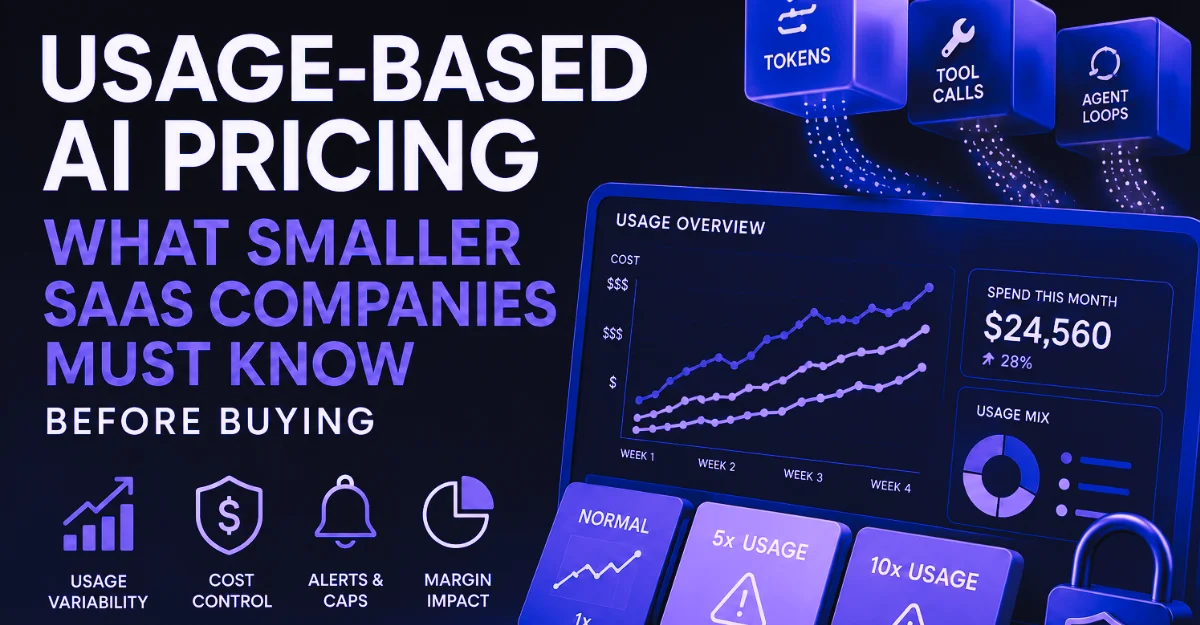
What Is Usage-Based AI Pricing and Why Does It Matter?
Usage-based AI pricing turns software evaluation into cost-governance review
Buyers no longer evaluate only whether an AI product creates value. They now evaluate whether variable usage can be seen, bounded, forecasted, allocated, audited, and explained before adoption scales.
Evaluation centered on product fit, subscription cost, and approval of a known budget line.
Evaluation now includes usage visibility, alerts, caps, exports, overage rules, and forecasting discipline.
What the product must prove before approval
Measured by usage, model, project, customer, or workflow
Bounded through limits, caps, restrictions, or throttles
Forecasted through scenarios before adoption scales
Allocated across teams, products, customers, or budgets
Audited through exports, dashboards, and billing evidence
Explained clearly to finance, procurement, legal, and executives
Providers that treat cost controls as a product feature reduce procurement friction. Providers that treat them as an afterthought create it.
How Major AI Providers Charge for Usage-Based Pricing
Across OpenAI, Anthropic, Azure OpenAI, Google Gemini, and Amazon Bedrock, AI pricing is no longer only about model access. Buyers now need to understand token usage, tool charges, soft limits, provisioned capacity, spillover, discounts, and governance controls before adoption scales.
OpenAI API
Token-based pricing across input and output, plus per-call tool charges such as web search.
Anthropic Claude API
Token-based pricing with prompt caching, Batch API discounts, tool pricing, and real-time cost visibility.
Azure OpenAI / Foundry
Standard pay-per-token deployments sit alongside Provisioned Throughput Units billed hourly.
Google Gemini / Vertex AI
Token-based access is paired with Generative Scale Units for provisioned throughput.
Amazon Bedrock
Standard, Flex, Priority, and Reserved tiers create multiple pricing paths for different workload priorities.
Usage-based pricing is becoming a SaaS operating model, not just an AI billing detail
Turn weak signals into better decisions.
I study the signals most teams overlook: competitor moves, product changes, pricing shifts, customer friction, and market pressure.
Key Terms in Usage-Based AI Pricing
Usage-based AI pricing introduces a new language of tokens, caps, overages, throughput, and cost controls. These terms define how variable AI spend is measured, limited, forecasted, and governed.
What usage is billed on
Billing tied to actual consumption metrics rather than fixed seats or subscriptions.
Cost calculated per million input and output tokens.
Units measuring prompt/context sent and response generated.
What changes the final bill
Discounted pricing for retained context.
Discounted asynchronous processing.
Reserved dedicated capacity billed at fixed hourly/monthly rate.
PTU / GSU / MUWhere buyer risk is managed
Notification trigger that does not automatically block usage.
Limit that stops or throttles requests.
Usage or traffic beyond committed capacity, often at standard or premium rates.
Why Usage-Based AI Pricing Makes Software Buying More Complex
Variable AI costs transfer more demand-side uncertainty onto the buyer. For smaller companies, that turns procurement into a broader governance review involving finance, procurement, legal, RevOps, engineering, and executive sponsors.
Margin protection
Usage-based pricing helps providers protect against unpredictable inference loads and high compute variance.
Governance burden
Smaller buyers must prove they can forecast, cap, allocate, and explain variable AI spend before approval.
How software was bought before usage-based AI pricing
Does this tool solve the problem?
Owner: Product / engineeringCan we afford the subscription?
Owner: Department headAre terms acceptable?
Owner: Procurement / legalIs the annual cost justified?
Owner: Finance / executive sponsorHow software buying works after usage-based AI pricing
What drives token, API, tool, or agent consumption?
Friction: Engineering must estimate behavior before productionWhat happens at 2×, 5×, or 10× usage?
Friction: Finance needs variance modelsAre there hard caps, alerts, exports, and admin controls?
Friction: Procurement evaluates governance featuresCan we pass cost downstream or absorb it?
Friction: Product and finance must alignWhat happens during overages, spikes, or provider price changes?
Friction: Legal and procurement become more involvedCan we detect runaway usage before invoice shock?
Friction: RevOps / FinOps / engineering need ongoing instrumentationThe provider’s AI cost-control layer becomes a procurement criterion before the product reaches production, not a billing detail discovered after deployment.
Usage-Based AI Pricing Comparison by Provider
The buying risk is no longer only the list price. Smaller companies must compare usage models, predictability options, control features, and where each provider leaves room for cost exposure.
OpenAI API
Teams may mistake soft alerts for hard caps.
Anthropic Claude API
Cost varies by model, output, tools, and cache behavior.
Azure OpenAI / Foundry
Reserved capacity creates underutilization risk.
Google Gemini / Vertex AI
Spillover can create unexpected pay-go exposure.
Amazon Bedrock
Model and provider differences complicate forecasting across workloads.
Pricing details that change buyer risk
OpenAI API pricing and cost controls
- Pricing model: Token-based input/output + tool charges such as web search.
- Budget behavior: Project budgets are soft thresholds and notification triggers; requests continue after threshold unless contractually enforced.
- Usage dashboard: Available with project-level restrictions.
- Project-level controls: Model restrictions and rate limits available.
- Export options: Usage data visible in dashboard; export capabilities documented for billing cycles.
- Buyer risk: High chance of mistaking alerts for hard caps.
- Sources: OpenAI Developers documentation, June 23, 2026.
Anthropic Claude API pricing and cost controls
- Pricing model: Token-based with prompt caching and Batch API discounts.
- Prompt caching: Cache reads at 0.1× base input price.
- Batch API: 50% discount.
- Tool pricing: Web search at $10 per 1,000 searches + token costs.
- Console visibility: Real-time cost and usage tracking.
- Enterprise options: Custom rate limits and volume commitments available.
- Buyer risk: Cost variation by model, output volume, tools, and cache behavior.
- Sources: Anthropic Claude Platform documentation, June 23, 2026.
Azure OpenAI pricing and cost controls
- Pricing model: Pay-per-token standard deployments or PTU hourly billing.
- Predictability: Reservations and PTUs create fixed hourly commitments.
- Control features: Azure cost management tools and capacity reservation.
- Buyer risk: Underutilization waste if demand falls below reserved capacity.
- Sources: Microsoft Azure and Learn documentation, June 23, 2026.
Google Gemini and Vertex AI pricing and cost controls
- Pricing model: Token-based standard access + GSU-based provisioned throughput.
- Overage / spillover: Excess traffic routes to pay-as-you-go by default and appears on monitoring dashboards.
- Control features: Overage controls, usage metrics, and Google Cloud monitoring dashboards.
- Buyer risk: Spillover can create unexpected pay-go exposure during spikes.
- Sources: Google Cloud Gemini Enterprise Agent Platform and Vertex AI documentation, June 23, 2026.
Amazon Bedrock pricing and cost controls
- Pricing model: Token-based with Standard, Flex, Priority, and Reserved tiers.
- Provisioned Throughput: Hourly per Model Unit with 1-month+ commitments.
- Control features: AWS billing tools and model-unit commitments.
- Buyer risk: Model and tier differences complicate cross-workload forecasting.
- Sources: Amazon Web Services Bedrock documentation, June 23, 2026.
Alerting is not enforcement
Usage dashboard
Does: Shows historical or current consumption.
Does not: Prevent future spend.
Budget alert
Does: Notifies owners when spend crosses threshold.
Does not: May not stop requests.
Rate limit
Does: Limits request volume or throughput.
Does not: May not map cleanly to dollars.
Hard cap
Does: Stops or blocks usage after threshold.
Does not: Can interrupt production workflows.
Provisioned capacity
Does: Creates predictable capacity cost.
Does not: Can create unused-capacity waste.
Spillover
Does: Maintains availability during spikes.
Does not: Can reintroduce pay-go cost exposure.
How to Compare AI Pricing Controls Across Providers
The AI Pricing Control Plane Score evaluates whether a provider gives buyers enough visibility, controls, forecasting support, overage governance, and procurement-ready documentation to manage variable AI spend.
Usage visibility
Can buyers see usage by project, user, model, feature, or customer?
Budget control
Are budgets only alerts, or are hard-cap options clearly documented?
Forecasting support
Are calculators, exports, scenario tools, or usable cost data available?
Overage governance
Are overages, throttling, spillover, and enforcement behavior clear?
Procurement readiness
Are pricing terms, limits, controls, and documentation easy to cite during internal approval?
AI Pricing Control Score by Provider
Dimension scores by provider
OpenAI API
Visibility is improving, but budget behavior creates hard-cap confusion.
Anthropic Claude API
Strong cost modifiers, but forecasting depends heavily on workload behavior.
Azure OpenAI / Foundry
PTUs and reservations make predictability more procurement-ready.
Google Gemini / Vertex
Strong monitoring, forecasting, and overage visibility support buyer governance.
Amazon Bedrock
Strong procurement readiness, but provider and model differences add complexity.
GroqCloud
Fast infrastructure story, but weaker documented buyer-control surface.
Perplexity API
Limited public control-plane depth creates approval friction for smaller buyers.
Cohere
Moderate visibility and procurement readiness, weaker forecasting support.
Vendors scoring 16+ reduce procurement uncertainty and can turn governance into competitive advantage. Vendors scoring below 12 create measurable buyer-process friction.
How a 5x Usage Spike Can Increase AI Costs
Teams can model usage-based AI exposure with a simple spreadsheet using provider pricing pages or APIs. The goal is not perfect prediction. The goal is to see when normal adoption becomes reforecasting, emergency review, or invoice-shock risk.
What teams should model before approval
Monthly users
Average requests per user
Model calls per request
Average input tokens / output tokens
Tool calls per workflow
Cache hit rate / retry rate / agent loop multiplier
Batch percentage / provisioned vs pay-go share
Gross margin target
What the model should reveal
Manageable with normal dashboard review.
Moderate variance; finance needs an updated forecast.
Potentially material margin impact.
High exposure without a strong control plane.
Higher control maturity is needed once usage variance becomes material to margin, forecasting, or board reporting.
Who gets pulled into the buying process?
Can we forecast cost variance before approving this?
Are overages, renewal terms, and usage rights clear?
Who is liable for uncontrolled usage or customer-triggered spikes?
Can we meter usage by customer, feature, model, and workflow?
Should we delay AI features until controls exist?
Can we explain expected usage before the buyer asks?
Can we prevent customers from getting surprised by bills?
Does AI adoption improve margin or create hidden volatility?
Documents teams need before buying usage-based AI software
Usage forecast model
Estimate cost variance at scale.
Control-plane checklist
Confirm dashboards, caps, exports, and alerts.
Overage policy memo
Understand liability and contractual exposure.
Cost allocation map
Assign cost by customer, team, product, or feature.
Runaway usage incident plan
Prevent agent loops or abuse from creating surprise cost.
Customer-facing TCO explanation
Reduce buyer hesitation.
Gross-margin sensitivity model
Decide whether AI feature economics work before the usage curve becomes a board-level issue.
What Smaller Companies Should Do Before Buying Usage-Based AI Tools
The immediate task is not to predict every token. It is to build enough visibility, ownership, and review discipline to catch cost exposure before it becomes a surprise invoice, stalled renewal, or sales objection.
Map dependencies
List every current AI API or AI SaaS dependency and score its control plane across the five dimensions.
Model the spike
Run a 5× usage scenario for the top three dependencies before the next planning cycle.
Add a review gate
Make “AI cost-control plane review” a required checkpoint in the next three vendor evaluations.
Assign invoice visibility
Confirm the person who would first see a surprise AI invoice has dashboard access.
Monitor pricing changes
Subscribe to pricing-page and documentation change alerts for the top providers used by the company.
What to track in AI pricing pages and provider documentation
Pricing page diffs and new model tiers
Docs changes for caps, alerts, dashboards, exports, and overages
Batch, caching, priority, flex, and provisioned pricing changes
Enterprise admin-console releases and FinOps integrations
Terms updates around overages, commitments, and usage rights
Usage-export APIs and billing data access
Customer complaints or case studies about cost visibility
Job postings for billing, metering, usage analytics, and pricing operations
Competitor packaging changes and investor commentary on AI gross margins
Where smaller companies usually underestimate usage-based AI pricing
Treating provider budget alerts as hard caps.
Pricing AI features before modeling usage variance.
Ignoring output-token exposure, often more expensive than input.
Failing to meter usage by customer, feature, or workflow.
Not separating pilot economics from production economics.
Assuming batch and caching savings apply to real-time workflows.
Overlooking spillover in provisioned-throughput plans.
Letting sales promise predictability before engineering can enforce it.
Failing to write overage language into customer contracts.
Tracking model price changes but not control-plane changes.
When usage-based AI pricing may become easier to manage
The governance burden becomes lighter if providers standardize stronger hard caps, exports, hybrid contracts, and buyer-friendly controls faster than usage volatility grows.
Usage-based pricing changes what sellers must be ready to explain
“What will this cost at scale?”
“It depends on usage.”
“Here are three usage scenarios based on similar deployments.”
“Can we cap spend?”
“You can monitor usage.”
“You can set alerts, restrict models, export usage, and define thresholds.”
“What happens if adoption spikes?”
“That is a good problem to have.”
“Here is the spike-response plan and overage policy.”
“Who owns usage internally?”
“Usually the admin.”
“Finance, product, and engineering each get different reporting views.”
How smaller SaaS companies should price AI features
Subscription + fair-use policy
Use when usage is easy to forecast.
Usage-based pricing
Use when consumption tracks customer value.
Base fee + included usage + overage cap
Use when buyers want budget confidence.
Credit model + admin controls
Use when cost exposure needs visible governance.
Packaged tiers with guardrails
Use when buyers cannot model usage themselves.
Usage-based + exports + contract terms
Use when buyers can manage reporting and governance.
Pass-through pricing or customer-level metering
Use when upstream costs can materially compress gross margin if hidden inside a flat subscription.
How This AI Pricing Analysis Was Created
This analysis evaluates provider control planes using public documentation, pricing pages, billing docs, release notes, case studies, buyer reporting, and industry research. The score measures buyer governance readiness, not model quality or absolute price.
Five dimensions, scored from 0 to 4
Not publicly documented
Partially documented, limited self-serve control
Documented visibility but weak enforcement
Usable controls with some caveats
Strong self-serve controls with clear documentation and exportability
What was reviewed and excluded
Included
- Official pricing pages
- Product documentation
- Billing documentation
- Release notes
- Public case studies
- Public buyer reporting
- Industry research
Excluded
- Private enterprise contract terms
- Undocumented console behavior
- Unofficial blog claims
Sources used for AI pricing and cost-control data
Confirms token/tool pricing and soft-budget behavior.
Confirms caching, batch, and tool charges.
Confirms hourly PTU and reservation mechanics.
Confirms GSU, overages, and monitoring behavior.
Confirms model, tier, and provisioned-throughput differences that affect forecasting.
What this analysis does not claim
Public pricing pages may not reflect negotiated enterprise contracts.
Console features may differ by plan, region, model, or account status.
Pricing changes frequently; this analysis reflects public sources as of June 23, 2026.
A high control-plane score does not mean a provider is cheaper.
A low score does not mean a provider’s models are weak.
This analysis evaluates buyer governance readiness, not model quality.
Article updates and pricing-change log
Initial publication. Added provider comparison, control-plane framework with actual scores, hard-cap distinction, 5× usage scenario, evidence cards, procurement checklist, sales enablement angle, decision tree, common mistakes, buyer artifacts, source table, methodology, limitations, and expanded FAQ.
Track changes to OpenAI, Anthropic, Azure, Google, AWS, and additional provider pricing/control documentation.
Common Questions About Usage-Based AI Pricing
These questions cover the cost controls, pricing mechanics, forecasting risks, procurement checks, and margin implications that smaller SaaS companies need to understand before AI usage scales.
What are AI pricing controls?
The set of dashboards, alerts, caps, exports, rate limits, model restrictions, overage rules, forecast tools, and admin permissions that let buyers govern variable AI spend.
Why are AI API costs hard to predict?
Because cost depends on tokens, tool calls, agent loops, context length, cache behavior, retries, model fallback, and customer usage patterns that are difficult to forecast before production.
What is the difference between token pricing and seat pricing?
Token pricing charges for actual consumption such as input tokens, output tokens, and tool calls. Seat pricing charges a fixed fee per user regardless of usage.
What is provisioned throughput in AI pricing?
Reserved dedicated capacity, such as PTU, GSU, or MU, billed at a fixed hourly or monthly rate regardless of actual usage within the reservation.
What is spillover in AI pricing?
Excess traffic above provisioned capacity that automatically routes to pay-as-you-go pricing, visible on monitoring dashboards.
How do prompt caching and batch pricing lower AI costs?
Prompt caching discounts repeated context, often at 0.1×. Batch pricing offers roughly 50% discounts for asynchronous, non-real-time workloads.
What is a soft budget in the OpenAI API?
A project budget that triggers notifications when spend crosses a threshold but does not automatically stop requests.
How should smaller SaaS companies price AI features?
Subscription + fair-use policy
Usage-based pricing
Base fee + included usage + cap
Should AI SaaS companies pass AI usage costs to customers?
Only with transparent metering, customer-level visibility, and contractual overage language to avoid margin leakage and disputes.
How can finance teams forecast AI usage costs?
Build variance models using 2×, 5×, and 10× scenarios, provider calculators, and historical usage data segmented by customer, feature, and model.
What should procurement ask before buying usage-based AI software?
Use the procurement checklist: exact billable usage definition, hard cap vs soft alert behavior, exportability, breakdown granularity, alert recipients and automation, overage/spike behavior, model restriction options, termination/renegotiation rights on price changes, chargeback support, and enterprise vs public pricing differences.
What are the biggest hidden costs in AI agents?
How does usage-based AI pricing affect SaaS gross margins?
It can improve alignment with value but creates margin leakage risk when upstream costs rise faster than pass-through mechanisms or customer pricing can absorb.