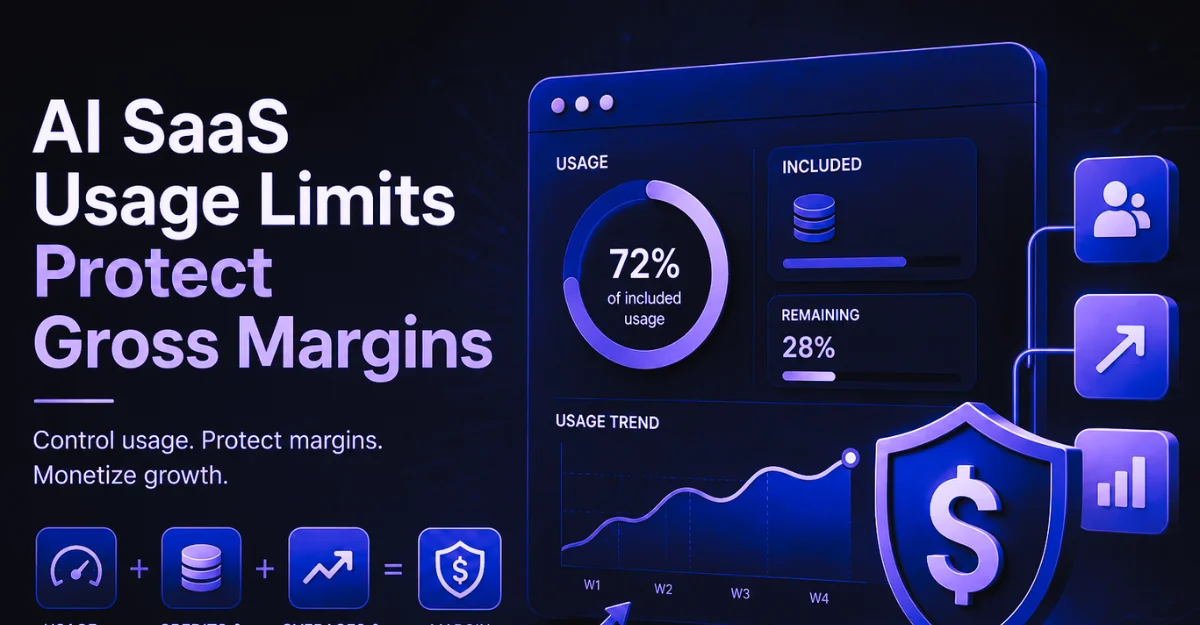
Why AI SaaS Usage Limits Matter
Usage limits are not only a customer-facing pricing detail. In AI SaaS, they define how much variable consumption the business can support profitably.
In AI SaaS, usage limits are not primarily customer-control mechanisms. They are margin-control mechanisms. Because each customer action can trigger variable inference, compute, retrieval, orchestration, or third-party model costs, sustainable pricing architecture must separate the consumption level that the base subscription can profitably support from the expandable consumption that requires additional payment, upgrade, or routing.
What Are AI SaaS Usage Limits?
These terms define how AI SaaS companies measure consumption, control variable cost, and convert heavier usage into paid expansion.
Usage limit
Any boundary placed on customer consumption of AI features.
Hard cap
Absolute maximum consumption allowed before access is blocked or throttled.
Soft cap
Threshold that triggers warnings, reduced priority, or upgrade prompts without immediate blocking.
Fair use policy
Provider discretion clause for abuse or edge cases; often vague and low in buyer trust.
Rate limit
Constraint on speed or frequency, such as requests per minute or tokens per minute.
Throttling
Degradation of service quality or speed after a threshold, without full blocking.
Credit system
Abstracted unit that bundles backend costs into a buyer-facing meter.
Overage
Paid consumption above the included allowance, usually at a higher per-unit rate.
Included usage
The AI consumption covered by the base subscription and expected to support target gross margin.
Metered usage
Consumption that is measured and either included up to a limit or charged incrementally.
Billable event
The unit that triggers cost attribution and potential revenue, such as token, message, workflow, or task.
Expansion capture
Mechanism that converts heavier usage into additional revenue through overages, credits, or upgrades.
Inference cost
Variable cost of running the model, including compute, tokens, energy, and third-party API fees.
Token cost
Subset of inference cost measured in input and output tokens.
Margin leakage
When gross margin per account declines because AI costs grow faster than account revenue.
Admin spend control
Buyer-side visibility tools such as dashboards, caps, alerts, and exports.
Usage governance
The system of measurement, limits, controls, expansion paths, and visibility that aligns usage with economics.
If this analysis is useful, let’s talk.
I am open to remote roles and selective strategy work focused on market research, competitor analysis, growth direction, and positioning.
Why AI SaaS Costs Are Different From Traditional SaaS Costs
Traditional SaaS and AI SaaS differ fundamentally in cost structure. The risk appears when engagement begins to create variable delivery costs.
Traditional SaaS
Fixed-cost biasAI SaaS
Variable-cost exposureWhat Counts as Usage in AI SaaS Pricing?
AI SaaS companies must choose what constitutes a billable event. The choice determines both buyer comprehension and the ability to map revenue to actual cost.
Customer action
A user sends a message, runs a workflow, generates content, or triggers an agent task.
Billable event
The product decides what unit of usage is counted and explained to the buyer.
Cost event
The action creates inference, compute, retrieval, orchestration, or third-party model cost.
Usage boundary
The plan defines what is included before warnings, caps, overages, or upgrades appear.
Margin outcome
The company either captures expansion revenue or absorbs margin leakage.
Token
Input plus output tokens.
Message or generation
A user-visible interaction or output.
Workflow or agent run
A completed automated sequence.
Document processed
A file, record, or indexed item.
Resolved ticket or task
An outcome tied to operational value.
Voice or video minute
Usage tied to time-based AI processing.
API call
A request made through the product or platform API.
Credit
An abstracted bundle across multiple backend costs.
Outcome
A result such as a resolved customer interaction.
Types of AI SaaS Usage Limits
Not all limits serve the same economic purpose. Some protect infrastructure, some protect margins, and some build buyer trust.
Rate limit
Low trust visibilityControls speed or frequency.
Included usage allowance
Base marginControls baseline consumption.
Credit system
Medium-high trustControls abstracted consumption.
Hard cap
Cost controlControls maximum allowed consumption.
Soft cap or warning
High trustControls threshold before action.
Overage pricing
Expansion pathControls paid expansion.
Fair use policy
Low buyer trustControls abuse or edge cases.
Admin spend control
Enterprise trustControls buyer-side visibility and caps.
How Usage Limits Protect AI SaaS Gross Margins
Assume a $99/month base plan with a target 75% gross margin on AI features. The risk appears when heavy usage exceeds the cost level the base subscription can profitably support.
Base plan revenue
Fixed subscription revenue per month.
Target gross margin
The margin benchmark the plan needs to protect.
Included AI cost budget
The approximate cost envelope inside the base price.
Normal user cost
Typical inference cost that remains inside the margin envelope.
Power user cost
Usage level where margin leakage becomes visible.
Automated workflow cost
Heavy usage that can turn the account structurally negative.
Common AI SaaS Usage Limit Models
AI SaaS companies use different pricing structures to balance buyer simplicity, cost visibility, and margin protection.
Seat-based with hidden AI allowance
Simple to sell, but high leakage risk when AI usage varies across customers.
Seat-based plus message cap
Adds a basic boundary and is common in productivity AI products.
Credit-based pricing
Abstracts complexity while supporting expansion capture and buyer simplicity.
Pure token-based pricing
Transparent on cost, but creates buyer cognitive load and bill-shock risk.
Workflow or run-based pricing
Aligns with agentic value, but requires a clear definition of “run.”
Outcome-based pricing
Strong value alignment, but complex to meter and attribute cleanly.
Hybrid subscription + usage overage
Combines predictability with margin protection and is the converged mature pattern.
How AI SaaS Companies Manage Usage Limits
A complete usage-limit system does more than meter activity. It defines what is measured, what is included, what happens at the boundary, and how buyers control spend.
Measurement
What usage is tracked and how the billable event is defined.
Boundary
What consumption is included in the base price.
Control
What happens near the limit: warnings, throttling, or caps.
Expansion
How heavier usage is monetized through overages, credits, or upgrades.
Trust
How buyers see, forecast, and control spend with dashboards and alerts.
Strategic
How the architecture shapes adoption, positioning, and competitive response.
Examples of AI SaaS Usage Limits in Pricing
These examples show how different AI products use limits, credits, tiers, or outcome-based pricing to manage variable usage and protect margins.
Cursor
Devtool AI example where a single developer generated a large one-day invoice after exhausting an allowance.
OpenAI API
Usage tiers increase rate limits as organizational spend rises.
ChatGPT consumer & team plans
Time-windowed message limits manage capacity and access by plan type.
Intercom Fin
Support AI example using outcome-based pricing tied to resolved interactions.
Salesforce Agentforce
Enterprise AI example using hybrid seat plus usage pricing.
How to Evaluate AI SaaS Usage Limit Design
Select the level that best matches a public pricing page, documentation, and buyer controls. The result appears at the bottom.
Select a score to evaluate the pricing page
Use the public pricing page, product documentation, and buyer controls to choose the closest maturity level. Higher scores indicate stronger margin protection and stronger enterprise buyer trust.
High margin exposure and low buyer clarity
This pricing page does not clearly show how AI usage is measured, limited, controlled, or monetized. If usage varies across customers, the company may be absorbing hidden cost risk while buyers receive little clarity on what happens at higher consumption levels.
Some boundary exists, but the system is incomplete
The product has basic usage limits or message caps, but buyers still lack a clear overage path, usage visibility, or spend-control mechanism. This reduces immediate risk but leaves margin protection and customer trust underdeveloped.
Early margin protection is visible
The pricing model defines included usage and shows how paid expansion works. This is a meaningful step toward margin protection, but the buyer may still need better dashboards, alerts, and admin controls to manage usage confidently.
The pricing model is operationally credible
The product combines limits, overages, and basic usage visibility. This gives both the provider and buyer a clearer view of consumption. The next maturity step is stronger admin control, proactive alerts, and enterprise-grade governance.
Strong margin protection and stronger buyer trust
The product gives buyers visibility and control before usage becomes a billing or margin issue. Spend alerts, soft caps, admin controls, and upgrade prompts reduce surprise while helping the provider convert heavier usage into expansion.
Enterprise-ready usage governance
The pricing architecture clearly connects measurement, limits, buyer controls, and expansion paths. This level supports stronger margin protection, clearer procurement conversations, and higher trust for customers with complex or high-volume AI workloads.
What Buyers Should Ask About AI SaaS Usage Limits
Enterprise buyers evaluate usage governance on predictability, control, and surprise avoidance. Weak answers create procurement friction and higher churn risk.
Predictability
Can the buyer understand what is included, what is charged, and when costs increase?
Control
Can admins set caps, receive alerts, export data, and manage usage across teams?
Surprise avoidance
Does the vendor prevent unclear overages, silent throttling, and unexpected invoice changes?
What exactly counts as usage?
Buyers need to know whether usage means tokens, messages, workflows, tasks, API calls, or outcomes.
How much AI consumption is included?
The included allowance determines whether the plan feels predictable or structurally incomplete.
Is usage pooled or per-user?
Pooled usage supports team flexibility. Per-user limits can create friction in heavy-use departments.
What happens after the limit?
Buyers need clarity on throttling, overage charges, blocked access, or upgrade prompts.
Can admins set caps and alerts?
Enterprise buyers need spend controls before AI usage becomes a procurement issue.
Can usage data be exported?
Usage exports support forecasting, chargeback, renewal planning, and internal accountability.
Are failed actions or retries charged?
Failed generations, retries, and background agent actions can create buyer distrust if unclear.
Are API and UI actions metered differently?
Different usage channels can create different cost patterns and invoice expectations.
Does unused usage roll over?
Rollover rules affect perceived value, especially for teams with uneven monthly demand.
Can buyers negotiate custom pools?
Committed spend and custom usage pools matter for large, variable workloads.
How quickly do overages appear?
Delayed visibility turns normal usage growth into billing surprise.
Does quality degrade near limits?
Buyers need to know whether limits affect speed, model quality, priority, or availability.
What AI SaaS Founders Should Check Before Adding Usage Limits
Before adding limits, AI SaaS teams need to understand which customers create cost pressure, which actions drive the most expense, and where pricing fails to capture usage growth.
Which 10% of accounts generate the most AI cost?
This reveals whether margin risk is concentrated in a small power-user segment.
Are the heaviest users profitable?
High engagement is not enough if account-level gross margin is deteriorating.
Do we see AI gross margin by account?
Aggregate margin can hide negative-margin power users or workflows.
Which action creates the highest per-event cost?
The most expensive event should influence metering, routing, and packaging design.
Can one customer exceed our margin assumptions?
Automated workflows can break the model before finance sees the issue.
Do we warn customers before limits or overages?
Warnings reduce surprise and make expansion feel governed rather than punitive.
Are limits tied to value or infrastructure convenience?
Buyer trust improves when the limit maps to value, not just backend constraint.
What happens if model costs rise 2× or 5×?
Pricing architecture should survive provider cost changes without emergency repricing.
What usage should trigger upgrade or sales outreach?
Heavy usage should create a clean expansion signal, not only a cost problem.
Can Sales explain the limits in under 60 seconds?
If the pricing logic is hard to explain, buyers will assume it is risky.
Do Product and Finance define usage the same way?
Misalignment on the billable event creates pricing confusion and margin blind spots.
What Product, Finance, and RevOps Teams Need to Build
Strong usage governance requires product instrumentation, customer visibility, account-level economics, and billing systems that can handle hybrid pricing cleanly.
Event-level metering infrastructure
Tracks the actions that create cost and define usage.
Usage dashboards and exports
Gives customers visibility for forecasting and internal reporting.
Configurable spend caps and alerts
Prevents surprise bills and gives admins control before limits are reached.
Account-level cost attribution
Shows which customers, cohorts, or workflows pressure gross margin.
Model routing logic
Uses cheaper models for suitable workloads to reduce avoidable cost.
Usage and limit audit logs
Creates a record of usage events, alerts, throttling, and overage triggers.
Plan entitlement and packaging system
Connects product access, usage limits, and upgrade logic to each plan.
Hybrid billing integration
Handles credits, overages, usage charges, and upgrades without manual workarounds.
How One Heavy User Can Hurt AI SaaS Margins
A single automated workflow can turn a healthy-looking customer into a negative-margin account if usage is not measured, capped, or monetized.
Person AI SaaS company
A smaller team with limited margin room and limited billing infrastructure.
Monthly plan price
Fixed subscription revenue that must cover variable AI delivery costs.
Automated workflow cost
One enterprise workflow can exceed the account’s monthly plan revenue.
Normal customers
Most accounts generate $15–22/month in inference costs.
Automated workflow
One enterprise customer enables a daily workflow that consumes $230+/month in model calls.
False success signal
The account shows strong activation and retention while gross margin turns negative.
Late discovery
The company only sees the problem after quarterly margin review, when options are narrower.
How We Reviewed AI SaaS Pricing Pages
IVVORA reviewed public pricing pages and supporting documentation to identify how AI SaaS companies expose, limit, and monetize usage.
AI SaaS products reviewed
Products with material inference components and public pricing or documentation signals.
Review period
Public pages and documentation reviewed as of June 2026.
Classification dimensions
Usage credits, overages, admin visibility, billable event clarity, and enterprise controls.
Pricing pages
Plan structure, included usage, limits, and overage language.
Product docs
Usage definitions, counters, dashboards, and limit behavior.
Terms
Fair use, abuse clauses, throttling, and commercial restrictions.
Help centers
Buyer-facing explanations of caps, credits, usage, and billing.
Release notes
Signals of new counters, controls, packaging, or usage governance changes.
Which AI SaaS Companies Are Most Exposed to Usage Cost Risk?
The highest exposure sits where AI costs are material and customer usage varies sharply across accounts, teams, or workflows.
AI agent platforms
Autonomous workflows can create repeated model calls without direct human pacing.
Vertical AI SaaS
Sales, legal, support, and operations tools often have uneven usage by team or function.
Devtool AI
Engineers can create concentrated high-usage periods during build, test, or coding cycles.
B2B platforms adding AI
Legacy seat-based pricing can collide with new variable inference costs.
When AI SaaS Usage Limits May Not Be Needed
The margin-protection thesis weakens only if the economics of AI delivery, pricing structure, or buyer behavior change in sustained ways.
Inference costs collapse
Equivalent model performance becomes cheap enough that variable costs are negligible relative to subscription revenue.
Open-source or routing reduces dependency
Cached, routed, or open-source models materially reduce reliance on expensive frontier APIs for most workloads.
Enterprise contracts absorb variation
Committed spend, true-up mechanics, or enterprise terms routinely cover usage swings at scale.
Limits hurt adoption more than margins
Usage limits demonstrably reduce win rates or adoption more than they protect gross margin across categories.
Unlimited pricing outperforms hybrid pricing
Simple, unlimited, or lightly governed pricing consistently wins on retention and gross margin in public data.
Overages create more churn than protection
Aggressive overage pricing or complex credit systems increase churn and support load enough to offset margin gains.
What Most Articles Miss About AI SaaS Usage Limits
Most commentary treats usage limits as a pricing communication problem. The deeper issue is whether AI adoption creates profitable expansion or margin-negative consumption.
Usage limits as customer friction
Most articles frame limits as a pricing UX issue, a packaging decision, or a customer-control mechanism. That framing is incomplete because it focuses on how limits feel, not why they exist.
Usage limits as unit economics control
In AI SaaS, usage limits determine whether product adoption becomes profitable expansion or margin-negative consumption. The real issue is the structural cost asymmetry AI introduces.
Product adoption rises
More customers use AI features, workflows, agents, or automated actions.
Variable cost increases
Inference, compute, retrieval, orchestration, and API costs scale with usage intensity.
Pricing must capture expansion
Limits, credits, caps, and overages determine whether growth protects or compresses gross margin.
Common Questions About AI SaaS Usage Limits
These answers clarify how usage limits, credits, overages, and unlimited access affect AI SaaS margins.
Do usage limits help AI SaaS companies protect margins?
Yes. Usage limits create explicit economic boundaries around variable inference and compute costs. Without them, subscription revenue can remain fixed while delivery costs rise with heavy or automated usage, producing margin leakage.
Why do AI SaaS companies use credits instead of raw tokens?
Credits abstract complex backend costs, including multiple models, retrieval, and orchestration, into a single buyer-facing unit. This improves buyer comprehension and enables cleaner expansion capture while still allowing the provider to manage actual infrastructure costs.
What is the difference between usage limits and overages?
Usage limits define the included consumption boundary that the base price is expected to cover profitably. Overages define the paid expansion path once that boundary is exceeded. Together they form the core of hybrid margin protection.
Can unlimited AI access ever work?
It can work when inference costs are negligible relative to revenue or when usage is extremely uniform and predictable. For most AI SaaS with material variable costs and heterogeneous customer intensity, unlimited access creates hidden cross-subsidies from light to heavy users.
How should smaller AI SaaS teams start?
Define the billable event clearly. Run the margin math on your heaviest observed and plausible future users. Set an included allowance that supports target gross margin on normal usage. Add visibility, alerts, and a transparent expansion path before power users or automated workflows expose the gap.
Key Takeaways About AI SaaS Usage Limits
The core argument is simple: AI SaaS usage limits matter because variable consumption can grow faster than fixed subscription revenue.
Usage limits protect AI SaaS margins by preventing variable inference costs from growing faster than fixed subscription revenue and by converting heavier consumption into paid expansion.
The single most important design choice is the definition of the billable event: token, message, workflow, credit, task, or outcome.
Good usage governance combines included allowances, transparent overage paths, admin visibility, pre-limit alerts, and buyer controls.
Unlimited or lightly governed AI access can create hidden cross-subsidies where light users subsidize power users and automated workflows.
For smaller AI SaaS companies, margin exposure appears first in usage intensity patterns, often before it appears cleanly in aggregate gross margin reports.
The AI SaaS Usage Limit Maturity Score provides a 0–5 framework for evaluating public pricing architecture.
The IVVORA AI Usage Governance Stack — Measurement, Boundary, Control, Expansion, Trust, Strategic — offers a complete model for auditing pricing architecture.
Sources Used for This AI SaaS Usage Limits Article
These sources support the article’s claims about AI SaaS pricing models, usage tiers, hybrid pricing, and documented bill-shock incidents.
Multiple 2025–2026 pricing analyses
2025–26How IVVORA Tracks AI SaaS Usage Limit Changes
IVVORA helps AI SaaS teams monitor pricing architecture shifts across competitors, detect usage-governance changes before they affect win rates or gross margins, and translate those signals into concrete packaging, roadmap, and sales decisions.
Need to understand how usage governance is evolving across your category?
Build a private competitor usage-governance watchlist and implication map before pricing shifts affect your unit economics or competitive positioning.
Contact Samarthya on LinkedIn