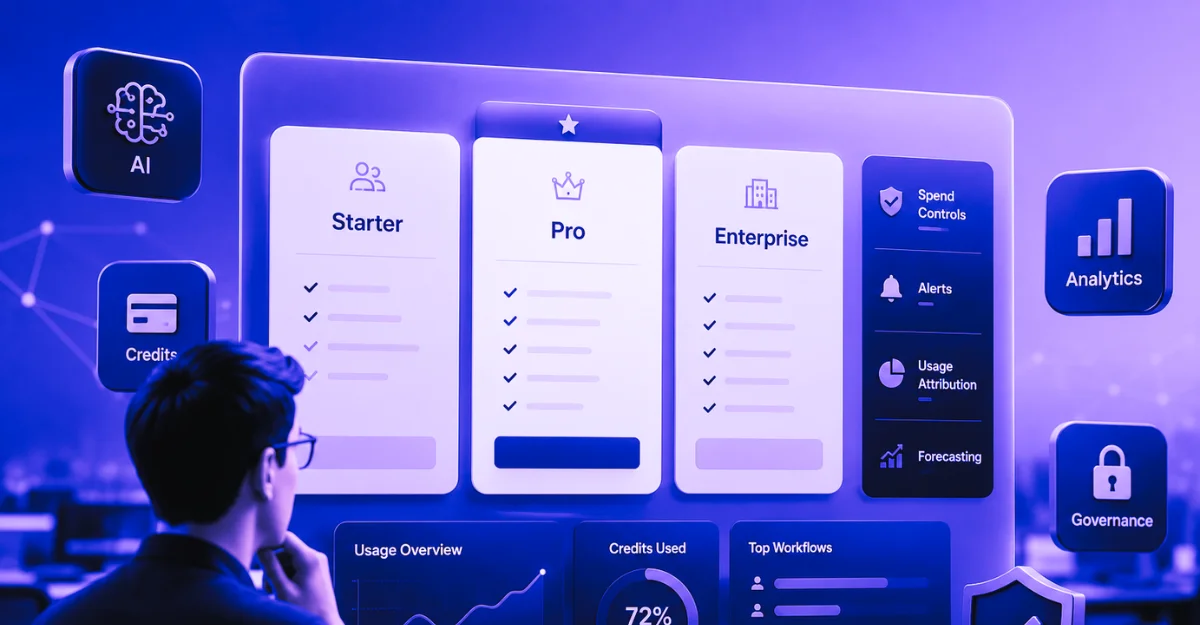
Why AI SaaS Pricing Pages Matter to Buyers
AI SaaS pricing pages are no longer plan-selection tools. They are the first governance surface where buyers evaluate whether usage can be measured, forecasted, controlled, attributed, and justified before adoption scales.
What the review shows
In IVVORA’s June 2026 review of leading AI platform and tool pricing pages and documentation, most pages disclose plan structure and entry pricing but leave critical operational boundaries (spend caps, credit-burn examples, overage behavior, team-level attribution, and forecasting) either buried in docs or requiring sales to access.
Why this matters
This creates silent procurement friction, especially for agentic and variable-usage workflows.
The strategic split
The companies that make cost boundaries visible on or one click from the pricing page reduce buyer risk before sales engagement. The companies that do not transfer that risk to internal approval processes.
Quick Answer: What Buyers Check on AI SaaS Pricing Pages
Buyers evaluating AI SaaS pricing pages look for six signals: usage metric clarity, included versus metered usage, overage behavior, credit transparency, spend-control mechanisms, and governance visibility before sales.
Why this changes the role of the pricing page
As products move toward usage-based, credit-based, and agentic pricing, the pricing page functions less like a plan selector and more like a buyer risk-assessment surface.
What lowers buyer friction
Vendors that make cost boundaries, attribution, caps, alerts, and forecasting visible reduce procurement friction before sales engagement.
Key Findings About AI SaaS Pricing Pages
Plan pricing is visible. Cost boundaries are not.
Most AI SaaS pricing pages disclose plan structure and entry pricing but not the operational cost boundary.
Credits are common, but still hard to translate.
Credit systems are widespread, but concrete credit-to-workload translation (examples of what consumes how many credits) is rare on the main pricing page.
Agentic cost exposure is under-explained.
Agentic and multi-step workflow cost impact is under-explained relative to its real budget exposure.
Spend governance is treated as enterprise-only.
Spend governance (caps, alerts, attribution) is usually positioned as an “enterprise feature” rather than a baseline pricing-page requirement.
The strongest pages reduce buyer risk before sales.
The strongest pages reduce buyer risk before sales by showing limits, controls, attribution examples, and realistic workload costs.
Pricing pages and documentation reviewed: June 15, 2026. Public pricing and enterprise terms may change. Readers should verify live pages.
Turn weak signals into better decisions.
I study the signals most teams overlook: competitor moves, product changes, pricing shifts, customer friction, and market pressure.
What Is an AI SaaS Pricing Page?
An AI SaaS pricing page is a public risk-assessment surface where buyers evaluate whether AI usage can be measured, forecasted, governed, capped, attributed, and justified before adoption scales. It is distinct from traditional SaaS pricing pages because usage intensity (not just seat count) can drive cost independently of headcount, especially with agents and automated workflows.
Questions buyers ask before choosing an AI SaaS plan
Before approving a pilot or procurement review, buyers internally answer:
What is the primary usage metric (tokens, credits, actions, queries, agent runtime)?
What exactly is included in the base plan versus metered or credit-based?
What happens when included usage is exceeded — automatic overage, throttle, block, or sales-assisted?
Can admins set hard or soft spend caps at user, team, workspace, or org level?
Can usage be attributed by user, team, workflow, project, or API key for chargeback and accountability?
Are proactive alerts available before spend increases?
Are credits transparent in burn rate and variability, or abstracted in ways that hide cost drivers?
Can finance forecast cost at 2×, 5×, and 10× current usage without a sales call?
Can finance reconcile invoice line items back to specific usage events?
Are meaningful enterprise controls and security terms visible before engaging sales?
Is the pricing model aligned to delivered value or primarily to vendor cost recovery?
Can we test or pilot this without creating unlimited liability?
What Pricing Details Help Buyers Trust an AI SaaS Company?
The AI Pricing Governance Layer is the set of visible pricing-page and documentation signals that show buyers how AI usage is measured, controlled, attributed, capped, alerted, and forecasted.
Higher layers reduce internal approval risk.Plan comparison only
Buyer reaction: “What does this actually cost when we use it?”
Usage metric visible
Buyer reaction: “We understand the cost driver.”
Credits / limits explained
Buyer reaction: “We can estimate normal usage.”
Caps, alerts, attribution visible
Buyer reaction: “We can govern adoption.”
Forecasting + admin controls + procurement docs
Buyer reaction: “We can approve and scale this with defensible internal controls.”
OpenAI
HybridPricing model: per-user + credits/usage
Strong signal: Business per-user pricing, Enterprise custom + security path, credit purchase option.
Weak signal: Exact credit burn for agents/Excel, worst-case modeling, team-level caps without sales.
Anthropic
Seat + usagePricing model: hybrid seat + usage/credits
Strong signal: Team includes usage + optional credits; Enterprise seat + API-rate usage; spend limits in help docs.
Weak signal: Precise credit-to-token mapping on main page; workflow attribution examples; hard vs soft cap behavior.
Cursor
Credits + on-demandPricing model: subscription + included credits + on-demand
Strong signal: Included usage credits ($20 on Pro, multipliers higher), on-demand billing, Admin Dashboard for usage.
Weak signal: Task-level cost variance by model complexity still hard to forecast on pricing page.
GitHub Copilot
AI CreditsPricing model: subscription + included AI Credits
Strong signal: Org-level AI Credits, pooled usage for Business/Enterprise, budget controls and notifications.
Weak signal: Full token-to-credit conversion and agentic task cost modeling still complex.
Perplexity
Daily limitsPricing model: seat-based with daily limits
Strong signal: Daily Pro search limits by tier clearly stated; Max = unlimited.
Weak signal: How file analysis or API usage compounds daily limits; worst-case for heavy research teams.
Vercel v0
Credits + meteringPricing model: subscription + included credits + token metering
Strong signal: Included monthly credits per user, additional credits purchasable, token-based metering noted.
Weak signal: Credit-to-generation mapping for complex prompts; team-level spend alerts before upgrade.
Pricing pages and linked documentation, June 15, 2026: OpenAI, Anthropic/Claude, Cursor, GitHub Copilot, Perplexity, and Vercel v0.
Credits are not a pricing model.
Credits are a translation layer between vendor-side compute volatility and buyer-side budget comprehension.
Real differences in cost by model, context size, tool calls, output length, retries, and agent runtime.
Raw token math for non-technical buyers who need a more readable pricing unit.
When burn rates are shown with realistic workload examples and admins can see, cap, and attribute consumption.
When burn logic is opaque and variability is not explained.
How Clearly Should AI SaaS Companies Explain Credits?
Credit transparency ladder
Buyers trust credits only when they can connect them to real workloads, burn rates, and controls.
Why AI agents make SaaS pricing harder to understand
More users = more seats = more cost
Cost usually scales with headcount. Buyers can estimate spend by counting users and plan tiers.
One user can trigger many cost events
A single user or scheduled automation can trigger prompts, tool calls, model routes, retrievals, context windows, outputs, retries, and long-running steps.
What happens when AI SaaS pricing is unclear?
Pilot delayed or reduced
Longer sales cycle, lower expansion signal.
Procurement enters earlier
More friction before value is proven.
Custom caps or terms requested
Higher contract complexity and legal cost.
Invoice examples requested
Finance distrust; slower approval.
Better-known vendor compared
Brand-trust disadvantage for smaller vendors.
Security packet requested early
Governance concern, not just security concern.
Common Problems with AI SaaS Pricing Pages
Weak AI SaaS pricing pages usually fail in the same place: they show the plan, but not the buyer’s real cost-control path.
Show plan names but hide cost drivers.
Mention credits but not credit burn with examples.
Say “unlimited” with unclear guardrails.
Hide overage behavior in support docs.
Show enterprise controls but not spend controls.
Do not explain whether limits are hard, soft, or throttled.
Do not show what happens when credits run out.
Do not show example workloads with consumption impact.
Do not include buyer-specific FAQs on usage and governance.
Require sales for basic usage and cap questions.
Do not separate seat access from AI consumption cost.
Do not explain agentic or automated workflow cost.
Do not show invoice reconciliation path.
Do not mention team/workspace/org-level controls.
Do not explain how adoption intensity changes cost.
What should an AI SaaS pricing page include?
A stronger page helps buyers understand cost, control, attribution, and approval risk before sales engagement.
- Base plan price and included usage
- Primary usage metric clearly defined
- Credit explanation with at least one realistic workload example
- Overage behavior: auto, throttle, block, or top-up
- Hard/soft limit and cap language
- Admin budget controls and alert thresholds
- Usage dashboard or attribution model
- Invoice example or reconciliation path
- Forecasting calculator or scenario examples
- Enterprise security and governance summary or clear link
- Buyer FAQ addressing the 12 questions above
- Documentation links for deeper metering details
- Clear path to procurement/security packet
What Pricing Information Should Be on the Page, in Docs, or Handled by Sales?
Common buyer objections to AI SaaS pricing
Types of AI SaaS pricing models and metrics
Used for: Predictable access
Buyer risk: Underprices heavy users
Used for: Direct compute mapping
Buyer risk: Hard for buyers to forecast
Used for: Abstraction layer
Buyer risk: Hides burn variability if not explained
Used for: Workflow alignment
Buyer risk: Action definitions can be vague
Used for: Runtime alignment
Buyer risk: Hard to predict duration
Used for: Value alignment
Buyer risk: Attribution disputes possible
Used for: Infrastructure clarity
Buyer risk: Ignores complexity variance
Used for: Vertical workflow clarity
Buyer risk: Edge cases create cost surprises
Traditional SaaS pricing vs AI SaaS pricing
Traditional SaaS
Seat count
Features and tiers
Adoption usually improves margin
Help choose plan
Contract review
AI SaaS
Usage intensity: prompts, tools, agents, output
Limits, controls, attribution, forecasting
Adoption can increase COGS
Assess risk and governance readiness
Usage exposure and control review
What Most AI Pricing Articles Miss About Buyers
Most commentary focuses on vendor monetization, gross margin protection, seat vs usage, credits vs tokens, and outcome-based packaging.
Buyer-side evaluation depends on forecastability, attribution, caps, alerts, invoice reconciliation, approval risk, governance maturity, and procurement defensibility.
Better ways to explain AI SaaS pricing
“Includes 10,000 AI credits.”
“Includes 10,000 AI credits/month. A standard support-summary workflow usually consumes 8–12 credits. A multi-step research agent usually consumes 40–90 credits depending on file length, model choice, and output size.”
“Overages may apply.”
“Admins can choose to block usage at the monthly limit, allow manual top-ups, or enable automatic overages with alerts at 50%, 80%, and 100% consumption.”
“Unlimited with fair use.”
“Usage is subject to abuse guardrails. Admins can view consumption and set team-level alerts or caps.”
How to Improve an AI SaaS Pricing Page in 30 Days
Define the cost driver
Define usage metric and separate included vs metered usage.
Show the limit logic
Add overage behavior and cap language.
Translate credits into work
Add one realistic workload example and credit explanation.
Make governance visible
Add admin control visibility, buyer FAQ, and clear docs links.
Why smaller AI SaaS companies need clearer pricing pages
Large platforms can survive ambiguity because they have brand trust, enterprise procurement relationships, custom contracts, account teams, mature billing infrastructure, and ecosystem lock-in.
Smaller AI SaaS companies do not. Their public pricing page must compensate for missing institutional trust.
The smaller the vendor, the more governance work the pricing page has to do.Limits of this AI SaaS pricing page review
Enterprise custom contracts are not publicly observable. Pricing pages may show different information by geography or login state. Login-gated admin dashboards may contain controls not visible publicly. Public documentation may lag actual product capability. Vendor terminology differs, making exact cross-vendor scoring imperfect. Credit values and model pricing can change without immediate pricing-page redesign.
How this AI SaaS pricing page review was done
IVVORA Pricing Page Governance Review, June 2026. Focused directional review of publicly accessible pricing pages and linked documentation for leading AI foundation/assistant platforms, devtools, app builders, infrastructure/API tools, and vertical AI examples.
Signals assessed for visibility on the main pricing page or one clear click into referenced docs without requiring login or sales contact. “Visible” = clearly stated or shown with actionable language or examples. “Buried” = requires deep navigation, login, or sales engagement. This is not an exhaustive census of all AI SaaS vendors; it maps observable patterns among prominent players as of the review date.
AI SaaS pricing terms explained
The unit that drives cost: tokens, credits, actions, agent runtime, resolutions, etc.
Abstraction layer that converts variable compute consumption into a buyer-facing unit.
Direct metering of input/output tokens.
How quickly credits are consumed by different workflows or models.
Usage beyond included amount and how it is handled.
Hard stop on usage or spend.
Warning or throttling rather than hard stop.
Slowing or limiting usage when thresholds are reached.
Shared credit pool across users or teams.
Ability to assign consumption to user, team, workflow, project, or key.
Mapping invoice line items back to specific usage events.
Contains enough governance signals for internal approval without immediate sales intervention.
Visible signals that show buyers how usage is measured, controlled, attributed, capped, alerted, and forecasted.
Common questions about AI SaaS pricing pages
What should an AI SaaS pricing page include?
Usage metric, included vs metered usage, overage behavior, credit logic with examples, spend cap and alert options, attribution model, and a realistic workload example.
How do buyers evaluate AI credits?
They test whether they can translate credits into expected work, budget consumed, and limits reached. Opaque burn rates reduce trust.
What is the difference between usage-based and credit-based pricing?
Usage-based meters the actual resource, such as tokens or actions. Credit-based pricing is an abstraction layer on top that simplifies perception but can hide variability if not explained.
Why do AI SaaS buyers worry about overages?
Because agentic and automated workflows can create spend that scales independently of headcount and without direct oversight.
What are spend caps in AI SaaS?
Admin-set limits, hard or soft, on total or per-user/team spend that prevent or alert on unexpected consumption.
What is usage attribution?
The ability to see and assign consumption by user, team, workflow, project, or key for chargeback and accountability.
How should AI SaaS companies explain agent pricing?
Show how runtime, model routing, tool calls, and output length affect cost, not just per-user or per-seat framing.
Should AI SaaS pricing pages show token costs?
Not necessarily raw token tables for all buyers, but they should show realistic workload examples and variability drivers so buyers can model exposure.
What AI pricing details should be on the pricing page vs documentation?
Pricing page: metric, included usage, overage behavior, caps/alerts, basic attribution, example workloads, buyer FAQ. Docs: full metering tables, model-specific rates, deep implementation guides. Sales: custom discounts and contract terms.
How can AI SaaS companies make pricing easier for buyers to approve?
Make usage metric, included usage, overage handling, spend controls, attribution, and one workload example visible on or one click from the pricing page.
The minimum information every AI SaaS pricing page should show
The minimum viable AI SaaS pricing page should show the usage metric, included usage, overage behavior, credit logic with at least one realistic workload example, spend-control options, and attribution visibility.
Price still matters. For serious buyers and scaling adoption, the deciding question is whether the vendor has made usage legible, controllable, attributable, and governable before the first procurement conversation.