Why AI Usage-Based Pricing Matters for SaaS Companies
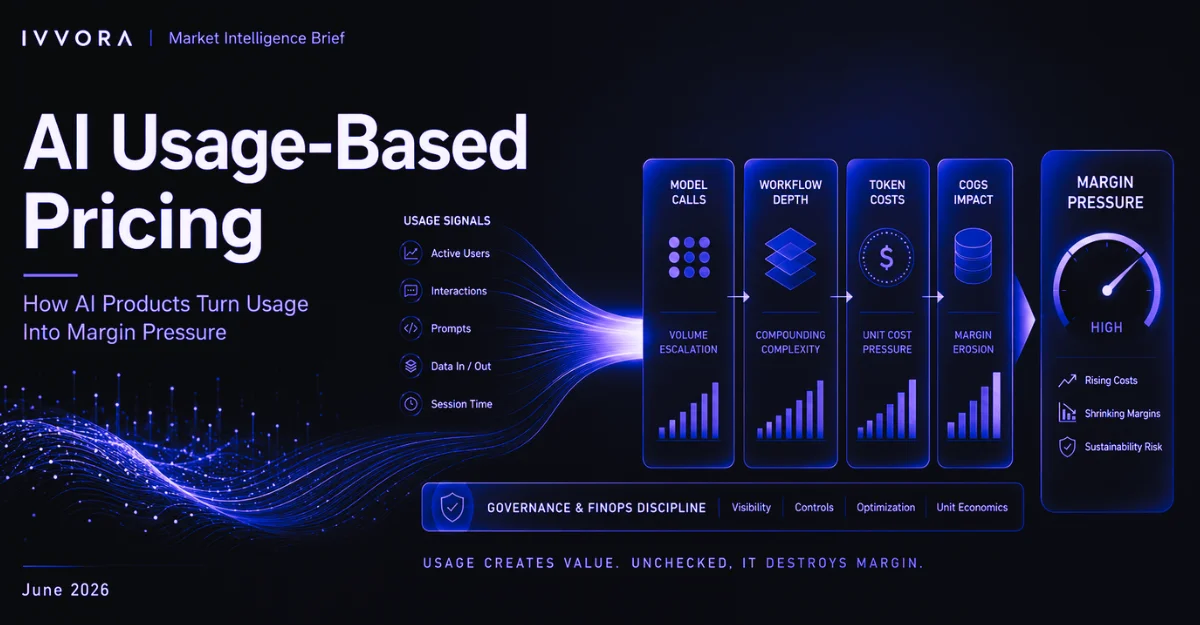
The old SaaS assumption was simple: more usage usually strengthened the business. AI changes that logic because every action can now create measurable delivery cost.
Usage supported scale
More users often improved unit economics because marginal delivery cost stayed low.
Usage creates cost
Prompts, uploads, context, inference, tool calls, and agent loops can all become billable cost events.
Growth does not protect margin unless usage is governed.
Growth in seats or active users no longer reliably expands contribution margin. Durable AI product economics depend on whether usage depth, model choice, workflow complexity, and customer concentration are explicitly governed inside the pricing architecture.
AI pricing changes are more than subscription updates
Most public coverage treats AI pricing changes as vendor announcements. That framing misses the business issue: AI usage has become financially legible.
Subscription plans changed
Coverage focuses on plan names, vendor pricing updates, credits, and customer reaction.
Usage became financially measurable
Every prompt, model call, context expansion, and agent step can now be traced to cost.
If this analysis is useful, let’s talk.
I am open to remote roles and selective strategy work focused on market research, competitor analysis, growth direction, and positioning.
What Most AI Pricing Articles Miss
Public coverage usually stops at the vendor announcement. This brief focuses on the operating consequence: how usage-based pricing changes margins, procurement, and product economics.
Which AI pricing claims are confirmed or reported?
The brief separates provider-confirmed facts, reported market reactions, and IVVORA analysis so readers can see the source strength behind each claim.
Effective June 1, 2026.
Source type: GitHub official announcement and documentationInput, output, and cached tokens shape the credit model.
Source type: GitHub documentationHeavy workflows created effective price increases after the transition.
Source type: Business press and user forumsInput, cached input, output, and differentiated tiers remain central.
Source type: OpenAI pricing page, checked June 9, 2026Reported as base access plus separate usage at API rates.
Source type: The Information via PYMNTS and subsequent coverageUsage concentration and workflow depth transfer provider economics downstream.
Source type: Derived from provider pricing mechanics and observed consumption patternsWhat Changed in AI Pricing in 2026?
Three AI pricing moves made variable cost visible
GitHub, OpenAI, and Anthropic show the same structural direction: AI pricing is moving toward explicit usage metering, token-level cost recovery, and stronger consumption visibility.
From request units to AI Credits
Copilot moved from premium request unit billing toward AI Credits calculated from token consumption, including input, output, and cached tokens.
Token pricing remains the core model
OpenAI pricing separates standard input, cached input, output, and processing tiers such as Batch, Flex, Priority, Scale Tier, and Reserved Capacity.
Enterprise billing shifted toward seat plus usage
Reporting described Claude Enterprise moving toward a base seat fee with usage charged separately at API rates and limited or zero included usage.
Heavy workflows exposed the pressure first.
Business press and user forums reported sticker shock and rapid credit exhaustion after GitHub’s usage-based billing shift. These reactions matter because they show where buyer expectations, developer behavior, and provider cost recovery collide.
These moves reflect providers responding to divergence between forecasted and actual consumption once agentic and heavy workflows moved into production.
Why AI SaaS Companies Depend on Model Provider Pricing
AI product companies are pricing a dependency stack they do not control
Smaller AI product companies are not only pricing their own product. They are pricing upstream model economics that can change underneath their roadmap, margins, and customer contracts.
Provider pricing becomes a live strategic input
Foundation model providers can change token rates, model multipliers, caching rules, included credits, latency tiers, reserved capacity terms, or enterprise billing structures at any time.
Downstream companies must treat provider pricing and metering rules as part of product strategy, roadmap prioritization, and margin modeling — not as a background vendor cost.
How does AI usage create product costs?
The cost does not appear at the subscription layer first. It appears inside the workflow, where one user action can trigger multiple billable events.
Prompt, upload, request, or task.
Prompt tokens, retrieval, and context expansion.
Inference call, output tokens, and model tier.
Tool calls, retries, validation, and loops.
COGS rises unless pricing captures usage.
Pricing Pressure = Usage Intensity × Model Cost per Token × Workflow Depth × Customer Concentration ÷ Revenue Capture Mechanism
When usage and workflow cost grow faster than revenue capture, margin pressure appears even if ARR or active users rise.Where AI pricing pressure becomes visible
The risk becomes easier to see when product usage is translated into direct model cost, workflow depth, and user concentration.
$30 seat can become a thin-margin account
The seat looks profitable in ARR reporting. The workflow economics do not.
One request can become several billable events
A normal AI query may trigger one model call. An agentic workflow can trigger planning, retrieval, execution, verification, and retries.
Included usage hides the gap between light and heavy users
Ninety light users may consume modest inference while ten heavy users or agentic accounts consume most of the cost. Flat or generous included-usage pricing hides this imbalance until margin compresses or billing support volume rises.
What do key AI pricing terms mean?
These terms define the operating language of AI pricing pressure. They help separate normal adoption from margin leakage.
The moment AI usage grows faster than the pricing model’s ability to recover the cost of serving that usage.
The control layer that prevents AI adoption from silently becoming margin leakage.
The point where the most engaged users become the most expensive users to serve.
The cost expansion created when one user action turns into multiple autonomous model calls.
Bundled or generous included usage feels customer-friendly, but allows a small share of users or workflows to consume a disproportionate share of inference cost, creating hidden cross-subsidization.
How Can AI Usage Hide Gross Margin Problems?
The AI gross margin trap hides inside healthy growth metrics
A company can report healthy ARR growth and strong product engagement while inference cost, support cost, and power-user concentration quietly reduce contribution margin underneath the headline numbers.
Positive signals can hide weakening AI economics
Traditional SaaS dashboards can show strong adoption while AI-specific costs accumulate underneath usage, workflow depth, and model consumption.
Companies that only watch traditional SaaS metrics discover the trap in Stage 4 or 5 of the failure timeline rather than preventing it.
How is AI SaaS pricing different from traditional SaaS?
Traditional SaaS pricing was built around access. AI SaaS pricing must account for access and variable consumption because usage now creates measurable cost.
Access-based economics
Usage usually supports retention, expansion, and margin leverage.
Usage-based economics
Usage can increase COGS, compress margin, and expose model-cost risk.
What Makes AI Product Costs Increase?
AI cost pressure does not come from usage alone. It comes from the type of usage: larger inputs, longer outputs, agentic workflows, premium models, and heavy users who are not priced correctly.
Input token growth
Longer prompts, larger documents, bigger context windows, and retrieval-augmented generation increase input workload.
Output token growth
Detailed responses, code generation, structured reports, and analysis increase generation cost.
Agentic loops
Multi-step tasks multiply model calls through planning, tool use, verification, retry, and iteration.
Premium model selection
Users or workflows default to frontier models when cheaper alternatives may be sufficient.
Unpriced heavy usage
Flat-rate or lightly metered plans hide unequal consumption across users and workflows until margin pressure appears.
Why can heavy AI users become less profitable?
In traditional SaaS, power users often improve retention and expansion. In AI products, the most engaged users can become the most expensive users to serve.
Power users strengthen the account
They drive expansion, reduce churn, and often improve unit economics because usage does not create large variable delivery cost.
Power users can compress margin
Long-context research, iterative code generation, and agent loops can consume more inference budget than the account’s pricing captures.
Flat or lightly metered plans can turn heavy users into a structural subsidy: dozens of light users may fund the consumption pattern of one high-intensity workflow.
Why do AI agents increase token costs?
Agentic workflows are expensive because one visible request can trigger a chain of backend actions. The cost scales with task depth and autonomy, not only with user count.
A conventional AI feature usually produces one primary model call. An agentic workflow produces chained calls. Customers who move from occasional chat to production agent loops can increase token consumption materially on the same seat or account.
Why can included AI usage hurt margins?
Bundled usage feels simple and customer-friendly, but it can hide unequal cost behavior until the provider or downstream company is already absorbing the difference.
Simple included AI usage
One plan, one allowance, one easy purchasing story.
Unequal consumption concentration
A small share of users or workflows consumes a disproportionate share of inference cost.
The trap surfaces when power users or agentic workloads scale faster than expected, or when the company lacks visibility and controls to separate light usage from heavy consumption.
Which AI Products Face Usage-Based Pricing Pressure First?
Pressure appears first where usage concentration, workflow depth, or model cost is highest relative to current revenue capture.
AI legal research and document tools
Long documents, long-context synthesis, and detailed outputs create high input and output exposure.
AI coding assistants and devtools
Codebase context, iterative generation, multi-file edits, and agentic review multiply both context and output tokens.
AI customer support and internal agent platforms
High volume, escalation loops, and tool calls create unpredictable per-resolution cost.
AI market research and competitive intelligence assistants
Long-context synthesis across sources and structured report generation create expensive, high-depth workflows.
AI sales and outreach assistants
Lower per-interaction context can still create pressure when frequency and multi-step sequences increase.
Agencies and smaller B2B platforms embedding these capabilities inherit the same exposure without equivalent scale, reserved-capacity leverage, or pricing-negotiation power.
How Can Companies Measure AI Pricing Pressure?
Pricing pressure rises as workflows become deeper, model usage becomes heavier, and customer-facing controls become weaker.
Simple AI usage with basic controls
Simple AI feature, short prompts, low output, non-agentic usage, low usage concentration, and strong existing metering or caps.
Frequent usage with limited visibility
Frequent usage, moderate context, some premium model selection, and limited caps or customer-facing visibility.
Agentic workflows with power-user concentration
Agentic or multi-step workflows, long context, heavy power-user concentration, premium model usage, and weak cost controls.
Autonomous agent loops at enterprise scale
Autonomous multi-step agent loops, unlimited or very generous included usage, no customer-level spend visibility, and high concentration in a few accounts.
What Are the Main AI Pricing Model Options?
How Does AI Pricing Usually Break?
AI pricing rarely fails at launch. It usually breaks after adoption looks successful, usage concentrates, and finance discovers that workflow cost is rising faster than the pricing model can recover.
AI feature added with simple, bundled, or unlimited pricing.
Usage rises, demos improve, and product adoption signals look positive.
Top 10–20% of users or workflows consume disproportionate inference.
COGS rises faster than expected and gross margin by cohort reveals weakness.
Caps, credits, overages, or plan restructuring are introduced reactively.
Billing unpredictability, support volume, and renewal objections increase.
Dashboards, admin controls, model routing, revised packaging, and cohort monitoring are added.
Most companies reach Stage 4 or 5 before recognizing the pattern. Earlier detection of concentration and workflow depth shortens the path to Stage 7.
What Do Enterprise Buyers Worry About With AI Pricing?
Enterprise buyers do not only evaluate AI capability. They evaluate whether usage can be predicted, controlled, audited, and explained before it becomes a finance or compliance problem.
“If my team actually uses this, what will next quarter’s invoice look like?”
“Can I see, control, and audit usage before it becomes a finance or compliance problem?”
What Should Companies Model Before Changing AI Pricing?
AI pricing should not be finalized from seat counts, average usage, or ARR alone. It needs workflow-level cost visibility, cohort-level margin analysis, and clear break-even thresholds.
- Cost per workflow by task type and depth
- Cost per successful task or outcome
- Model-routing and caching savings potential
- Cost per active user, average and by decile
- Cost per power user in the top 10–20%
- Gross margin by usage cohort or decile
- Cost per enterprise account
- Billing-related support burden
- Churn risk from overage sensitivity
- Break-even usage threshold per pricing tier
- Included-usage exhaustion point
- Typical workflow vs power workflow exposure
Teams unable to answer these with reasonable confidence are not pricing from data. They are pricing on assumptions.
What Metrics Matter for AI Usage-Based Pricing
Traditional SaaS metrics explain adoption. AI pricing requires a second layer: workflow cost, inference exposure, cohort margin, and billing friction.
Provider announcements should not sit in Slack threads or vendor emails. They should become a living pricing-risk watchlist that links every external change to an internal decision.
Which upstream AI vendor changed pricing, metering, credits, or access rules.
When the pricing or billing change was first identified internally.
The official page, documentation, announcement, or credible report behind the change.
Token rate, credit logic, overage rule, included usage, tier, or contract structure.
Input tokens, output tokens, cached tokens, tool calls, credits, seats, or task units.
Whether bundled usage, free allowances, or plan limits were reduced, expanded, or redefined.
Whether excess usage became more expensive, more restricted, or more visible to buyers.
Power users, enterprise accounts, dev teams, agentic users, or high-volume departments.
How the change may affect margins, packaging, roadmap decisions, support load, or customer pricing.
Re-model margins, adjust caps, update pricing pages, change model routing, or review enterprise terms.
Timestamp and link every entry. This converts external pricing announcements into a decision-support asset.
What Should Companies Do in the First 90 Days?
The goal is not to redesign pricing immediately. The first priority is to expose where AI usage is creating cost, concentration, and governance risk.
- Map every AI workflow to model calls.
- Estimate token-volume ranges by workflow.
- Identify primary customer segments.
- Find top usage deciles from existing data.
- Run first-pass margin-by-cohort analysis.
- Build or extend margin-by-cohort reporting.
- Quantify cost concentration in top 10–20% of users or workflows.
- Model at least three pricing architecture options.
- Test options against current and projected usage.
- Prototype spend visibility or alerts for one high-pressure workflow.
- Select revised pricing architecture elements.
- Add caps, hybrid structure, routing logic, or committed options.
- Build admin-level controls and dashboards.
- Test model routing and caching savings.
- Update sales and customer success language around predictability and governance.
- Establish recurring upstream provider monitoring.
First expose the cost pattern. Then model the pricing alternatives. Only then revise packaging, controls, sales language, and provider-monitoring cadence.
What Could Reduce AI Pricing Pressure?
The thesis is not permanent. It weakens if model costs fall faster than workload intensity rises, or if product architectures reduce inference exposure enough to restore software-like margins.
Lower model prices could absorb heavier usage without forcing major pricing changes.
More workloads could move away from expensive frontier APIs.
Providers could reintroduce generous allowances without heavy overage exposure.
Large buyers may reject usage volatility and push vendors toward flat or committed structures.
Technical controls could reduce COGS enough to support traditional SaaS-like margins.
Predictable low-token workflows would reduce exposure from long-context and agentic usage.
No. The issue is not whether AI products can produce strong margins. The issue is whether the pricing architecture governs the cost behavior created by usage depth, model choice, workflow complexity, and customer concentration.
That overstates the risk. AI companies can still build durable margins.
Profitability depends on whether usage depth, model choice, workflow complexity, and customer concentration are governed inside pricing.
AI companies can build strong margins, but not by blindly importing traditional SaaS pricing assumptions into compute-intensive workflows.
What Is the Main Takeaway About AI Usage-Based Pricing?
AI usage is no longer only an engagement signal. It is a margin event.
Providers at the foundation layer are making usage cost visible and billable because they can no longer sustainably absorb the divergence between light and heavy consumption.
Durable economics will depend on building monitoring, modeling, architectural options, and buyer-facing controls before power users and agentic workflows expose weakness in margin lines or renewals.
This brief separates provider-confirmed facts, reported pricing changes, market reactions, and IVVORA analysis. Provider-confirmed facts are drawn from official announcements, pricing pages, and documentation. Reported pricing changes are treated as reported until confirmed directly by provider documentation.
Market reactions are used as directional evidence, not statistically representative samples. IVVORA frameworks are analytical models derived from token-based pricing mechanics, observed provider moves, and downstream product economics.
For teams that need a private exposure map, cohort margin model, or 90-day governance implementation plan tied to upstream AI pricing signals, start with a direct work inquiry.