Executive Summary
IREN’s Dell Blackwell deal is a capacity conversion test
IREN’s $1.6 billion Dell Blackwell deal shows how AI infrastructure value is moving from hardware access toward commissioned, billable compute.
IREN is buying Dell-supplied Nvidia Blackwell systems for its Childress, Texas campus to support a five-year $3.4 billion managed services AI cloud contract with Dell.
The market signal is not the size of the hardware order. It is the attempt to turn controlled power, ready data halls, servers, storage, networking, vendor integration, financing, and contracted demand into commissioned AI compute by early 2027.
IREN Dell Blackwell Deal Summary
Deal Snapshot
The key facts show how IREN is connecting Nvidia Blackwell systems, Dell’s managed services contract, and Childress infrastructure into one AI cloud capacity plan.
Why Is IREN Buying Dell-Supplied Nvidia Blackwell Systems?
IREN’s $1.6 billion Dell Blackwell purchase is not primarily a chip-access story alone.
It is a capacity conversion story: a test of whether controlled power, ready data center infrastructure, full-stack vendor integration, financing, and contracted demand visibility can turn AI hardware into billable cloud compute by early 2027.
The headline number is $1.6 billion. The market signal is larger. IREN’s deal shows that the value of AI infrastructure is no longer created at the time of hardware procurement.
It is created when hardware becomes powered, cooled, networked, commissioned, utilized, and billed.
What Does Capacity Conversion Mean in AI Infrastructure?
Commissioned compute is not the same as ordered hardware.
It is compute capacity that has passed the operational threshold: power is available, systems are installed, networking is live, cooling is stable, workloads can run, customers can access capacity, and revenue can be recognized.
AI infrastructure value = hardware access × power readiness × integration speed × utilization × pricing durability.
If any part of the equation weakens, the headline capacity does not fully convert into revenue.
Operating Model
How AI hardware becomes billable compute
IREN’s deal only becomes strategically valuable when the hardware moves through the full conversion chain.
Available load supports high-density compute.
Ready data halls reduce deployment friction.
Blackwell systems provide the compute layer.
Dell connects servers, storage, networking, and support.
Capacity becomes stable and usable.
Utilized compute becomes revenue.
Key Players in the Deal
Important distinction: Nvidia supplies the Blackwell GPU platform.
Dell is the supplier, integrator, and managed services AI cloud contract counterparty in the $3.4 billion arrangement.
Microsoft is tied to a separate $9.7 billion agreement.
Mixing these roles changes the meaning of the deal.
Deal Parties and Roles
Who does what in the IREN Dell Blackwell deal
The strategic meaning changes when Dell, Nvidia, Microsoft, and IREN are separated by role.
Buys the systems and converts owned power and data center infrastructure into AI cloud capacity.
Provides Blackwell systems, supporting hardware, services, warranties, and the managed services contract pathway.
Supplies the Blackwell GPU platform that powers the compute layer.
Connected to a separate $9.7B agreement supported by separate Dell hardware sourcing and Nvidia GPU deployments.
Dell’s Three Roles
How Dell supports IREN’s AI cloud deployment
Dell is not only supplying hardware. Its role connects system delivery, integration, and the managed services revenue pathway.
Provides the Blackwell systems and supporting hardware.
Coordinates servers, storage, networking, services, and warranties.
Links deployment to a managed services AI cloud revenue pathway.
Why Is IREN’s Childress Texas Campus Important?
IREN’s Childress campus anchors the early links in the capacity conversion chain.
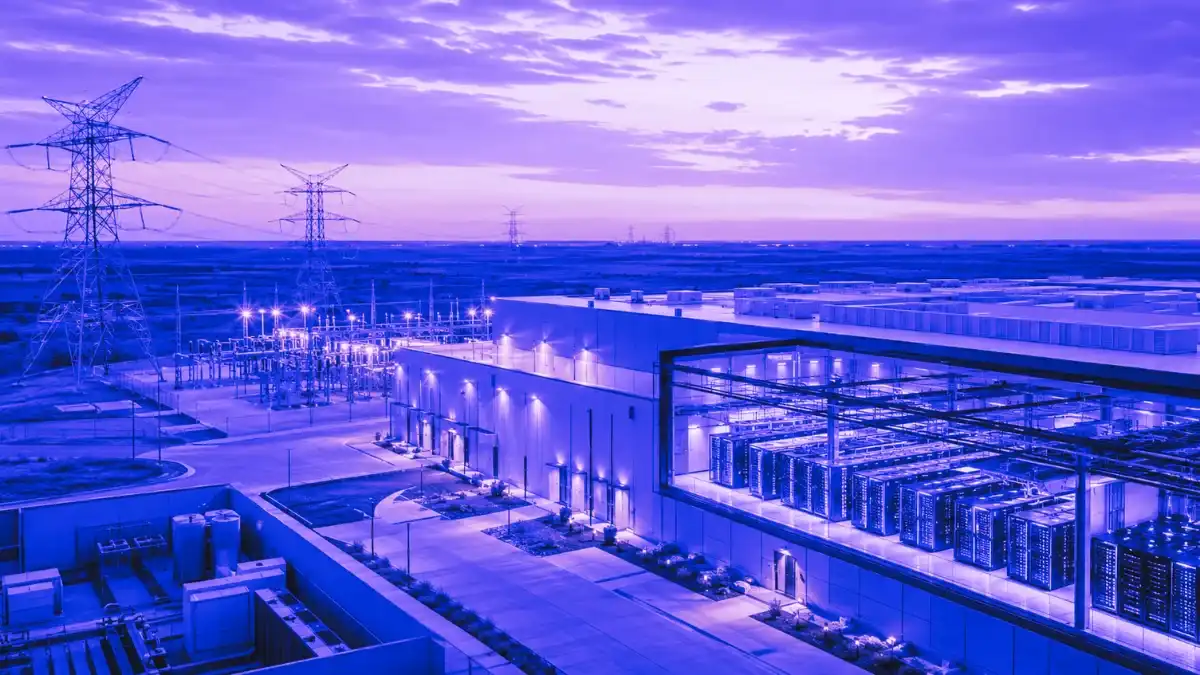
The 750 MW grid-connected site spans 576 acres and includes owned substations and dual, physically diverse fiber paths.
Existing data halls and Texas grid-connected infrastructure allow Blackwell systems to deploy without greenfield development cycles that can delay new capacity.
The air-cooled configuration aligns with the facility’s current capabilities and may reduce the need for cooling redesign.
Power gives IREN the entry point, but it does not automatically make Childress an AI cloud platform.
Execution determines whether the site becomes commissioned, billable AI cloud capacity.
IREN’s deal matters because it attempts to combine those layers, not because power alone guarantees success.
Infrastructure Readiness
Childress gives the Dell Blackwell deployment a physical base instead of leaving it as a hardware announcement.
Power availability is the first constraint in high-density AI deployment.
Physical site control supports expansion beyond a single hardware order.
Diverse paths help move the site from power asset to cloud infrastructure.
System design aligns with current facility capabilities and may reduce redesign risk.
Build strategy from better signals.
I help teams make sense of market movement, competitive pressure, buyer shifts, and public business signals before deciding what to do next.
Why Is IREN’s Dell Deal More Than a GPU Purchase?
A GPU order becomes strategic only when the infrastructure around it is ready to turn hardware into billable compute.
IREN satisfies these conditions at Childress.
The site’s pre-positioned power and fiber infrastructure reduces exposure to delays in land, interconnection, substation, and data hall approvals that constrain operators still securing approvals.
Dell’s full-stack supply reduces fragmented coordination among vendors.
Post-shipment payment terms and separate GPU financing align cash outlay with delivery and reduce the capital-to-revenue dead zone.
How Dell Compresses the Path From Hardware to Revenue
Dell functions as the industrialization layer.
AI infrastructure is no longer assembled by separately procuring GPUs, servers, storage, networking, and support.
Dell’s full-stack package compresses the operational sequence between Nvidia hardware availability and IREN’s revenue activation.
How Could IREN’s Dell Deal Affect Revenue and Risk
The $4.4 billion ARR target includes $1.9 billion in average annual revenue from the Microsoft contract and $0.7 billion from the Dell $3.4 billion AI cloud contract.
It also includes $1.8 billion estimated from planned GPU deployments at Childress and British Columbia sites.
Only portions are fully contracted. The remainder rests on internal assumptions for GPU models, utilization, and pricing.
Revenue Model
What sits inside IREN’s $4.4B ARR target
The target combines contracted visibility with estimated deployment assumptions, which makes execution timing central to the story.
ARR is not the same as recognized revenue, free cash flow, or profit. It is a run-rate metric that depends on timing, utilization, customer ramp, pricing, and operating cost.
ARR can show revenue potential, but it does not prove economic strength. The real test is whether utilization, power costs, financing, support, pricing, and GPU lifespan leave enough margin after the systems are running.
What Financial Questions Still Matter for IREN’s AI Cloud Business?
These are the unanswered questions that determine whether the revenue story becomes an economic story.
Unit Economics Watchlist
Financial questions IREN still has to answer
These questions determine whether the revenue story becomes an economic story after the Blackwell systems are deployed.
What is the cost per deployed Blackwell system?
What utilization rate is needed to support the ARR target?
What power cost assumption underpins the model?
How much of the $4.4B ARR is contracted versus estimated?
What financing costs are associated with the deployment?
What is the expected payback period?
How much margin remains after power, depreciation, support, and financing?
How sensitive is the model to AI compute price compression?
What Could Go Wrong With IREN’s Dell Blackwell Deal
Execution Risk
What could weaken the IREN Dell Blackwell deal before early 2027
The risk sits between demand and revenue. IREN has to prove that the Dell systems can become monetized capacity before AI compute conditions shift.
Delayed deployment pushes revenue activation beyond the expected window.
Capacity must fill at modeled rates for ARR assumptions to hold.
Pricing compression can weaken revenue and margin before ramp.
Higher capital costs or dilution pressure can affect expansion economics.
IREN still needs to prove reliable AI cloud execution beyond power access.
Newer Nvidia platforms could reset Blackwell economics over time.
How Does IREN Compare With Other AI Infrastructure Companies
Market Context
How AI infrastructure operators differ
IREN’s position is not the same as a hyperscaler, neocloud, traditional data center REIT, or pure chip buyer.
Advantage: balance sheet and customer base
Constraint: long build cycles and capex burden
Advantage: AI-focused deployment speed
Constraint: financing risk and customer concentration
Advantage: existing power and sites
Constraint: enterprise-grade cloud execution
Advantage: real estate and relationships
Constraint: slower GPU cloud conversion
Advantage: hardware access
Constraint: no immediate deployment environment
Advantage: energy and land position
Constraint: cloud software, trust, and contracts
IREN is not trying to beat hyperscalers at software breadth.
IREN is targeting a narrow market window where existing power-rich sites can convert into AI cloud capacity before greenfield data centers come online.
That is a different competitive game from AWS, Microsoft Azure, or Google Cloud.
Bitcoin mining monetizes power through hash rate. AI cloud monetizes power through enterprise compute demand.
The physical overlap is power-heavy infrastructure, but the operating model is different. Mining is commodity-like and market-priced.
AI cloud requires customers, contracts, uptime, networking, support, security, and deployment reliability.
IREN’s Dell deal tests whether a power-first operator can cross that operational gap.
What Does IREN’s Dell Deal Reveal About AI Infrastructure?
The core market signal is that AI infrastructure competition is shifting from chip scarcity to scarcity of converted capacity.
Companies that only announce hardware access are not in the same position as companies that control power, sites, integration, financing, and customer contracts.
IREN’s Dell deal is important because it tests the full conversion chain.
What Are the Main Takeaways From IREN’s Dell Blackwell Deal
Key Takeaway
IREN’s Dell Blackwell deal matters because it tests whether AI infrastructure value now belongs to operators that can convert power and hardware into commissioned, billable compute faster than competitors can build new capacity.
IREN’s deal is the beginning of the proof period.
The market will not ultimately judge the agreement by its purchase value, press release size, or Blackwell branding.
It will assess whether the systems arrive, integrate, are commissioned, are loaded with workloads, and produce revenue at the pace implied by IREN’s ARR targets.
The next AI infrastructure winners will not be the companies that only buy Blackwell systems. They will be the companies that can make those systems earn.
FAQ
IREN Dell Blackwell deal questions
Five questions clarify why the deal matters beyond the headline purchase value.
IREN is buying the systems to support its five-year $3.4 billion managed services AI cloud contract with Dell.
Childress gives IREN a power-rich Texas site where AI hardware can move toward commissioned, billable capacity.
No. The larger signal is capacity conversion, which means turning hardware, power, integration, and demand into usable AI cloud output.
No. ARR is a run-rate target, not recognized revenue, cash flow, or profit. It depends on commissioning, utilization, pricing, and execution.
The risk sits between demand and revenue. IREN has to prove that the Dell systems can become monetized capacity before AI compute conditions shift.
What Sources Support the IREN Dell Blackwell Deal Analysis
| Fact | Source |
| $1.6B Dell purchase agreement | IREN press release & 8-K, May 26, 2026 |
| May 19, 2026 signing date | IREN 8-K filing |
| $3.4B Dell managed services AI cloud contract | IREN press release, May 26, 2026 |
| Childress 750 MW, 576 acres, substations, dual fiber | IREN investor site & Q3 FY26 results |
| Early 2027 commissioning target | IREN press release, May 26, 2026 |
| $3.7B to $4.4B ARR uplift | IREN Q3 FY26 & May 26 release |
| Microsoft $9.7B agreement | Microsoft/IREN announcement, November 2025 |
| $5.8B earlier Dell hardware agreements | IREN filings, November 2025 |
Source hierarchy: This analysis prioritizes IREN’s press release, IREN’s 8-K filing, IREN’s Q3 FY26 results, and company-disclosed contract figures. Reuters and other news coverage are used only to confirm the public reporting context.
IVVORA’s contribution is the capacity-conversion framework and the market-structure interpretation.
This analysis distinguishes company-disclosed deal terms, IREN’s forward-looking revenue targets, and IVVORA’s market interpretation. The article focuses on IREN’s $1.6 billion Dell Blackwell purchase, the $3.4 billion managed services AI cloud contract with Dell, Childress site readiness, ARR assumptions, and what the deal reveals about capacity conversion in AI infrastructure.
This is not only a GPU procurement story. It is about how power, site readiness, integration, financing, and contracted demand become billable AI cloud capacity.
The $4.4 billion ARR target is treated as a company run-rate projection, not as recognized revenue, free cash flow, or profit.
Last updated: May 27, 2026