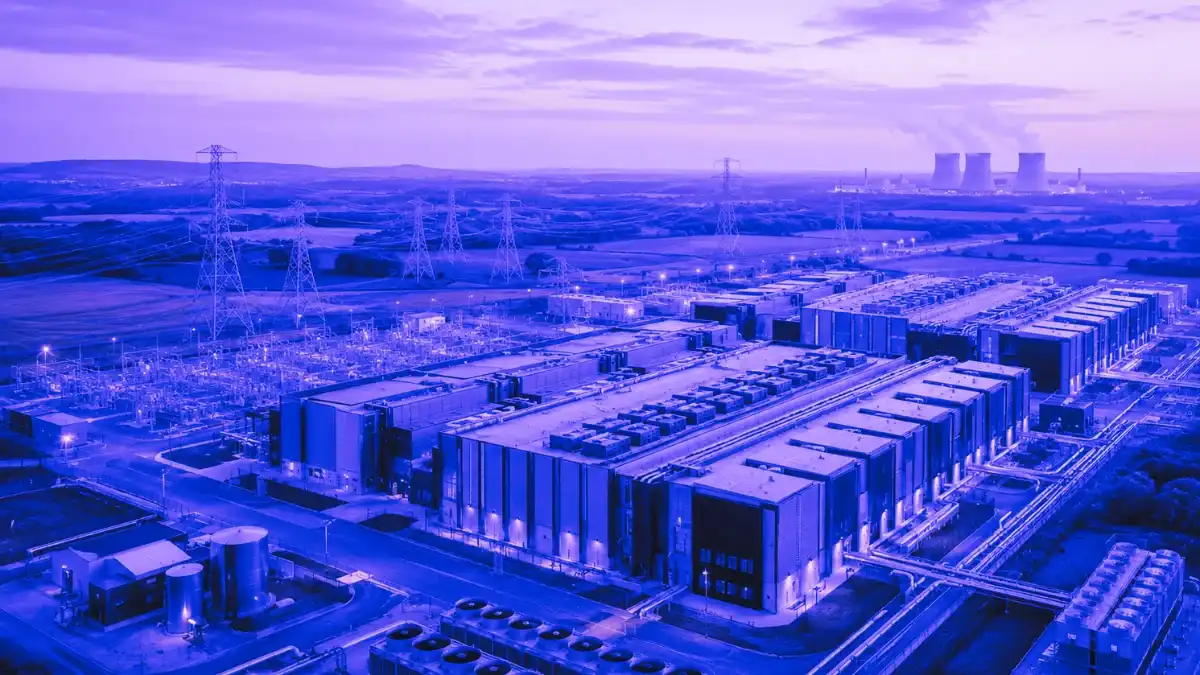
SoftBank’s France AI data center plan matters because it reframes AI infrastructure as a physical capacity problem. The company is planning up to 5 GW of AI data center capacity in France, with a €45 billion first phase targeting 3.1 GW by 2031 across sites including Dunkirk/Loon-Plage, Bosquel, and Bouchain.
The deeper signal is that AI leadership is moving beyond model access and GPU availability. The next advantage depends on who can secure electricity, grid connections, land, cooling, chips, capital, tenants, and jurisdiction before AI demand outruns physical infrastructure.
This analysis is for market interpretation, AI infrastructure analysis, and corporate strategy commentary only. It is not investment advice.
Why SoftBank’s France AI Data Center Deal Matters
SoftBank’s $52B France AI data center deal is about more than new server capacity.
SoftBank is planning up to 5 GW of AI data center capacity in France, turning the country’s power system, industrial land, and European jurisdiction into a strategic compute platform.
Competition centered on models, APIs, cloud access, and software capability.
Advantage now depends on electricity, grid connections, cooling, chips, capital, tenants, and jurisdiction.
In that context, SoftBank is not just expanding AI infrastructure.
It is attempting to convert France’s nuclear-heavy electricity system, EDF-linked sites, Schneider manufacturing capacity, and EU regulatory position into a financeable AI compute platform before infrastructure scarcity tightens toward 2030.
What Has SoftBank Officially Announced About Its France AI Data Center Plan?
The confirmed announcement establishes the scale, locations, partners, and strategic framing. The unresolved items show where execution risk still sits.
Investment ceiling of up to €75 billion, with a first phase of €45 billion and 3.1 GW by 2031 in Hauts-de-France.
Initial locations include Dunkirk/Loon-Plage, Bosquel, and Bouchain, with additional sites planned across France.
Schneider supports power modules and enclosures, while EDF is linked to the former power-plant site at Bouchain.
The project was announced in the Choose France context and described as one of Europe’s largest AI infrastructure commitments.
The strategic value is not only data-center real estate. It is the ability to coordinate power, land, capital, tenants, chips, and jurisdiction.
Final tenant mix, debt partners, GPU procurement, site-level power-purchase terms, and post-2031 construction timelines remain open.
Turn weak signals into better decisions.
I study the signals most teams overlook: competitor moves, product changes, pricing shifts, customer friction, and market pressure.
What Is Confirmed and Still Unknown About the SoftBank France AI Deal?
The announcement confirms the scale and initial locations. The execution questions sit around tenants, financing, GPUs, power terms, grid milestones, and operational timing.
- Up to 5 GW of planned AI data center capacity
- 3.1 GW first phase targeted by 2031
- Initial sites include Dunkirk/Loon-Plage, Bosquel, and Bouchain
- Schneider Electric and EDF are named partners
- SB Energy is involved
- Additional sites are planned across France
- Final tenant names and offtake structure
- Full financing close and debt partners
- Exact SoftBank equity contribution
- GPU supplier commitments
- Site-level power-purchase terms
- Grid connection milestones
- PUE, cooling design, and first operational MW date
- Public subsidies, incentives, and local permitting completion
What Do Compute Territory and Sovereign Compute Mean for AI Data Centers?
Compute territory is the full physical and institutional system that must work together before announced AI data center capacity becomes usable compute.
Gigawatts do not become intelligence by themselves. Power, grid access, cooling, chips, financing, and location must align before AI workloads can run at scale.
The state does not need to own every server. It needs enough influence over power allocation, permitting, location, and governance to treat compute as national capacity.
Why Does AI Data Center Capacity Depend on Gigawatts?
AI scale used to be explained through model parameters, GPU counts, cloud regions, and benchmark scores. SoftBank’s France plan shows the next constraint: electricity.
AI leadership was measured through software access, model performance, and available accelerator supply.
GPUs, cooling, and high-density racks turn electricity into the ceiling on future AI scale.
Why Is SoftBank Building AI Data Centers in France
France offers a rare combination of nuclear-heavy electricity, EDF-linked infrastructure, industrial land, and policy alignment.
For SoftBank, that makes the country more than a data center location. It becomes a platform for European AI compute capacity.
France’s nuclear-heavy grid gives AI data centers a low-carbon baseload story that many European markets cannot match.
EDF’s former power-plant site at Bouchain gives the project a stronger industrial and energy-infrastructure foundation.
Industrial land and Schneider’s manufacturing role help connect AI data centers with local electrical infrastructure capacity.
The project fits France’s investment strategy and Europe’s broader push for technological sovereignty.
Harder baseload and grid-expansion challenge after nuclear exit.
Planning, grid-connection, and power-availability pressure.
Land and power-density constraints limit expansion flexibility.
France’s power profile helps the project, but grid connection, power pricing, cooling design, local acceptance, tenants, and financing still decide whether planned capacity becomes usable compute.
SoftBank’s major AI exposure, including OpenAI-linked strategy, makes the France deployment a move toward long-cycle infrastructure economics if offtake agreements materialize.
Why Announced AI Data Center Capacity Is Not the Same as Usable Compute
Gigawatts measure available electricity input before power-usage-effectiveness overhead, cooling demand, redundancy, and non-IT load. The real question is how much announced capacity becomes connected, commissioned, GPU-filled, and contracted.
A public plan or target. It signals ambition, not delivery.
Grid access and site infrastructure begin turning the plan into progress.
The facility has operational power available for computing systems.
Power becomes actual AI compute only when chips and systems are installed.
Tenants and workloads create economic proof.
Secured GW means capacity with site control, grid interconnection, power pricing, financing, permits, tenants, and equipment supply materially de-risked.
How Will SoftBank Finance and Deliver Its France AI Data Center Plan
Gigawatts measure available electricity input before power-usage-effectiveness overhead, cooling demand, redundancy, and non-IT load.
The real question is how much announced capacity becomes connected, commissioned, GPU-filled, and contracted.
A public plan or target. It signals ambition, not delivery.
Grid access and site infrastructure begin turning the plan into progress.
The facility has operational power available for computing systems.
Power becomes actual AI compute only when chips and systems are installed.
Tenants and workloads create economic proof.
Secured GW means capacity with site control, grid interconnection, power pricing, financing, permits, tenants, and equipment supply materially de-risked.
How Does France Compare With Other AI Data Center Markets
France does not have the largest data center market today. Its advantage is the combination of nuclear-heavy power, policy alignment, industrial land, and a large announced AI capacity pipeline.
~68% nuclear baseload
Execution on multi-site scale
Limited baseload
Grid congestion, coal phase-out
Mixed renewables + gas
Grid connection and planning
High density limits
Land and power availability
Scale but regional strain
Grid delays, local opposition
These ranges are directional estimates across market reports, including EUDCA 2026, and should not be read as exact apples-to-apples IT-load totals. Data center capacity is reported differently across sources. The comparison focuses on constraint profiles, not audited installed capacity.
Who Benefits From SoftBank’s France AI Data Center Deal
SoftBank’s France AI data center plan creates strategic upside for France, SoftBank, EDF, Schneider Electric, and European enterprises.
But it also raises questions about capacity access, grid costs, local acceptance, and whether sovereign infrastructure remains sovereign when foreign capital, chips, and tenants shape the system.
- France gains investment, industrial jobs, and AI sovereignty signaling.
- SoftBank gains infrastructure coordination and geographic diversification.
- EDF may monetize former power-plant infrastructure.
- Schneider Electric secures local manufacturing demand.
- Hauts-de-France gains industrial redevelopment momentum.
- Germany faces baseload and grid-expansion pressure.
- The UK and Netherlands face planning, land, and power-density constraints.
- Smaller European AI firms may lose access if large tenants lock capacity.
- Local communities may question power, water, land, and cost allocation.
- Rival hubs must prove energy availability, not just AI demand.
France gains jurisdictional leverage by hosting AI infrastructure. But if the project is financed, occupied, or operationally shaped by foreign capital, foreign chips, and foreign tenants, full control over the AI value chain becomes more complex.
- European entities influence power allocation
- Tenant access is not fully locked by hyperscalers
- Data governance remains inside EU oversight
- Industrial supply is meaningfully localized
- Foreign hyperscalers control most capacity
- Foreign chips determine compute availability
- Financing terms shape strategic access
- European startups remain capacity-constrained
Multi-GW AI data center projects often require transmission, substations, and grid planning. The unresolved question is how those costs are divided between the developer, utility, state, ratepayers, industrial users, and local communities.
What Are the Biggest Risks for SoftBank’s France AI Data Center Plan
The biggest risks sit between announcement and operational compute. Financing, grid connection, tenant demand, GPU supply, cooling design, power prices, and local acceptance will decide whether planned capacity becomes usable infrastructure.
€75B scale needs debt partners and committed tenants.
3.1 GW load requires coordinated upgrades.
Multi-site delivery by 2031 creates schedule risk.
Power without chips does not deliver compute.
High-density AI racks increase thermal load.
AI workload mix may shift toward efficient models.
Low-carbon does not automatically mean low-cost.
Large energy users can trigger public pushback.
AI Act or sovereignty measures may evolve.
The project runs beyond one political cycle.
Shows financing risk is being reduced.
Creates revenue visibility and demand proof.
Clarifies power economics and pricing exposure.
Tests whether the delivery timeline is realistic.
Shows whether power can become actual compute.
Marks the shift from announcement to operation.
Clarifies usable IT load, operating efficiency, and sustainability pressure.
Signed hyperscaler or sovereign tenants at scale, on-time grid connections, debt close without full recourse, localized manufacturing output, and first operational megawatts ahead of 2031 targets.
Capacity delayed materially past 2031, offtake shortfalls, local opposition blocking sites, power prices rising sharply, or AI demand shifting to edge inference or smaller models that reduce centralized needs.
Why SoftBank’s France AI Data Center Deal Matters for AI Infrastructure
SoftBank’s France plan reframes AI infrastructure as compute territory: a sovereign system of electricity, land, grid access, capital, tenants, chips, and jurisdiction that decides whether AI capacity can move from announcement to operation.
Model quality still matters. GPU access still matters. But frontier AI now depends on whether power, grid access, land, cooling, chips, financing, tenants, and jurisdiction can be synchronized into operational compute.
Advantage came from model quality, benchmark performance, cloud access, and GPU availability.
Advantage shifts toward whoever can turn electricity, grid access, cooling, capital, chips, tenants, and jurisdiction into governed compute.
This analysis separates confirmed SoftBank France AI data center details from IVVORA’s market interpretation. The article focuses on SoftBank’s planned AI data center investment in France, the €45 billion first phase, the 3.1 GW capacity target by 2031, the broader €75 billion / 5 GW ambition, the Hauts-de-France sites including Dunkirk/Loon-Plage, Bosquel, and Bouchain, Schneider Electric’s manufacturing role, EDF-linked infrastructure, project-finance uncertainty, grid connection risk, and the broader shift from model access to compute territory.
This article is for market, AI infrastructure, corporate strategy, energy infrastructure, sovereign compute, and business model analysis only and is not financial advice, investment advice, or a recommendation to buy or sell any security.
Last updated: May 31, 2026