Inside this article
Why Is McDonald’s Removing Self-Serve Soda Fountains?
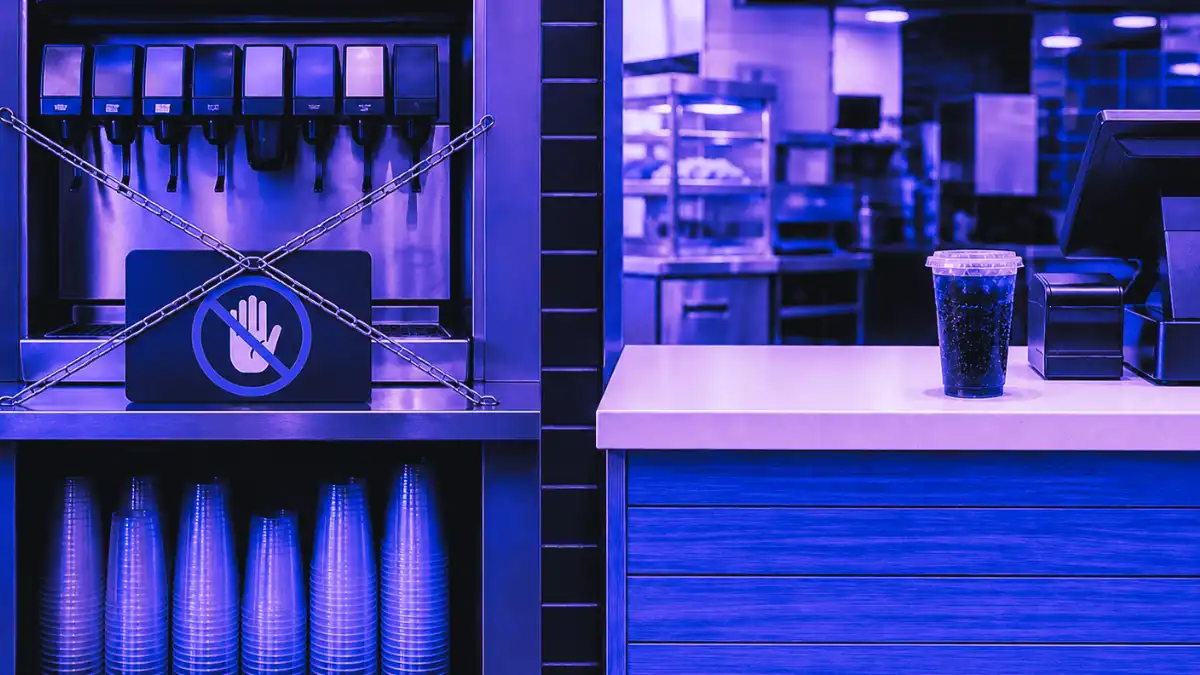
McDonald’s is removing self-serve soda fountains from many U.S. restaurants as part of its long-term beverage station phase-out.
The change affects McDonald’s free refills, as customers may no longer be able to refill their drinks at the fountain.
McDonald’s had previously confirmed that it would transition away from self-serve beverage stations in U.S. restaurants by 2032.
Now, more drinks are being poured by crew members behind the counter, and refill policies may vary by location. Some restaurants may still offer complimentary refills on request, while others may charge for additional servings.
What looks like a small soda policy change points to a larger shift in the fast-food industry. Chains are reducing open self-service features and moving toward more controlled store operations.
Why Did McDonald’s Offer Free Refills?
Free refills once operated as an open-access consumption system. Customers controlled their own volume at the fountain.
This design created a perception of abundance inside a transaction that customers increasingly experienced as expensive.
Diners refilled multiple times during a meal. The ritual reinforced a small fairness signal. Customers sensed they received one area of generosity even as menu prices rose year after year.
The system also reduced immediate labor at the point of service by allowing guests to handle their own top-ups.
The arrangement carried hidden operational weight. Unlimited access encouraged variable consumption volumes. Spills accumulated around stations. Syrup levels required constant monitoring. Unauthorized refills occurred without register linkage.
Across McDonald’s large U.S. footprint, these small exposures become harder to ignore.
McDonald’s removal of self-serve access converts that open point into a managed service point. Crew preparation replaces customer self-service.
The change looks minor on the surface. It quietly eliminates an uncontrolled variable from daily store operations.
Why Are Customers Upset About McDonald’s Soda Changes?
Customer backlash is predictable because free refills carried emotional weight. They never represented only beverage volume. They functioned as a small fairness signal inside a system where prices kept climbing.
Removing that signal makes the transaction feel narrower.
Diners who once topped off their drinks without a second thought now face a crew-poured limit, a request for a refill, or a possible additional charge.
The adjustment disrupts a habit that felt baked into the McDonald’s experience.
The friction exposes how deeply customers internalized self-service abundance as part of the brand promise.
How Do McDonald’s Soda Changes Affect Refills?
McDonald’s removes customer-controlled access to fountain drinks. This adjustment addresses several operational variables at once. Customer movement inside stores decreases around former fountain zones.
Staff no longer monitor or clean open stations multiple times per shift. Cleanliness improves because spills, ice overflow, and mixing residue no longer collect in public areas.
Waste tightens as portion control moves behind the counter. Unauthorized refills become harder without staff involvement.
The workload shifts from scattered fountain maintenance to visible counter service. Beverages now integrate into the normal order flow rather than requiring separate station oversight.
This consolidation aims to reduce unplanned labor around cleaning and monitoring.
The bigger alignment is not with drive-thru drink preparation, which was already controlled. It is with a store model where fewer customer actions happen outside the managed service flow.
| Service Model | Customer Role | Operational Variables |
| Legacy Open-Access | Self-pour and refills | Movement, spills, variable volume, unauthorized use |
| Emerging Controlled | Receive crew-poured drink | Standardized portions, integrated counter flow, and reduced public stations |
Why Is McDonald’s Moving Away From Self-Service?
Fast-food economics once supported large dining rooms and high-volume self-service. Customers lingered and refilled freely. Dine-in traffic justified the open layout.
That model no longer matches current realities. Labor costs consume a rising share of revenue across quick-service restaurants.
High turnover and wage pressures make every minute of unplanned work expensive. Store footprints shrink in new builds to favor drive-thru and digital channels.
Smaller dining rooms reduce real-estate overhead and maintenance demands. McDonald’s continues to push kiosk adoption and mobile ordering.
Kiosks and mobile ordering route more transactions through controlled handoffs.
Open fountains created friction in a system optimized for speed and consistency across channels.
The removal of self-serve stations eliminates one source of inconsistency. More beverage now ties directly to a registered transaction. Inventory tracking sharpens. Portion control becomes uniform.
The older abundance-based convenience gives way to measurable operational precision.
How Do McDonald’s New Drinks Fit Into the Soda Changes?
McDonald’s expands its beverage lineup in 2026 with new Refreshers and crafted sodas rolling out nationwide.
These items carry a more premium positioning than standard fountain soda. Preparation stays behind the counter inside the controlled model.
The business logic changes from “let customers consume more of a low-cost product” to “make beverages feel differentiated enough to justify controlled pricing.”
The chain now channels that profitability through managed offerings rather than unlimited self-service volume.
Some locations may continue complimentary refills upon request. Others may charge for additional servings depending on local policy.
Corporate direction creates system-wide consistency in service delivery while allowing local flexibility.
The approach balances control at scale with operator-level judgment.
What Can Marketers Learn From McDonald’s Free Refill Changes?
Marketers still sell convenience emotionally. Operations increasingly deliver it conditionally. The McDonald’s soda changes expose this tension.
Brands built promises around abundance and ease. Free refills reinforced that emotional contract. When operations remove the perk to protect labor, waste, and flow metrics, the promise collides with reality.
Customers notice the narrower transaction even if the actual cost difference remains small. For senior marketers, the lesson runs deeper than one menu item.
Every convenience feature eventually faces scrutiny when store economics tighten.
Open-access elements create operational liabilities once labor, waste, and redesign priorities shift.
Brands that ignore this pattern risk promising experiences their systems can no longer support at scale. The soda adjustment offers an early signal.
Marketers who map how small service reductions reveal larger cost and control pressures gain advantage in pricing, promotion, and customer-experience messaging.
What Do McDonald’s Soda Changes Mean for Fast Food?
This is not the end of free soda, but fast food pretending that unlimited convenience has no operational cost. McDonald’s advances a store-level reset.
The chain removes an open-access consumption system that once delivered perceived value at the expense of labor predictability, waste control, and flow consistency.
The adjustment aligns with a broader industry trend toward controlled service points and margin protection.
Soda policy remains the visible front line while store economics drive the actual story. Fast-food chains move from customer-managed abundance to operator-controlled efficiency.
What looks like a customer inconvenience functions as a disciplined recalibration inside the operating model.
The next wave will not always look dramatic. It may look like fewer refills, fewer customizations, smaller dining rooms, tighter pickup flows, and more controlled service points.
That is the signal McDonald’s soda changes make visible.