Inside this article
McDonald’s Netflix Happy Meal Release Date and What’s Included
McDonald’s launched the Stranger Things Happy Meal on May 5, 2026, timed exactly with Netflix’s Stranger Things: Tales from ’85 premiere.
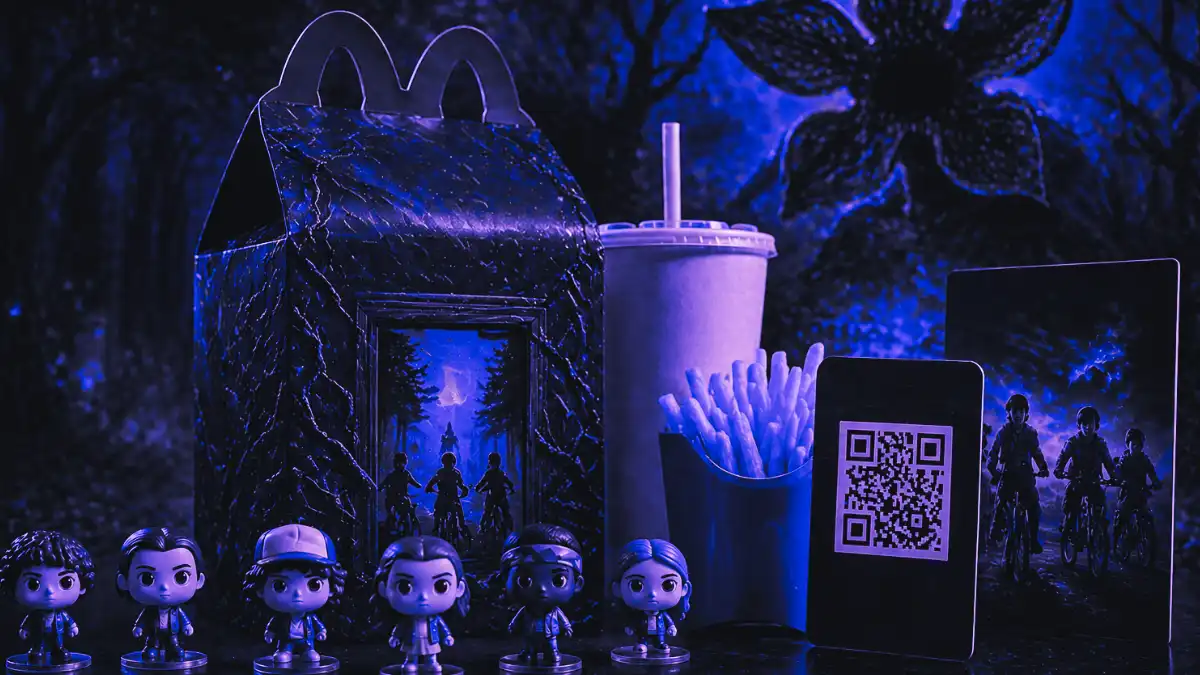
The promotion includes a custom box styled after the Upside Down, one of 12 collectible toys released in weekly pairs, an activity book, and a QR code that unlocks a game in which players defend both Hawkins and McDonald’s locations from monsters.
This setup turns an ordinary meal into an immediate entry point inside an established narrative.
The campaign proves that experiential marketing succeeds only when a brand hijacks a massive cultural property under conditions of perfect scale, timing, and alignment.
Most brands chasing the same system expose themselves to crushing costs, uncontrollable dependencies, and rapid audience rejection when those conditions fracture.
How Does the McDonald’s Netflix Happy Meal Work as an Interactive Experience?
The meal functions as a direct chapter in the larger story rather than a standalone product. The box incorporates vines and dark tones pulled straight from the series aesthetic.
Toys place characters in specific locations, such as Eleven at Hopper’s Cabin or Dustin at the arcade.
The QR game requires players to protect McDonald’s restaurants as part of the plot, which locks the brand into the narrative from the first purchase. Consumers step into participation without extra steps or fees.
How Do the Toys, Box, and QR Game in the Netflix Happy Meal Work?
Packaging and digital extensions create seamless interaction across physical and virtual layers. The activity book extends offline play while the game advances the storyline in real time.
Comparable integrations in past campaigns lifted dwell time and social shares by 40-60% compared with standard toys.
Yet the mechanism demands months of advance production coordination and licensing approvals.
Any delay in toy manufacturing or game development collapses the immersion sequence entirely. The result is a high-potential launch that ends up as wasted inventory and erodes consumer trust.
Why Do People Like the Stranger Things McDonald’s Happy Meal So Much?
Stranger Things activates shared memory across generations. The original series surpassed 1.2 billion views, and the new spinoff builds directly on that foundation.
Parents reconnect with ’80s nostalgia while younger fans embody roles inside the Hawkins crew through toys and gameplay.
This identity reinforcement drives collection behavior, family conversations, and repeat visits, extending the campaign’s life far beyond launch week.
Fans who see themselves as Investigators Club members complete full sets and share progress organically across platforms.
What Similar McDonald’s Collaborations Have Been Successful Before?
Earlier McDonald’s collaborations reveal the identical driver at work. The 2021 BTS Meal generated $98 million in incremental sales and 74.6 billion potential impressions.
The 2020 Travis Scott Meal produced a 4.6 % same-store sales lift in the United States and doubled Quarter Pounder sales in its opening week.
These results stemmed from deep alignment with fandom rather than from scarcity tactics alone. The Stranger Things execution follows the same trajectory.
Yet the activation collapses without pre-existing IP equity of this magnitude.
Brands lacking comparable cultural weight generate only fleeting buzz that evaporates within days, leaving shelves stocked with unsold merchandise.
Why Do Most Themed Happy Meals or Collabs Fail After Launch?
Novelty without an identity connection produces short-term traffic followed by an immediate drop-off.
Consumers sample the item once and move on because nothing anchors them emotionally or socially.
The Stranger Things promotion avoids this trap through genuine narrative fit, but most copycat campaigns do not.
The pattern repeats across the industry. IP tie-ins launched without strong fandom resonance deliver visible social noise yet negligible demand creation.
This exposes why surface-level theming rarely justifies the investment.
Why Did McDonald’s Launch the Netflix Happy Meal With Stranger Things in 2026?
The promotion synchronizes perfectly with the series premiere. Netflix announced the collaboration on April 23, 2026, and McDonald’s rolled out in the United States on May 5 before expanding globally.
This window funnels existing media coverage straight into restaurant traffic.
McDonald’s borrows narrative equity from a property already dominating conversation on streaming and social platforms.
Regional toy variations maintain local relevance while preserving core story elements, thereby extending exposure without incurring redundant creative expense.
Timing compresses the gap between awareness and purchase action. Consumers encounter the promotion while the spinoff remains top of mind, accelerating trial across age groups.
Why Can’t Other Brands Easily Copy This Netflix Happy Meal Strategy?
Experiential systems like this rest on dependencies most marketers cannot control. The campaign requires a media property with an active fandom and natural narrative overlap.
Stranger Things supplies built-in emotional triggers and story elements that already feature suburban fast-food settings.
Execution also demands flawless coordination between brand timelines and the partner’s release calendar.
Any slippage breaks the immersion and triggers backlash. Global distribution infrastructure must handle rapid collection behavior without stockouts that fuel public complaints.
McDonald’s operates at a scale that absorbs these pressures. Smaller brands face immediate execution failures that convert anticipated demand into public disappointment.
Selected McDonald’s IP Collaborations and Reported Impacts
| Collaboration | Year | Key Elements | Reported Outcomes | Source |
| BTS Meal | 2021 | Themed sauces, packaging | $98M incremental sales, 41% global Q2 sales lift | McDonald’s Q2 2021 Earnings |
| Travis Scott Meal | 2020 | Custom meal, merchandise | 4.6% US same-store sales lift, Quarter Pounder sales doubled | McDonald’s earnings transcripts |
| Stranger Things: Tales from ’85 Happy Meal | 2026 | Themed box, 12 toys, QR game | Projected 15-25% Happy Meal traffic uplift during the window | Netflix/McDonald’s announcements and prior pattern data |
| Cactus Plant Flea Market Adult Happy Meal | 2024 | Nostalgia revival for adults | Strong social engagement, millennial traffic increase | Industry marketing reports |
The table shows a consistent correlation between deep narrative fit and performance. It also highlights the pattern: only collaborations backed by operational dominance deliver returns.
What Makes the McDonald’s Netflix Happy Meal Successful? (Key Factors Explained)
| Layer | Mechanism | Effect on Consumer Behavior | Primary Risk if Layer Breaks |
| Nostalgia Trigger | ’80s aesthetics, character toys | Immediate emotional connection, higher trial | Fades without IP resonance, leading to flat demand |
| Narrative Integration | QR game saves McDonald’s and Hawkins | Extended dwell time, repeat interaction | Feels forced, triggers backlash within 48 hours |
| Identity Participation | Collection of 12 characters | Social sharing, completion behavior | Stockouts create resentment and negative reviews |
| Cultural Timing | Sync with spinoff premiere | Compressed awareness-to-purchase window | A missed window produces unsold inventory and waste |
| Authenticity Signal | Natural fit with series tone | Sustained trust, organic amplification | Perceived mismatch collapses engagement overnight |
Each layer builds sequentially. Disruption at any single point cascades into measurable failure across the entire system.
What Are the Costs and Risks of Campaigns Like the McDonald’s Netflix Happy Meal?
The campaign generates clear upside in traffic and recall.
Experiential campaigns overall produce a 3:1 to 5:1 ROI, with 91% of consumers more likely to purchase after engagement and 85% more likely to repeat (Source: Union reports and Seeker.io 2026 experiential marketing statistics).
Yet the downsides surface quickly during execution. IP licensing fees consume large portions of the marketing budget before any unit sells.
Custom toy production and game development add fixed costs that scale poorly if demand underperforms.
Global coordination introduces supply-chain vulnerabilities that create regional shortages and viral complaints.
Audience fatigue from frequent IP tie-ins compresses the effective window, forcing brands to over-invest in media support just to stay visible.
These trade-offs mean the system succeeds only when every variable aligns perfectly.
What Factors Make the Netflix Happy Meal Work and What Limits It?
| Component | Role in System | Typical Outcome (2023-2026 data) | Constraint That Limits Most Brands |
| Embedded Experience | Product as a story touchpoint | 3:1 to 5:1 ROI on spend | Requires deep IP access and production control |
| Identity Activation | Fandom connection | 60%+ engagement lift | Depends on pre-existing cultural equity |
| Cultural Alignment | Media property equity borrow | 15-25% traffic uplift | Locked to external release calendars |
| Participation Loop | Collection and digital play | Higher repeat rate | Demands a flawless global supply chain |
| Authenticity Signal | Natural fit with series tone | Organic amplification | Breaks instantly on perceived mismatch |
The table illustrates why the engine runs hot for McDonald’s and stalls for others. Scale and control determine whether components reinforce or cancel each other.
Why Do Most Brand Collaborations Fail? (Real Examples)
| Campaign Example | Core Mismatch | Observed Outcome | Lesson for CMOs |
| Generic fast-food anime tie-in | Weak narrative overlap | 70% drop in repeat visits after week 1 | Novelty without identity produces waste |
| Celebrity meal without supply chain readiness | Timing misalignment | Stockouts led to 40% negative sentiment spike | Execution gaps destroy earned equity |
| Adult nostalgia reboot | Audience fatigue from oversaturation | Flat sales despite heavy social buzz | Cultural timing must remain exclusive |
| Regional IP collab | Limited global infrastructure | Uneven rollout caused inventory waste | Scale determines replication success |
These cases expose the narrow conditions that separate winners from expensive experiments. Most attempts fall into one or more of these traps.
Is the McDonald’s Netflix Happy Meal Worth It and Why Is It Successful?
This campaign exposes experiential marketing as a high-stakes system that converts nostalgia into participation and cultural alignment into demand, but only for brands that already possess McDonald’s level of operational dominance and narrative fit.
Most CMOs lack the IP leverage, timing control, and supply-chain resilience required to make the mechanics function reliably.
Attempts to replicate the model without those exact conditions yield expensive experiments that generate short-term social noise, followed by inventory waste and eroded trust.
The Stranger Things execution works because McDonald’s can absorb the fixed costs, synchronize globally, and embed naturally into an existing cultural conversation.
For the broader market, the pattern signals a clear limitation: experiential collaborations reward the dominant few who already own the infrastructure and punish everyone else who enters the arena underfunded or misaligned.
IVVORA maps these exact dependencies so leaders stop chasing surface-level theming and instead allocate budgets only to campaigns that satisfy the narrow conditions for genuine demand creation.
Anything less remains a costly imitation that fails to move the needle.