Inside this article
Why Warehouse One and Bootlegger Are Liquidating Stores Across Canada
Warehouse One and Bootlegger liquidation is a warning about why mid-tier apparel retailers are struggling in Canada.
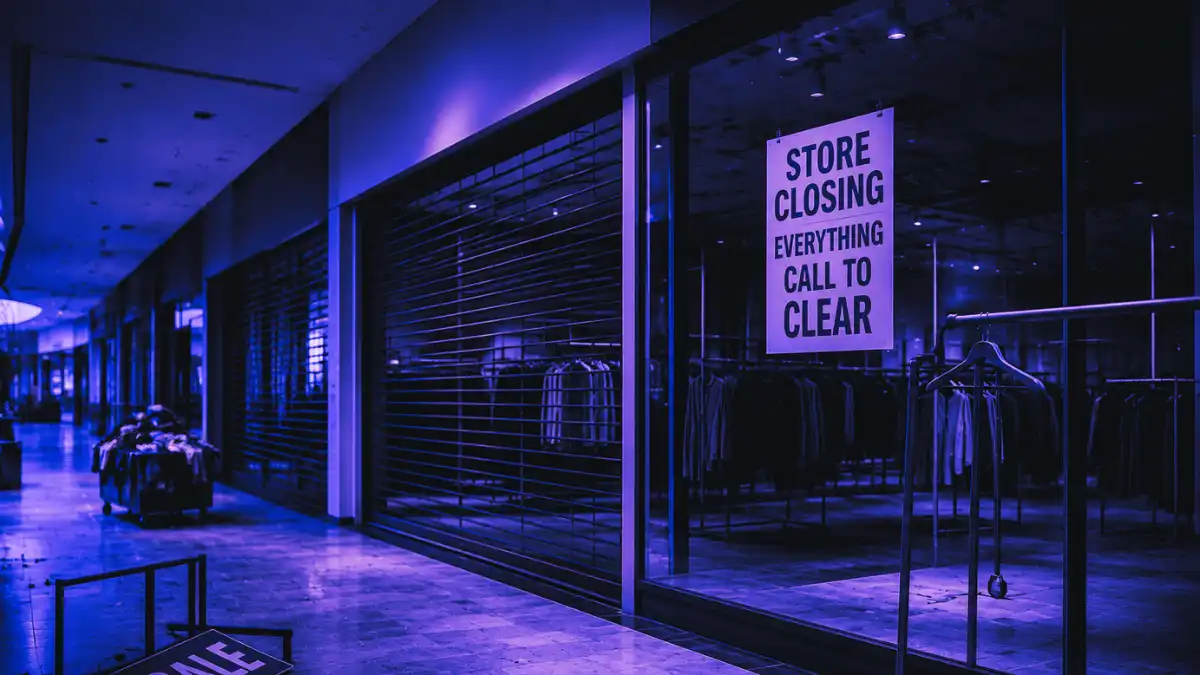
Warehouse One Clothing Ltd. filed for CCAA protection on May 6, 2026, and will close 128 Warehouse One and Bootlegger stores nationwide.
The filing affects 982 employees and follows Warehouse One’s April 2025 acquisition of Bootlegger from Comark Holdings.
Court records show the combined business lost roughly $15 million in the most recent fiscal period, following an earlier $6.5 million shortfall, while shareholder advances of more than $39 million since 2020 have failed to close the gap.
This is not just a weak-demand story. Shoppers did not stop buying clothes. They became less willing to buy from brands that offered recognition without a clear reason to choose them.
Warehouse One and Bootlegger occupied the exposed middle of apparel retail, where familiarity no longer translated into preference.
The Bootlegger acquisition did not solve that positioning problem. It expanded it into a larger cost structure.
That is why this liquidation matters beyond one Canadian retailer. It shows how the middle-market retail trap works when familiar brands lose ownership of value, identity, convenience, and customer loyalty.
How the Bootlegger Acquisition Added More Pressure to Warehouse One
The 2025 acquisition of Bootlegger looked like a logical survival move.
Two mid-tier banners with overlapping denim heritage could combine scale, reduce duplication, and strengthen negotiating leverage with landlords and suppliers.
Revenue increased in the short term. Store-level costs, corporate overhead, and integration expenses rose faster.
The combined entity inherited two versions of the same positioning weakness, thereby multiplying the operational load.
This sequence exposes the danger of treating consolidation as strategic repair.
Adding stores and banners does not create pricing power when the model lacks lowest-cost operations. It does not build identity when the product story remains generic.
Why Buying Bootlegger Did Not Fix Warehouse One’s Retail Problems
Post-acquisition data from court materials show that smaller-market locations, which accounted for about 40 percent of sales, experienced year-over-year traffic declines exceeding 10 percent.
These stores sat in regional malls with limited replacement tenant options and higher relative occupancy costs.
Any imported inventory exposure would have made it harder to absorb margin pressure, but the deeper problem was not currency. It was unclear positioning. The combined operation could not respond decisively.
The acquisition, therefore, amplified exposure rather than reduced it.
Why Mid-Tier Apparel Retailers Are Getting Squeezed From Every Side
Strategic compression occurs when all flanking forces in the market simultaneously attack the mid-tier value proposition. A mid-tier retailer now faces all these pressures at once.
Warehouse One and Bootlegger could match none of them decisively. They competed on familiarity and accessibility, yet delivered neither the lowest price nor the strongest desire.
The model, therefore, produced inventory that moved only at deep discounts, stores that required subsidies rather than generating rent cover, and a cost structure that outpaced revenue even after accounting for acquisition synergies.
The Five Forces That Squeeze the Middle
Strategic Compression Forces in Canadian Apparel Retail
| Force | Owner | Impact on Mid-Tier Operators |
| Price leadership | TJX, Walmart, Shein | Margin erosion on core denim and basics |
| Identity and desire | Aritzia, premium labels | Loyalty is shifting away from moderate brands |
| Trend velocity | Zara, H&M | Assortment disadvantage in fast cycles |
| Convenience | Marketplaces, Amazon | Reduced the necessity of regional mall visits |
| Community attachment | Niche and resale | Relevance loss among younger shoppers |
(Source: IVVORA analysis based on public retail positioning patterns and Retail Insider’s reporting on Warehouse One’s CCAA filing)
Need someone who reads beyond keywords?
I analyze annual reports, policy shifts, product decisions, customer behavior, and platform changes to find useful marketing direction.
Start the ConversationWhy Regional Mall Stores Became a Problem for Warehouse One
Regional mall dependence created additional vulnerability. Warehouse One maintained a heavy presence in smaller Canadian markets where population density is lower, and replacement tenants are scarce.
These locations once anchored local shopping, but now incur fixed lease and labor costs without generating proportional traffic.
Why Physical Stores No Longer Protect Warehouse One and Bootlegger
The stores generated awareness through decades of presence, yet no longer created a strategic necessity in the consumer path.
Shoppers recognized the banners but chose elsewhere because the proposition offered no compelling edge.
Moderate pricing looked neither affordable enough relative to discount channels nor aspirational enough relative to premium ones. The physical footprint, once an asset, now requires ongoing subsidies through liquidation pricing.
How Middle-Market Assets Flip from Strength to Weakness
| Legacy Asset | Historical Role | Current Reality in Compressed Market |
| Regional mall stores | Traffic anchor in smaller markets | High fixed costs with declining foot traffic |
| Broad denim assortment | Familiar everyday selection | No ownership of price or trend leadership |
| Long-term brand memory | Customer recognition | Recognition without preference or urgency |
| Moderate pricing | Accessible value | Neither cheapest nor most desirable |
How Retail Leadership Missed the Bigger Positioning Problem
The governance failure was likely deeper than one department. The business appears to have preserved its scale and footprint, while the consumer reason to choose the brand has been weakening.
Leadership teams tracked store count, same-store sales, and mall occupancy as primary metrics. These measures preserved the appearance of stability while the underlying positioning deteriorated.
How Store Count and Sales Metrics Can Hide Retail Weakness
The Bootlegger acquisition passed internal reviews because it increased top-line scale even though it added complexity without resolving core weaknesses.
Shareholder loans bridged gaps for years but delayed the hard decision to reposition or exit. When funding support ended, the accumulated tension turned into an insolvency event.
This pattern shows how governance systems built for an earlier retail era accelerate exposure when the market demands decisive ownership of a single advantage.
What Warehouse One’s Collapse Says About Canadian Apparel Retail
Warehouse One and Bootlegger fit a familiar sequence in Canadian apparel. A recognizable banner keeps stores open through legacy traffic. Promotions become routine. Differentiation weakens.
A restructuring or acquisition buys time. Then the cost structure catches up with the brand problem.
The same pattern appeared across other mid-tier apparel names, including Comark’s restructuring of the Ricki’s and Cleo banners and the prior liquidation of Le Château.
The names differ, but the sequence is consistent. Recognition lasts longer than relevance. The system consistently rewards clarity while penalizing ambiguity.
The same dynamics appear in other middle-market categories where undifferentiated players lose ground to specialists at either extreme.
Why Other Mid-Tier Retail Brands Face the Same Risk
Senior marketers overseeing mid-tier portfolios must run a focused audit before compression forces the same outcome. Examine whether the brand owns any non-negotiable advantage that shoppers will actively choose.
Test every element of the operating model against the compression forces now in play. Assess whether legacy metrics still drive decisions or mask positioning failures.
What Retail Marketers Should Check Before a Brand Starts Losing Relevance
Evaluate acquisition or consolidation logic by whether it fixes or merely enlarges ambiguity.
The middle market once appeared safe because it avoided extremes. It now sits exposed because those extremes have grown stronger and more targeted.
Brands that remain unclear will face the same progression from traffic decline to margin pressure to liquidity exhaustion.
What the Warehouse One and Bootlegger Liquidation Mean for Retail Brands
The Warehouse One and Bootlegger liquidation is not another routine retail failure. It demonstrates why the middle of apparel retail has become a trap.
The danger lies not in being too expensive or too cheap. It lies in being too unclear. Shoppers did not abandon apparel. They abandoned brands that could not give them a sharper reason to choose.
The Bootlegger acquisition combined two weak positions into a single larger operation without creating pricing power, identity strength, or operational urgency. That sequence turned strategic ambiguity into financial exhaustion.
For marketers, the lesson is direct. The market no longer protects brands that rely on familiarity, moderate pricing, and regional presence alone. A mid-tier retailer must own one reason shoppers cannot easily replace it.
Senior marketers should reposition before the court system does it for them.
IVVORA maps these collapses as predictable outcomes of positioning failure under strategic compression.
Warehouse One and Bootlegger did not lose to any single competitor. They lost to a market structure where every competitor had a clearer reason to exist.