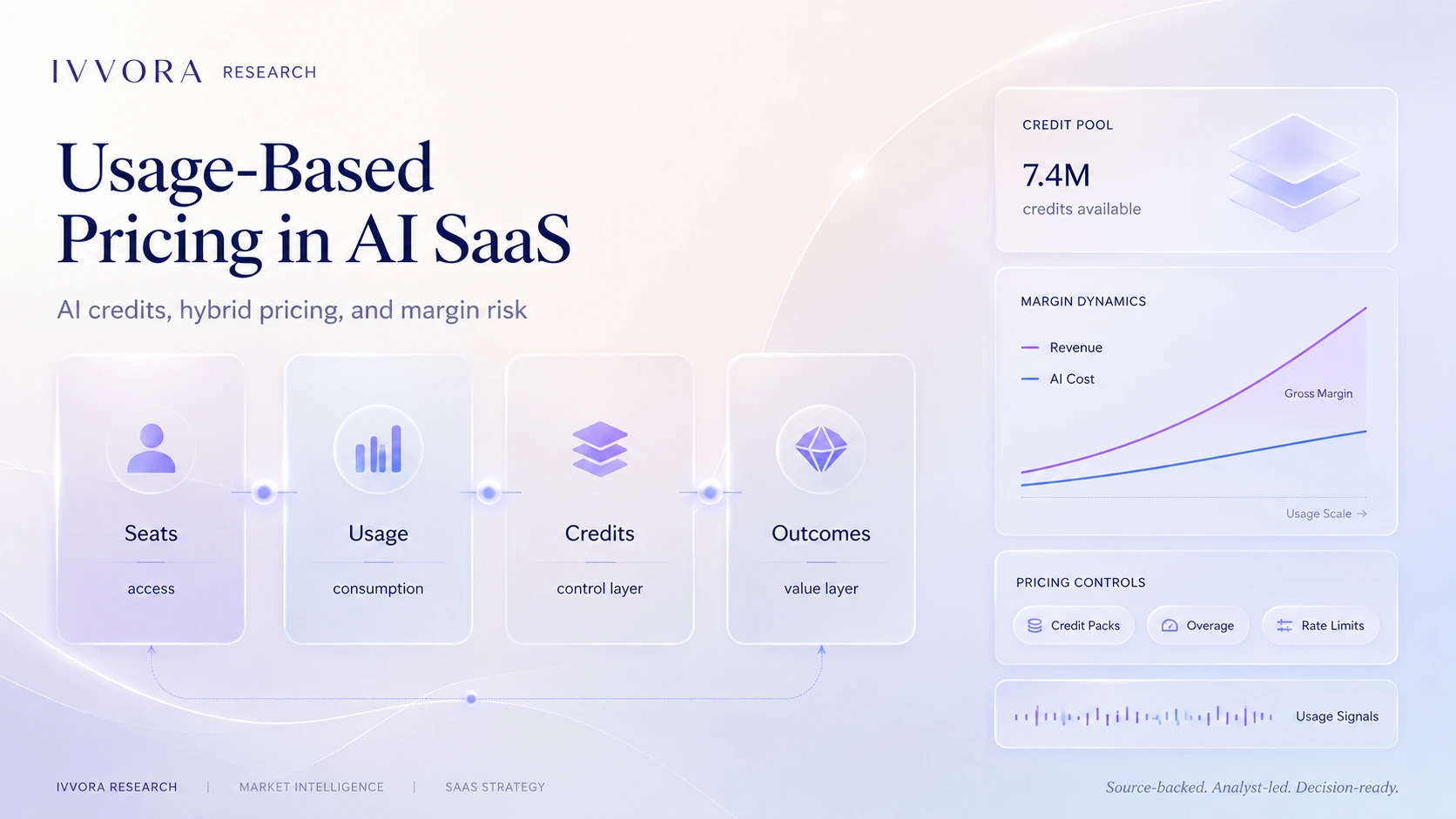
What Is Usage-Based Pricing in AI SaaS?
Usage-based and hybrid pricing is becoming common in AI SaaS because AI features create real costs every time they are used.
Those costs come from tokens, actions, workflows, outputs, and agentic sessions.
Seat-based and flat pricing models price access. AI pricing increasingly has to account for consumption.
Seats price access
Traditional SaaS pricing assumes user count is a useful proxy for value and cost.
That breaks when one user can run far more AI usage than another.
Usage reveals cost
AI features create cost at the point of consumption.
Tokens, actions, workflows, outputs, and agentic sessions become the economic signals.
Heavy users can become margin-negative
When usage intensity decouples from headcount, flat pricing creates margin risk.
The best customers can become the worst-margin accounts.
AI SaaS is moving from access pricing to consumption-aware pricing
- Seats no longer reliably predict cost or value.
- The dominant pattern is hybrid pricing.
- Hybrid pricing combines a base subscription, included AI credits, overages, and admin controls.
- Metering, attribution, and buyer controls are now table stakes.
Power-user margin leakage. Unlimited AI bundling without guardrails is structurally dangerous.
What Evidence Shows AI SaaS Pricing Is Moving to Usage-Based and Hybrid Models?
Evidence that AI SaaS pricing is moving to usage-based and hybrid models
All claims below are labeled by confidence level and tied to primary sources.
Last verified: June 20, 2026
How did GitHub Copilot move to usage-based AI Credits?
Effective June 1, 2026, GitHub moved all Copilot plans from Premium Request Units to GitHub AI Credits.
Credits are consumed by input, output, and cached tokens at published model rates. Code completions and Next Edit suggestions remain included.
How does Notion use AI Credits for Custom Agents?
Notion introduced Notion Credits for Custom Agents and Workers at $10 per 1,000 credits.
Credits are pooled at workspace level, with admin controls and auto-adjust purchasing for Business and Enterprise plans.
How does Salesforce Agentforce price AI usage?
Agentforce offers Flex Credits, conversation-based pricing, and per-user licensing options.
Flex Credits are priced at $500 per 100,000 credits. A standard action uses about 20 credits, or roughly $0.10.
How does Anthropic Claude API pricing work?
Anthropic uses token-based pricing across Claude models, with separate input and output token rates.
Caching discounts and batch processing discounts are available, showing how infrastructure cost controls affect pricing.
How does OpenAI API pricing work?
OpenAI API pricing is based on tokens, with volume tiers and caching options on supported models.
This reinforces the foundation-layer pattern that downstream AI SaaS companies inherit.
What does Metronome data show about usage-based pricing?
Metronome reported that 85% of surveyed SaaS companies have adopted usage-based pricing.
The report also says 77% of the largest software companies incorporate some level of usage-based pricing.
What does Revenera data show about usage-based pricing?
Revenera reported that 59% of software companies expected usage-based approaches to grow as a share of revenue in 2025.
That was up 18 points from 2023.
Why are enterprises adding AI spend controls?
Multiple enterprises reported AI spend caps, early budget exhaustion, and shifts to cheaper models after unexpected inference costs.
This is a directional signal, not a statistically sampled claim.
Verified AI SaaS pricing sources and changes
Full archive of 180 reviewed pages maintained internally with timestamps and screenshots.
Public sample available below.
Most teams see the move too late.
I help identify what competitors are changing, what buyers are signaling, and where the market may be moving next.
How Was This AI SaaS Pricing Research Done?
How this AI SaaS pricing research was done
IVVORA reviewed public pricing pages, changelogs, API documentation, terms of service, customer discussion threads, and billing infrastructure reports for 180 AI-native and AI-augmented SaaS companies.
Pricing movement was reviewed across public sources during this period.
AI-native and AI-augmented SaaS companies across devtools, vertical SaaS, productivity, and infrastructure.
A public dataset sample is available for transparency and verification.
Which AI SaaS pricing sources were reviewed?
- Public pricing pages
- Changelogs
- API documentation
- Terms of service
- Customer discussion threads from G2, Capterra, Reddit, and Hacker News
- Billing infrastructure reports
Which companies were included?
- Companies with visible AI features, including agents, copilots, generation, retrieval, automation, document processing, voice, and multimodal AI
- Pricing pages or documentation accessible without login or sales call for core plans
- AI-native startups and AI-augmented traditional SaaS companies
- Free trials and public plans where AI usage was relevant
Which companies were excluded?
- Pure infrastructure or API companies without application-layer SaaS products
- Pricing available only behind sales calls or NDAs
- Companies with no public AI feature monetization signals
How were AI SaaS pricing models classified?
Each company was scored on pricing model, AI monetization approach, primary usage metric, overage policy, buyer controls, cost visibility, model dependency, and last observed pricing-page change date.
Ambiguous cases were classified as inferred with notes. Edge cases used a two-analyst review process. Estimated error margin is ±8 to 12% because private enterprise pricing and rapid changes create uncertainty.
How many AI SaaS companies were reviewed by category?
What counts as a smaller AI SaaS company?
Companies with estimated ARR below $20M, based on public data, funding announcements, or reasonable inference from employee count and pricing.
What counts as hybrid pricing in AI SaaS?
Base subscription or seat fee plus metered AI credits, usage, overages, and at least one buyer control such as caps, alerts, or pooling.
What counts as unlimited AI usage?
Explicit unlimited or very high-limit language without clear metering, caps, or a fair-use definition tied to consumption.
Full methodology document, classification rubric, and error log are maintained internally. Public sample of 30 companies is published below with confidence levels.
Public AI SaaS pricing dataset sample for June 2026
Full 180-company review methodology is summarized above. The public sample below is included for transparency and verifiability. The full dataset includes additional columns for ARR estimate, screenshot archive links, and internal notes.
| Company | Category | Pricing model | AI monetization | Usage metric | Buyer controls | Overage policy | Source URL | Last checked | Confidence | Notes |
|---|---|---|---|---|---|---|---|---|---|---|
| GitHub Copilot | Devtools | Hybrid | Base + AI Credits | Tokens, input, output, cached | Caps, pooling, alerts | Purchase additional | github.blog + docs | June 20, 2026 | Confirmed | Agentic sessions driver |
| Notion Custom Agents | Productivity | Hybrid | Credits for advanced | Notion Credits | Workspace pooling, admin caps, auto-adjust | Purchase more | notion.com/pricing + help | June 20, 2026 | Confirmed | Advanced agents credit-gated |
| Salesforce Agentforce | Sales/GTM | Hybrid, multiple | Flex Credits + conversations + seats | Actions / conversations | Digital Wallet, budgets | Enterprise quote | salesforce.com/agentforce/pricing | June 20, 2026 | Confirmed | Parallel models maintained |
| Anthropic API | Infrastructure / model | Usage-based | Pure token | Tokens | Volume tiers, caching | Pay as you go | anthropic.com/pricing + API docs | June 20, 2026 | Confirmed | Foundation layer benchmark |
| OpenAI API | Infrastructure / model | Usage-based | Pure token | Tokens | Volume tiers, caching | Pay as you go | platform.openai.com/docs/pricing | June 20, 2026 | Confirmed | Foundation layer benchmark |
| Cursor | Devtools | Hybrid | Credits / usage | Requests / tokens | Limits, alerts | Overage | cursor.com/pricing | June 20, 2026 | Observed | Strong devtool shift |
| Replit | Devtools | Hybrid | AI credits / usage | Agent sessions / tokens | Controls emerging | Overage | replit.com | June 20, 2026 | Observed | Agentic focus |
| Harvey | Legal / vertical | Hybrid | Seat + document/usage | Documents / workflows | Enterprise controls | Custom | harvey.ai | June 20, 2026 | Inferred | Document-heavy cost |
| Intercom Fin | Support / CX | Hybrid | Conversation / resolution | Conversations / resolutions | Caps, alerts | Overage | intercom.com | June 20, 2026 | Observed | Outcome-leaning |
| Zendesk AI | Support / CX | Hybrid | Resolution / usage | Resolutions | Admin controls | Custom | zendesk.com | June 20, 2026 | Observed | Support resolution focus |
| Clay | Sales / GTM | Hybrid | Credits / enrichment | Enrichments / workflows | Limits | Overage | clay.com | June 20, 2026 | Observed | Data/API cost stacking |
| Gong | Sales / GTM | Hybrid | Seat + usage | Calls / insights | Enterprise dashboards | Custom | gong.io | June 20, 2026 | Observed | Conversation intelligence |
| Coda AI | Productivity | Hybrid | Credits / AI blocks | AI actions | Controls | Overage | coda.io | June 20, 2026 | Observed | Knowledge work |
| Atlassian Intelligence | Productivity | Hybrid | Included + credits | AI actions / search | Admin controls | Overage | atlassian.com | June 20, 2026 | Observed | Enterprise productivity |
| Microsoft Copilot | Productivity | Hybrid | Seat + credits / usage | Actions / tokens | Microsoft 365 admin controls | Overage / committed | microsoft.com/copilot | June 20, 2026 | Observed | Broad enterprise hybrid |
Additional companies in the full internal dataset include Sourcegraph Cody, JetBrains AI, Codeium, Tabnine, Spellbook, EvenUp, Ada, Forethought, Sierra, Freshworks AI, Cohere, Mistral, Together AI, Fireworks, LangSmith, Helicone, Vercel AI Gateway, Linear AI, Sentry AI, Monday AI, Asana AI, Apollo, 6sense, Outreach, and Ironclad AI.
Dataset download: Public 30-company CSV sample + methodology PDF available at ivvora.com/dataset/ai-saas-pricing-june-2026-sample.
Full 180-company dataset with screenshots and internal notes is available to clients.
Key findings from the AI SaaS pricing dataset
Use hybrid pricing
Base subscription plus AI credits, usage, overages, and at least one buyer control.
Observed / survey-supportedDevtools added usage elements
Token, credit, or action-based pricing elements are especially visible in devtools.
ObservedSmaller companies expose controls
Only a minority of companies below estimated $20M ARR publicly show detailed dashboards or spend controls.
Inferred / observedStill bundle high AI usage
Many still use high or unlimited AI language without clear separate metering.
ObservedProductivity tools are rapidly moving advanced agents to explicit credit systems with pooled controls.
Enterprise agent platforms maintain multiple parallel models to balance predictability and flexibility.
Key AI SaaS pricing terms explained
These terms define how pricing, usage, cost, and buyer controls are discussed throughout the research.
Usage-based pricing
Charging based on actual consumption, such as tokens, actions, messages, workflows, documents, conversations, agent steps, or compute resources.
Token-based pricing
Charging by input, output, cached, or reasoning tokens processed by an AI model.
Credit-based pricing
Customer-facing abstraction that converts underlying usage into simpler units, such as pools, bundles, and overages.
Hybrid pricing
Base subscription or seat fee plus metered AI credits, usage, overages, and buyer controls such as caps, alerts, pooling, and dashboards.
Outcome-based pricing
Charging tied to observable business results, such as tickets resolved, contracts reviewed, leads enriched, workflows completed, or pull requests merged.
Seat-based pricing
Charging by user count or license, regardless of AI consumption intensity.
AI credits
Pre-purchased or included units that abstract raw infrastructure cost, such as GitHub AI Credits, Notion Credits, or Salesforce Flex Credits.
Inference cost
Variable compute cost of running models, including tokens, context, tool calls, retries, long-running agent sessions, and multimodal processing.
Agentic workflow
Multi-step autonomous sequences that can run for extended periods and consume significantly more resources than single-turn interactions.
Power-user subsidy trap
Best and highest-usage customers become worst-margin customers when AI is bundled flat.
Credit abstraction problem
Credits simplify buyer experience but can obscure behaviors that drain the pool, including model choice, context bloat, retries, agent duration, and premium-model defaulting.
Gross margin / contribution margin
Revenue minus directly attributable costs, including inference, orchestration, retrieval, observability, and support.
Metering
Accurate, attributable tracking of usage and cost by customer, user, workflow, feature, and model.
Overage
Usage beyond included allowance, typically billed, throttled, or requiring approval.
Spend cap / admin controls
Buyer-side tools to set budgets, alerts, pooling, and approval flows.
Model routing
Engineering practice of directing tasks to the cheapest sufficient model.
Context bloat / retry loops
Invisible cost drivers from large prompts, retrieval, failed outputs, and regeneration.
Multimodal cost
Additional cost layers from image, video, audio, OCR, embeddings, and computer-use actions beyond text tokens.
Full glossary with examples, why it matters, and related terms is available as a downloadable asset and supporting page.
Why Is Usage-Based Pricing Growing in AI SaaS?
AI SaaS pricing is changing because AI usage creates variable cost. Seats still matter, but they no longer explain how much value or cost a customer creates.
How did AI SaaS pricing change from 2024 to 2026?
AI add-ons and bundles
AI features were commonly packaged as add-ons, bundled plan features, or early usage experiments.
Usage-based adoption accelerates
The Metronome 85% figure made usage-based pricing a visible SaaS market signal.
Agentic workflows expose the mismatch
Long-running AI sessions showed that requests, users, and cost no longer move together.
Credits become more visible
GitHub Copilot made the pressure highly visible. Notion and Salesforce expanded credit and flex models.
Hybrid pricing becomes table stakes
Base subscription, included usage, overages, admin controls, and governance become the expected pattern.
What is driving the shift to usage-based pricing in AI SaaS?
AI marginal cost is variable
Every prompt, tool call, retrieval, generation, or agent step can create measurable inference cost.
Agents increase usage variance
A quick chat and a multi-hour autonomous session do not create the same cost profile.
Seats no longer represent cost
One user running agents can generate more output than a 20-person team using traditional SaaS lightly.
Model providers already price consumption
OpenAI, Anthropic, and Google price APIs by tokens. Downstream SaaS inherits that economic structure.
Enterprise buyers want spend control
Procurement teams need transparency, caps, alerts, pooling, and predictable budget governance.
CFOs care about gross margin
Strong AI adoption can hide deteriorating contribution margin when heavy users are underpriced.
Why seat-based pricing does not work for many AI SaaS products
- Tokens processed
- Model calls
- Context length
- Retries
- Agent duration
- Cached or fresh inference
- Multimodal processing
- Tickets resolved
- Contracts reviewed
- Code merged
- Leads enriched
- Workflows completed
- Assets generated
- Business outcomes delivered
Pricing directly on raw tokens can create poor buyer experience because customers buy outcomes, not infrastructure units.
The best pricing metric balances cost protection, perceived fairness, predictability, expansion potential, and explainability.
Credit abstraction problem
Credits are a translation layer between machine cost and buyer psychology.
They work when they make cost mechanics understandable. They fail when credit drains feel hidden, arbitrary, or hard to forecast.
Transparent controls matter
- Clear rate cards
- Usage simulators
- Proactive alerts
- Admin dashboards
- Spend caps
- Account-level pooling
The future is hybrid pricing with consumption-aware controls
GitHub’s structure is a leading public example: base plans remain, included credits exist, additional credits are purchasable, and admin controls help govern usage.
How Does Usage-Based Pricing Affect AI SaaS Unit Economics and Pricing Models?
AI SaaS pricing becomes risky when revenue is fixed but AI cost grows with usage. The core question is whether each customer remains profitable as inference, orchestration, retrieval, observability, support, and billing costs increase.
AI gross margin per customer
Example of AI SaaS gross margin by user type
The same $99 plan can produce very different margins when AI usage varies by customer.
Example of how AI usage can break a flat SaaS pricing model
Traditional SaaS gross margin target is 75% to 85%.
In this case, growth looks strong on paper, but contribution margin is structurally broken on the best customers.
AI SaaS pricing models compared
The right model depends on cost variance, buyer clarity, value measurement, and the company’s ability to meter usage.
Simple products
Best for: Low AI cost variance.
Primary risk: Power-user subsidy.
AI SaaS fit: Weak when inference cost is material.
Human-centric workflows
Best for: Products where human access still drives value.
Primary risk: Seats decouple from AI usage and cost.
AI SaaS fit: Weak for agentic or high-output workflows.
Early monetization
Best for: Teams testing AI willingness to pay.
Primary risk: Hidden cost variance.
AI SaaS fit: Transitional only.
Mixed AI usage
Best for: Customer education and flexible usage.
Primary risk: Credit confusion and opaque drain.
AI SaaS fit: Strong when transparent with controls.
Technical buyers
Best for: APIs, infrastructure, and high-volume usage.
Primary risk: Budget anxiety and procurement friction.
AI SaaS fit: Strong for technical buyers.
Clear ROI workflows
Best for: Attributable outcomes.
Primary risk: Attribution complexity.
AI SaaS fit: Strong but implementation-heavy.
Hybrid pricing
Best for: Most B2B AI SaaS companies.
Primary risk: Requires metering infrastructure.
AI SaaS fit: Strong because it balances access, usage, and governance.
How to choose the best usage metric for AI SaaS pricing
A strong AI pricing metric should protect cost, make value clear, reduce buyer anxiety, and stay measurable for engineering and finance teams.
| Metric | Cost correlation | Value correlation | Buyer clarity | Best use case |
|---|---|---|---|---|
| Tokens | High | Low / medium | Low | API / infrastructure |
| Credits | Medium / high | Medium | Medium | B2B app layer |
| Actions | Medium | Medium / high | High | Workflow tools |
| Documents | Medium | High | High | Document AI |
| Conversations | Medium | High | High | Support AI |
| Outcomes | Variable | Very high | High | Mature workflows |
| Seats | Low | Low / medium | High | Human-access platform |
Which AI SaaS Companies Face the Most Pricing Risk?
AI pricing risk is not evenly distributed. It is highest where model cost, usage variance, weak pricing power, and limited metering infrastructure overlap.
AI wrapper and agent startups
Highest model-cost dependency, lowest pricing power, and weakest metering infrastructure.
Vertical SaaS adding copilots
Legal, sales, support, and ops tools risk bundling expensive variable AI into existing seat revenue.
Devtools
Developer workflows are becoming long-running and agentic. GitHub’s pricing change raises market expectations.
Support, sales, and ops automation
Value is often outcome-based, while cost scales with workflow volume and agent duration.
Data-heavy and retrieval AI
Long context, embeddings, retrieval, and processing costs compound as usage expands.
Agencies building custom AI
High risk of underquoting projects and absorbing client inference costs after deployment.
Bootstrapped SaaS
Least room to subsidize heavy users or invest early in metering, dashboards, and pricing operations.
Venture-backed AI SaaS
Growth can hide weak margins until pricing resets, investor scrutiny, or renewal pressure arrives.
Why smaller AI SaaS companies face higher pricing risk
Smaller companies are asymmetrically exposed because they have less leverage, less infrastructure, and less room for pricing mistakes.
Common ways AI SaaS companies lose margin from heavy usage
Power-user subsidy
Heavy users consume more AI cost while paying the same flat price.
Agent runaway
Long-running agents create usage that is difficult to predict or cap.
Context bloat
Large prompts and long histories increase cost without clear buyer visibility.
Retry loops
Regeneration, failed outputs, and repeated tool calls quietly raise AI COGS.
Premium-model creep
Expensive model defaults increase cost when routing rules are weak.
Bundled AI dilution
Included AI becomes a hidden subsidy inside the core subscription.
Enterprise pooling distortion
Large accounts can hide extreme usage variance across teams and users.
Support-cost spillover
Billing questions, credit disputes, and usage confusion add human support cost.
The best users become the worst-margin users when AI is bundled flat.
This is the central margin risk in flat AI pricing. The customers who adopt the product most deeply can become the accounts that cost the most to serve.
How to measure AI SaaS pricing risk
Score the company 1 to 5 across 10 pricing-risk dimensions. The total score shows whether the current pricing model is safe, exposed, or structurally misaligned.
How mature is your AI SaaS pricing model?
Pricing maturity depends on whether the company can measure, attribute, package, govern, explain, and monitor AI usage.
How Should AI SaaS Companies Choose, Change, and Govern Pricing?
The right pricing model depends on AI cost volatility, buyer clarity, metering readiness, and whether usage maps cleanly to customer value.
How to choose the right AI SaaS pricing model
What should each team do about AI SaaS pricing?
What should founders do?
- Check if top users are margin-negative today.
- Avoid unlimited AI before metering is live.
- Price AI as an expansion driver, not a hidden subsidy.
- Build the pricing narrative before any change.
What should CFOs track?
- Build AI COGS by account and cohort.
- Track gross margin by usage intensity.
- Model provider price sensitivity.
- Set margin thresholds that trigger packaging changes.
What should product leaders build?
- Define which AI actions create measurable value.
- Separate platform value from variable AI consumption.
- Build caps, alerts, and usage visibility into the product.
What should engineering track?
- Implement customer-level cost attribution.
- Route tasks by model cost and quality.
- Compress context and track retries and agent loops.
How should sales explain usage pricing?
- Explain credits as value units, not a penalty.
- Prepare for bill predictability objections.
- Use ROI examples, not token language.
How should CS manage usage spikes?
- Monitor usage spikes proactively.
- Warn before credit exhaustion.
- Turn heavy legitimate usage into expansion conversations.
How to move from seat-based pricing to usage-based or hybrid pricing
Pricing migration should happen in stages. Teams need instrumentation, testing, launch readiness, and governance before customers see hard billing changes.
Common ways SaaS companies move to usage-based pricing
Why AI SaaS pricing changes fail
- Customers feel punished for adoption.
- Credits are impossible to forecast.
- Sales cannot explain the model.
- Product lacks usage dashboards.
- Finance sets limits without value context.
- Engineering cannot attribute cost by account.
- Existing customers are surprised.
- Heavy users churn before expanding.
- Competitors frame the change as a price hike.
- Unlimited language conflicts with fair-use terms.
How to transition existing customers to AI credits or usage pricing
How to design AI credits for SaaS pricing
AI credits work when they translate infrastructure usage into buyer-understandable value. They fail when credit drains feel hidden or arbitrary.
Best practices for designing AI credits
How different AI workflows can consume credits
Why buyers accept usage pricing
- Fairness
- Flexibility
- Lower starting cost
- Value alignment
Why buyers resist usage pricing
- Budget uncertainty
- Bill shock risk
- Procurement friction
- Internal blame
- Fear that successful adoption will be punished financially
What buyers need before trusting AI credits
Examples of AI credit bill shock and buyer concerns
Public forum, Reddit, Hacker News, G2, and similar threads show concerns about unexpected credit drains or bill spikes after AI credit introductions.
These signals are directional only. They are not statistically representative.
When outcome pricing and multimodal AI change the pricing model
When outcome-based pricing works better than usage-based pricing
- The result is observable.
- Attribution is clear.
- The buyer values the outcome.
- The vendor can prevent gaming.
- The outcome occurs frequently.
- Cost per outcome is controllable.
Examples of outcome-based pricing metrics
Why image, video, audio, and document AI are hard to price
Text tokens are only one layer. Marketing, support voice, legal document, and design tools also create image, video, audio, OCR, retrieval, storage, and orchestration costs.
These costs do not map cleanly to seats or simple tokens.
What AI costs should SaaS companies track?
What most teams miss about AI SaaS margin risk
Most teams watch headline announcements. The margin trap appears inside customer behavior, workflow volume, and unmetered heavy usage.
Unlimited contract review
One customer uploads 30k pages and turns a flat package into a high-cost account.
Seat pricing with heavy enrichment
One rep runs 10k enrichments while the plan still prices only the seat.
Long agentic sessions
A $20 user can run agents for hours and create cost far beyond the subscription price.
Resolution volume grows 10x
Pricing by agent seat misses the cost of much higher resolution volume.
Generation without metering
Multimodal generation can create real cost while remaining bundled inside the plan.
Growth can hide broken margin
The detailed $20 per user example above shows how strong adoption can still produce structurally weak contribution margin.
What Should Teams Monitor Before AI Pricing Becomes a Margin Problem?
AI pricing risk becomes urgent when usage growth starts to separate from revenue growth, margin visibility, and buyer trust.
When pricing risk moves from warning signal to business risk
Top users may already be margin-negative if AI cost is not attributed by account.
Usage growth, credit questions, support load, and procurement concerns begin to show up in operations.
Pricing mismatch appears in gross margin, renewals, buyer trust, and competitor positioning.
for power users
of AI cost
between light and heavy users
of total AI activity
credit or usage questions
AI SaaS pricing risk benchmarks and warning signs
AI SaaS pricing examples from major vendors
Vendor pricing changes show how AI credits, usage pricing, hybrid models, and buyer controls are becoming visible across product categories.
GitHub, Cursor, Replit
Agentic workflows and developer usage variance make credits, requests, tokens, and admin controls more important.
Notion, Coda, Atlassian, Microsoft Copilot
Advanced agents and AI workspace features are moving toward pooled credits, admin visibility, and spend governance.
Salesforce Agentforce
Flex Credits, conversation pricing, and seats coexist because enterprises need both flexibility and predictability.
OpenAI, Anthropic, Cohere, Mistral, Together, Fireworks
Token and model-based pricing at the infrastructure layer shapes downstream SaaS unit economics.
Harvey, Intercom Fin, Zendesk AI, Clay, Gong
Pricing pressure appears through documents, resolutions, enrichments, conversations, and workflow volume.
LangSmith, Helicone, Vercel AI Gateway
Usage observability, routing, logging, and cost visibility become core infrastructure for pricing governance.
What each vendor example should explain
When usage-based pricing may not become the default in AI SaaS
The thesis is not that every AI SaaS company must use pure usage-based pricing. The pressure is that AI cost, agentic variance, and buyer governance requirements make consumption-aware pricing harder to avoid.
Model costs fall fast
Lower inference costs can make bundled AI more viable for some workflows.
Competition forces unlimited bundles
Some vendors may absorb cost to win share, especially in crowded categories.
Buyers hate variable pricing
Budget anxiety can slow adoption of pure usage-based models.
Outcome pricing leapfrogs usage
Some mature workflows may price resolved outcomes instead of raw consumption.
Open-source and self-hosting reduce API exposure
Some companies may reduce dependency on commercial model providers.
AI becomes a retention feature
Some AI functionality may remain bundled to protect core product retention.
Optimization absorbs cost
Routing, caching, context compression, and cheaper models may reduce pricing urgency.
Directional pressure from variable cost, agentic variance, foundation-layer economics, and procurement requirements is already visible in primary pricing sources.
What infrastructure is needed for usage-based AI pricing?
Usage-based and hybrid pricing only work when product, engineering, finance, sales, and customer-facing controls can see the same usage reality.
Practical rules for AI SaaS pricing
The Seat Decoupling Law
Seats no longer reliably predict AI cost or output.
The Power-User Subsidy Law
The best users can become the worst-margin users when AI is bundled flat.
The Credit Translation Law
Credits must translate machine cost into buyer-understandable value.
The Agentic Variance Law
Long-running agents create cost variance that access pricing cannot see.
The Margin Visibility Law
A pricing model that cannot see usage cannot govern margin.
10 AI SaaS pricing design principles
What AI SaaS pricing signals should teams monitor?
Pricing risk often appears first in small language changes, dashboard releases, support questions, job postings, and procurement requirements.
What should AI SaaS teams do before changing pricing?
Teams should not change pricing until they can measure usage, explain the buyer value, forecast margin, and support customer controls.
When usage-based pricing is wrong for AI SaaS
Usage-based or hybrid pricing may be wrong when cost is low, usage is predictable, buyers require strict budgets, the metric is unclear, or the company lacks metering and support readiness.
10 AI pricing myths
Myths should be addressed with short answers and operational implications before pricing changes reach customers.
Most analysis misses the cost structure
Weak analysis treats usage-based pricing as a billing trend instead of a response to AI cost variance, buyer psychology, engineering architecture, procurement pressure, and unit economics.
How should teams review AI pricing and usage costs each month?
What should customers be able to see and control?
What Should Buyers, Boards, and Teams Ask About AI Usage Pricing?
Usage pricing needs a clear commercial story. Buyers need to understand what is included, what creates cost, how usage is controlled, and why the model supports reliability.
How to answer buyer objections about AI usage pricing
Sample customer communication language
AI usage varies by workflow. Credits help keep pricing fair while giving teams visibility and control.
Your plan includes a defined monthly AI allowance for standard usage.
Basic product access and non-AI features remain part of the core subscription.
Admins can view credit balance, burn rate, usage by team, and forecasted exhaustion.
Admins can set limits, alerts, approval flows, and team-level controls.
Use alerts, usage exports, approval settings, and forecast reports before reaching the limit.
Usage-aware pricing helps ensure heavy workflows are supported without degrading reliability for other customers.
What AI pricing questions should buyers and boards ask?
Procurement teams need pricing clarity. Boards need margin clarity. Both need to know how AI usage changes cost, risk, and commercial leverage.
12 AI pricing questions buyers should ask in RFPs
- What AI usage is included in the base plan?
- What actions consume credits or usage units?
- What does not consume credits?
- How are credits calculated?
- Do premium models consume more credits?
- Can admins set caps and alerts?
- Can usage be pooled across teams?
- What happens when credits run out?
- Are overages automatic or approval-based?
- Can usage data be exported?
- How is usage forecasted before renewal?
- How often can pricing or credit rules change?
9 board-level questions about AI SaaS pricing risk
- What percentage of gross margin is exposed to AI inference cost?
- What share of AI cost comes from the top 10% of users?
- Are the best accounts margin-positive?
- Are AI features driving expansion or margin drain?
- How sensitive are margins to model-provider pricing?
- What happens if usage doubles without seat growth?
- Which pricing experiments are active?
- Are competitors more transparent about AI usage controls?
- Is AI being priced for retention, expansion, or both?
What should an AI SaaS pricing page include?
A strong AI pricing page reduces buyer anxiety. It explains included value, consumption rules, admin controls, and overage paths without forcing buyers to decode infrastructure terms.
What makes an AI SaaS pricing page confusing?
- Unlimited AI without definition
- No cap explanation
- No usage dashboard
- No model differences
- No workflow examples
- No admin control language
- No clear overage policy
What a better AI pricing page should show
- Included monthly AI credits
- What consumes credits
- What does not consume credits
- Example workflows
- Admin caps
- Overage policy
- Enterprise pooling
- Exportable usage logs
- FAQ
- Migration notes
What AI pricing terms should SaaS companies avoid?
AI SaaS pricing page checklist
Final Takeaway on Usage-Based Pricing in AI SaaS
The risk is not AI adoption. The risk is AI adoption without pricing control.
For smaller AI SaaS, devtool, vertical platform, and bootstrapped companies, strong AI adoption can become a margin problem when pricing, metering, and buyer controls do not keep up.
The best customers can become margin-negative accounts while competitors with hybrid packaging and governance pull ahead on unit economics and buyer trust.
Smaller AI SaaS companies
Companies with limited pricing power, weaker metering infrastructure, and less margin cushion are most exposed when AI usage scales faster than revenue.
Leader pricing and packaging changes
Watch GitHub Copilot, Notion, Salesforce Agentforce, and foundation model providers for changes in credits, usage units, admin controls, and included AI allowances.
Procurement wants AI spend control
Enterprise procurement language around AI spend caps, usage visibility, exportable logs, and admin dashboards is becoming an important market signal.
Waiting reduces pricing options
If teams wait until heavy users compress gross margins, lengthen sales cycles, or lose deals to better-aligned competitors, pricing resets become harder and more expensive.
Source-backed AI SaaS pricing watchlist and exposure assessment
IVVORA maintains a private AI SaaS pricing watchlist and builds source-backed competitor pricing movement tracking, category exposure scoring, account-level margin implication mapping, and executive-ready market signal briefs.
These briefs are built for teams that need category-specific intelligence using their own usage data.
- AI usage is growing faster than pricing can explain.
- Agentic workflows are increasing cost variance.
- Heavy users may be compressing gross margin.
- Buyers are asking for spend controls and dashboards.
Is AI usage growing faster than your pricing model can protect?
If AI usage and agentic workflows are growing faster than your pricing model, metering, and governance can explain or protect, connect with Samarthya or send a work inquiry to IVVORA.