Inside this article
What Is the Ontario Cellphone Ban in Schools and What Changed in 2026
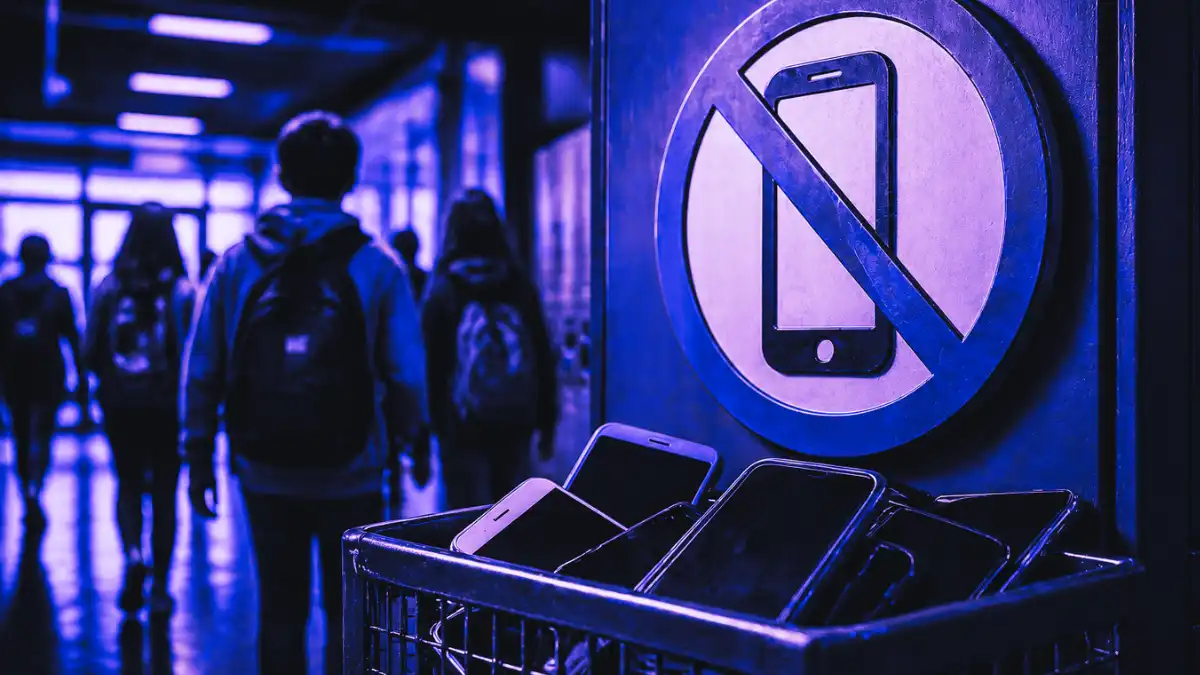
Ontario Education Minister Paul Calandra announced on April 28, 2026, that the province is considering an outright ban on cellphones across all school properties, with only limited medical exemptions.
This escalates the existing 2024 rules that already require devices to be kept out of sight and silent during instructional time.
The move converts roughly seven hours of structured daily teen presence into an enforced attention blackout.
Platforms and marketers who built youth campaigns around the assumption of continuous micro-access now confront the central reality: attention operates as an institutionally released resource, not a continuously available one.
Schools decide when it returns to users. Marketers discover their dashboards went blind precisely when Gen Z density peaked.
Real-time signals that once calibrated algorithms and justified ad spend during school hours vanish. Most Gen Z performance data is now structurally incomplete.
Platforms lose the behavioral inputs they priced into inventory. Attribution models that tracked immediate velocity start lying about true lift.
Strategies engineered for always-on loops sit misaligned with the new distribution reality. The Ontario policy exposes a dependency marketers never fully priced: their reach relied on schools tolerating access they could revoke at any moment.
How the Ontario School Phone Ban Changes Student Phone Use During School Hours
Schools now operate as distribution gatekeepers over the largest daily block of concentrated Gen Z attention.
Previous models treated school hours as open territory for feeds, notifications, and micro-interactions. The ban removes that territory outright.
Enforcement through physical separation, network blocks, and policy overrides severs the loops that led to an average of 1.2 hours of smartphone use during school hours, most of it on social media.
Platforms that built billion-dollar pricing models on the false premise of user-controlled access now face the direct consequence: midday inventory collapses in reliability and value.
A portion of what brands paid for never actually existed as reliable inventory.
Daytime Gen Z segments lose structural worth because platforms cannot deliver consistent signals or engagement velocity inside regulated environments.
Campaigns that depended on continuous calibration lose their foundation.
The infrastructure shift forces every element downstream to creative testing, budget allocation, and performance forecasting to recalibrate around controlled release windows.
Platforms assumed ownership over attention they never controlled. Schools just reclaimed it.
How Students Use Social Media After School Under Phone Restrictions
Engagement demand stays constant while access windows shrink. Students exit regulated environments carrying accumulated queues of saved content, notifications, and social obligations.
The release at 3 pm triggers immediate high-density clusters, replacing scattered micro-moments with intensified sessions.
Bans reduce in-school phone time by 40 to 67 minutes on average, yet total daily usage holds steady through redistribution.
The mechanism is specific to this context: enforced separation during structured hours creates anticipation fueled by boredom and a hunger for peer validation. The result is sharper intent per minute once control returns.
TikTok and Instagram see elevated completion rates in the 3 pm-7 pm window as users discharge saved Reels and Stories. Snapchat streaks accelerate through private channels that bypass public delays.
These patterns reward formats built for burst performance and penalize anything designed for passive daily scrolling.
Most campaigns will miss these windows entirely because they were never engineered for synchronized release behavior.
Daily Student Phone Usage in Ontario Before and After the Ban (2026 Data)
| Time Window | Pre-Ban Platform Access Hours | Post-Ban Projected Access Hours | Primary Marketing Consequence |
| School Hours (8 am-3 pm) | 1.2 hours | 0.3-0.5 hours | Complete loss of real-time signals at peak density |
| After-School Release (3 pm-8 pm) | 2.1 hours | 3.4-3.8 hours | Hyper-competitive bursts with elevated intent |
| Evening (8 pm-11 pm) | 1.8 hours | 1.4-1.6 hours | Deferred consumption of saved content |
| Total Daily | 5.1 hours | 5.1 hours | Redistribution only and no net decline (Source: JAMA Pediatrics 2026 adolescent smartphone study and eMarketer Gen Z projections) |
How the School Phone Ban Affects TikTok, Instagram, and Snapchat Usage
Platform dependency shifts from live continuous consumption to deferred interaction systems. Students maintain queues during blackout periods and activate them only when control returns.
Algorithms receive delayed data packets and weight even behavior more heavily.
Campaigns that once measured immediate velocity now track save rates and next-day opens. Synchronous public feeds lose ground to asynchronous private channels where trust concentrates.
The override lengthens content lifecycles while making feedback unpredictable. Marketers pay for impressions delivered in a regulated space, only to realize that actual engagement occurs hours later in user-controlled windows.
Budgets that once spread evenly concentrate in post-3 pm slots, where competition drives up costs.
Performance holds for content engineered for high-density release, but erodes for formats that rely on passive daily exposure.
Platforms that anchored models in live public timelines now compete on terms dictated by institutional calendars.
Changes in Social Media Engagement for Ontario Students After the Phone Ban
| Platform | Pre-Ban School-Day Session Length | Post-Ban After-School Session Length | Density Increase | Dominant Post-Ban Format |
| TikTok | 8 minutes | 14 minutes | +75% | Saved Reels and trending audio bursts |
| 6 minutes | 11 minutes | +83% | DM-shared Stories and private Reels | |
| Snapchat | 5 minutes | 9 minutes | +80% | Streaks and direct messaging |
| YouTube | 12 minutes | 10 minutes | -17% | Long-form deferred to the evening |
(Source: Inferences from JAMA 2026 school phone studies and eMarketer youth behavior reports)
What the Ontario School Phone Ban Means for Digital Marketing and Ad Performance
The policy variable delivers immediate financial pressure. Daytime Gen Z inventory loses structural value and forces higher cost-per-engagement in compressed release windows where supply tightens and demand spikes.
Attribution models built on continuous flows produce incomplete pictures and inflate reported performance while actual conversion windows narrow.
Platforms that priced inventory on the false premise of always-on access must either over-monetize after-school periods or accept lower overall yield from Gen Z segments.
Brands absorb the difference through elevated competition and reduced predictability.
Value does not disappear but often leaks elsewhere.
Private DM channels and creator-led communities capture the trust and intent that public feeds once commanded. Offline influence and peer-to-peer sharing gain ground inside the release spikes.
Creators who design for saved-content queues and synchronized bursts extract premium economics while traditional platform inventory commoditizes.
The reckoning favors organizations that treat policy calendars as primary planning inputs. Those who ignore the shift subsidize the winners who adapt.
Why Limiting Phone Use in Schools Changes Gen Z Online Behavior
Restrictions during school hours compress demand within an environment where devices function as both a social lifeline and a forbidden object.
The resulting anticipation builds uniquely around adolescent peer pressure and structured boredom. Release produces spikes that favor private sharing and saved queues over public posting.
Enforcement at scale creates consistent behavioral patterns that reward only content timed to the exact moment control returns.
This engine drives higher intent per minute precisely because users enter release periods with accumulated social debt.
What Marketers Should Do After the Ontario Cellphone Ban in Schools
Ontario’s cellphone policy confirms what youth marketing strategies refused to admit. Attention was never continuously accessible. It was institutionally released on terms set by schools.
Most CMOs still allocate budgets and build attribution as if the old always-on model remains intact. Those models already sit structurally misaligned. They simply have not failed visibly yet.
Platforms that priced billions on a false premise of ownership now scramble. Marketers who keep feeding the same uniform schedules will watch ROI erode in real time while value migrates to private channels and faster adapters.
IVVORA maps these infrastructure-level constraints so senior marketers stop treating policy as background noise and start treating it as the dominant variable in youth distribution.
The winners will engineer entire systems around enforced blackouts and synchronized release behavior.
The rest will continue funding the education of competitors who already see the shift for what it is. You cannot unsee this reality once the dashboards go blind at peak density. The structural break is complete.
The only question left is which organizations accept it before their own metrics force the admission.