AI SaaS Pricing Benchmarks and Data for 2026
AI SaaS pricing is not a packaging adjustment. It is a margin-control system for software whose cost now rises at the point of use.
Sold access
Pricing was built around seats, permissions, and predictable software usage.
Sells compute-consuming work
One user can trigger a summary, legal review, codebase analysis, or agent workflow — each with a different cost profile.
Traditional SaaS still operates from a high-margin baseline. AI-native software carries a lower and more variable margin structure because usage creates real compute cost.
Low variable costs
Added inference and evaluation costs
ICONIQ benchmark around 52%
High inference before guardrails
Outcome pricing helps protect margins
High willingness-to-pay verticals
Power-user cost concentration
Varies by optimization discipline
Inference costs can decline with optimization, but usage growth, larger context windows, and agentic complexity can absorb those savings before they reach the margin line.
Deflation creates room. Usage growth can take it back.
Inference costs for equivalent performance have fallen sharply, but larger context windows, heavier usage, and agent workflows can offset the savings. Companies that do not review pricing quarterly risk margin leakage even as the underlying technology improves.
What Are the Five Layers of AI SaaS Pricing?
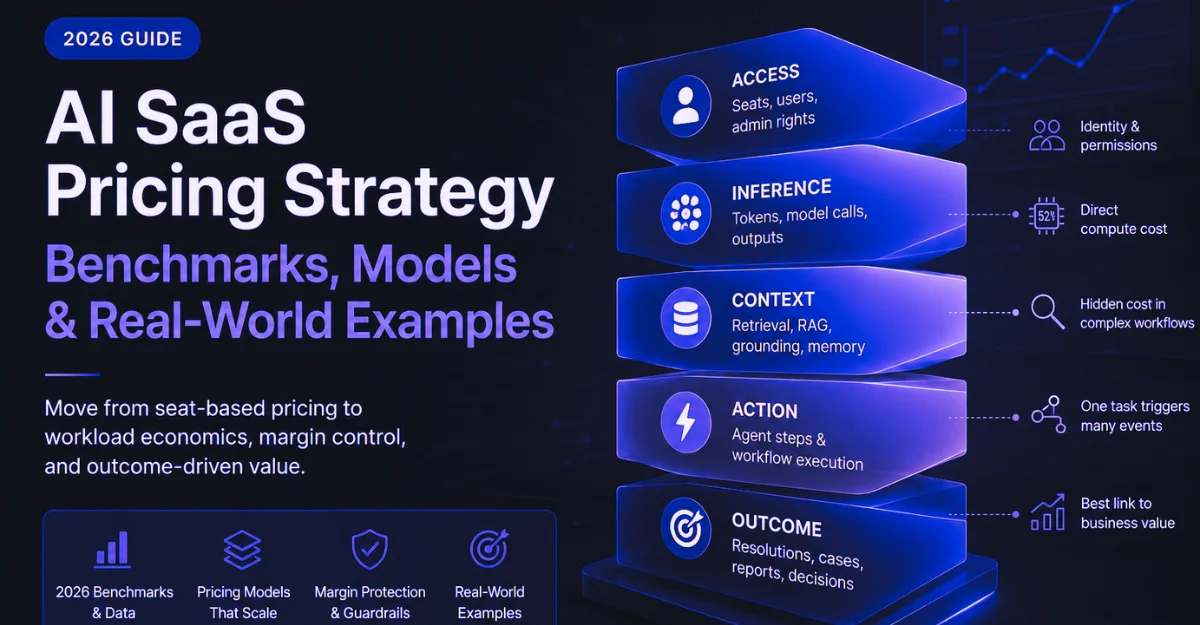
The shift from access pricing to workload economics creates five distinct layers that can now be priced separately or combined into a hybrid model.
Access
Seats, users, admin rights
Still useful for identity, permissions, and account control.
Inference
Tokens, model calls, outputs
The direct compute-cost layer that rises with usage intensity.
Context
Retrieval, RAG, grounding, memory
A hidden cost driver in complex workflows and trusted-answer systems.
Action
Agent steps and workflow execution
One visible task can trigger many invisible backend events.
Outcome
Resolutions, cases, reports, decisions
The strongest link between pricing and measurable business value.
Hybrid pricing is becoming the practical default.
Most companies now combine layers rather than pricing only one. Access plus inference, or access plus outcome, gives buyers more predictability while protecting vendor margins from uneven workload consumption.
Need someone who reads beyond the surface?
I look at reports, policies, product pages, pricing, positioning, and competitor behavior to uncover useful strategic signals.
How AI Changed Traditional SaaS Pricing
Traditional SaaS pricing worked because additional seats carried near-zero marginal cost. AI breaks that assumption because usage now creates variable compute cost at the point of work.
Three pillars supported the old model
High upfront software costs could be amortized across many users.
Adding another user usually did not create meaningful incremental cost.
Value came from permissions, seats, lock-in, and account expansion.
AI breaks the marginal-cost pillar
Inference, RAG, agent orchestration, and evaluation layers scale with output volume and workflow complexity. High-usage accounts can create costs that exceed the fixed revenue collected under legacy pricing.
Vendor charges one broad seat or subscription price across uneven usage patterns.
Light users consume little. Power users trigger heavier inference, context, and agent activity.
Fixed revenue no longer matches variable inference cost, damaging cohort-level unit economics.
One visible task becomes many billable events.
In agentic systems, a single user request can create planning, retrieval, model calls, tool use, retries, validation, and final response generation. The buyer sees one task. The vendor carries the full workload chain.
AI SaaS Pricing Models Comparison 2026
Each pricing model solves one problem while creating another. The strongest model depends on workload variability, buyer predictability needs, margin exposure, and how directly the product creates measurable outcomes.
Access Pricing
Best for low-variability core software where seats remain a reasonable proxy for value.
Consumption Pricing
Works for technical/API workloads, but creates buyer friction when usage becomes hard to forecast.
Base + Variable
Gives vendors a revenue floor while allowing usage or outcome-based expansion.
Workflow-Based Pricing
Strong fit for measurable, high-ROI workflows such as resolved conversations or legal packages.
AI Context Seat Pricing
Can work in low-AI-intensity or premium vertical contexts, but risks subsidizing power users.
Pricing models move along three executive trade-offs.
Strongest in pure usage and hybrid models because cost exposure is tied more closely to consumption.
Strongest in outcome pricing where the vendor charges against measurable business impact.
Strongest in traditional seat and flat models, but weaker when workload intensity varies heavily.
Highest when attribution, credit consumption, or workflow measurement are unclear.
Copilots
Sidekicks that enhance productivity. Often priced through seats, consumption, or a hybrid structure.
Agents
Autonomous workflow execution. Better suited to workflow, outcome, or guarded hybrid pricing.
AI-Enabled Services
Automation plus human oversight. Often priced through consumption, workflow, or outcome logic.
Hybrid pricing is becoming the practical default.
In practice, most AI SaaS companies need both a revenue floor and a variable expansion mechanism. Hybrid pricing balances buyer predictability with vendor margin protection better than pure seat or pure usage models.
Which AI SaaS Pricing Model Fits Your Product?
Before choosing a pricing model, operators should identify which economic unit actually drives cost and value. This selector translates workload behavior into a directional pricing recommendation.
Find the pricing model that fits your AI workload economics
Traditional SaaS pricing starts with users. AI SaaS pricing has to start with workload behavior: inference, context, agent actions, workflow complexity, and measurable outcomes.
Use this tool as an illustrative decision framework. It is not financial, legal, accounting, or pricing advice. Final pricing decisions should be based on actual usage data, customer segments, gross margin analysis, contract structure, and market testing.
Answer six questions to identify the strongest pricing direction.
Select answers and run the model.
The result will show a directional pricing model, risk level, reasoning, and guardrails to test before launch.
Treat the output as a strategic starting point, not a final answer. A real pricing decision should be validated against customer willingness to pay, cohort-level gross margin, workload concentration, competitive positioning, and contract enforceability.
Real Examples of AI SaaS Pricing Models
The strongest AI SaaS pricing models are not just packaging choices. They reveal how each company manages margin exposure, buyer predictability, workload intensity, and measurable value.
Intercom Fin AI Agent
Priced per resolved outcome, with one outcome charged per conversation and a performance guarantee tied to resolution quality.
EvenUp
Uses per-case and per-demand-package pricing, aligning the model with how personal injury firms already budget work.
GitHub Copilot
Moved toward usage-based billing with AI Credits effective June 1, 2026, exposing power-user cost concentration in developer tools.
Harvey AI
Uses premium per-user seat pricing in a high-value legal vertical where specialization supports stronger pricing power.
Traditional SaaS vendors are adding AI through hybrid pricing.
Zendesk, Salesforce Einstein, ServiceNow, and Adobe largely use base subscriptions with usage or outcome add-ons. The pattern protects core subscription margins while giving vendors room to price heavier AI consumption.
Pure usage and pure flat pricing both break without guardrails.
Several early AI startups launched with models that looked simple but failed under power-user concentration. Pure flat pricing absorbed too much inference cost. Pure usage pricing created bill shock and churn.
Why AI Agents Are Harder to Price Than AI Copilots
Copilots are expensive. Agents are more dangerous economically because one visible user request can trigger many invisible backend events.
Assistive work
A copilot usually supports a user inside a task. The cost profile can still be high, but the workflow is easier to observe, limit, and price.
Autonomous work chain
An agent can plan, retrieve, call tools, validate, retry, escalate, and produce a final response from one user request.
One visible task becomes many billable events.
This multiplies inference cost, makes pure usage models riskier, and increases the value of hybrid or outcome-based pricing with clear guardrails.
Pricing cannot be redesigned only at the packaging layer. It needs usage instrumentation, margin visibility, guardrails, cohort testing, and a quarterly review cycle.
Instrument usage and cost
Track usage at the customer, cohort, feature, and model level.
Build unit economics visibility
Include inference, retrieval, evaluation, and other variable AI costs.
Design guardrails first
Use caps, tiers, prepaid credits, and anomaly detection before scaling usage.
Test with live cohorts
Use shadow pricing before rolling out changes across the customer base.
Review pricing quarterly
Recheck pricing as model costs, workload behavior, and usage patterns shift.
Pull 90-day data
Collect usage and cost data by customer and cohort.
Calculate margin
Find margin by cohort and flag power-user accounts.
Map cost drivers
Compare current pricing against actual inference and workflow costs.
Find pressure segments
Identify the top segments creating margin compression.
Run shadow pricing
Draft 2–3 guarded pricing options and test them on top accounts.
Track the metrics that expose pricing health.
Calculate margin at the customer level, not only the company level.
Most AI pricing mistakes come from treating variable work like fixed software access.
Buyers who need a fuller contract and governance checklist can use this AI SaaS pricing risk and budget exposure guide before comparing vendor plans.
Questions Buyers Should Ask Before Buying AI SaaS
AI SaaS contracts need more scrutiny than traditional seat-based software contracts because usage, credits, failed actions, retrieval, and model tiers can all change the effective price.
What consumes credits or tokens?
Prevents opaque billing and clarifies what actually drives cost.
Are failed or retry actions billed?
Controls automation waste and prevents hidden charges from failed workflows.
Are premium models priced differently?
Avoids hidden escalation when workflows move to higher-cost models.
Can usage be capped by team or role?
Prevents budget shock and gives finance teams stronger control.
Do unused credits expire?
Changes the effective price and affects renewal economics.
Is grounding or retrieval included?
Clarifies the true cost of trusted-answer workflows.
Can we see usage by workflow?
Improves internal governance by showing which teams, workflows, and use cases create the most cost.
The largest risks are not only financial. They sit across supplier dependency, agentic usage growth, attribution, infrastructure exposure, and model-market power.
Vendors remain exposed to unilateral model price, capability, and availability changes.
Workflow expansion can outpace pricing controls and create margin leakage.
Outcome pricing breaks down when resolution quality or contribution is unclear.
Self-hosted options compress closed-model pricing power and shift leverage to workflow value.
Large-scale inference makes energy cost and reporting requirements more visible.
Guardrails are now part of the pricing architecture.
Pricing now touches risk allocation.
Output liability, performance SLAs, and data privacy implications of usage tracking need to be addressed before scale.
Infrastructure exposure becomes more visible.
Longer-term energy costs and reporting expectations are becoming more relevant for large-scale inference.
Self-hosted options pressure closed-model pricing power.
Open-weight and self-hosted models favor pricing structures tied to usage, workflow control, or measurable outcomes rather than model access alone.
Agentic systems become dominant
Outcome and workflow pricing accelerate as autonomous execution becomes more common.
Margin recovery becomes possible
Inference deflation and optimization could lift well-run AI SaaS margins toward 65–75%.
Hybrid becomes table stakes
Pure seat models become limited to low-AI-intensity features and specialized premium contexts.
Three futures remain plausible.
Moderate margin pressure continues, but pricing systems mature.
Optimization and inference deflation outpace workload growth.
Agentic usage grows faster than pricing controls can adjust.
Common Questions About AI SaaS Pricing
These questions focus on the operating decisions that matter most: margin targets, pricing model selection, bill shock prevention, billing infrastructure, review cadence, sales incentives, and risk exposure.
What gross margin should my AI SaaS target in 2026?
A 50–60% stabilized band is a practical target for most optimized AI-native products. Early-stage products can be lower before usage controls and optimization mature.
Is pure outcome-based pricing always best?
No. Outcome pricing has the strongest value alignment, but it requires clear attribution, measurable performance, and confidence in delivery quality. Hybrid is the practical default for most companies.
How do I prevent bill shock?
Use transparent real-time dashboards, usage alerts, prepaid credits, usage caps, and clear contract language before adoption scales.
What billing tools should I evaluate?
Metronome for enterprise scale and complex contracts, Orb and Lago for flexibility, and Stripe Billing for simpler billing needs.
How often should I review pricing?
Quarterly. Reviews should be tied to cost deflation, workload mix, usage intensity, and changes in customer consumption patterns.
How do sales compensation plans need to change?
Compensation should include usage or outcome influence. Pure seat-based quotas become weaker when revenue and cost depend on workload behavior.
What are the biggest risks?
The biggest risks are uncontrolled usage, attribution disputes, foundation model changes, legal liability, and pricing models that fail to match variable AI workload costs.
AI SaaS pricing should be reviewed like a live operating system, not a static packaging page.
The right pricing model can change as inference costs fall, agentic usage rises, buyers demand more predictability, and outcome attribution becomes clearer.
Conclusion: AI SaaS Pricing Is Moving to Workload Economics
AI SaaS pricing is moving from software access pricing to workload economics. The old assumption that one seat roughly equals one unit of cost and value no longer holds.
Averaged usage creates hidden subsidies.
Vendors that continue to average usage across customers will subsidize their heaviest users while carrying rising inference costs.
Weak questions create governance exposure.
Buyers that do not ask precise questions about consumption, guardrails, and attribution will face budget and governance problems.
The strongest pricing systems connect five layers to operating discipline.
Organizations that build pricing around these layers, with clear instrumentation, guardrails, and quarterly review, will have more durable unit economics as technology and usage patterns continue to evolve.
This checklist turns the pricing argument into an operating sequence: measure cost, identify pressure, test guarded options, and institutionalize review.
Pull last 90 days of usage and cost data by customer and cohort.
Calculate margin by cohort and identify power users.
Map current pricing against actual cost drivers.
Draft 2–3 pricing options with guardrails.
Run shadow pricing on top accounts.
Update sales compensation and customer success playbooks.
Select billing infrastructure that can support variable pricing.
Plan a 90-day migration or pricing test.
Schedule a quarterly pricing review process tied to usage and model-cost changes.
These terms define the operating vocabulary of AI SaaS pricing. They help buyers and vendors evaluate contracts beyond seats, users, and subscription tiers.
The AI Pricing and Monetization Playbook, 2026.
State of AI benchmarks and AI-native margin commentary.
LLMflation research and commentary on AI cost dynamics.
Intercom, GitHub Copilot, and other public pricing references.
Industry commentary on AI SaaS margin pressure, usage growth, and pricing transitions from 2025–2026.